

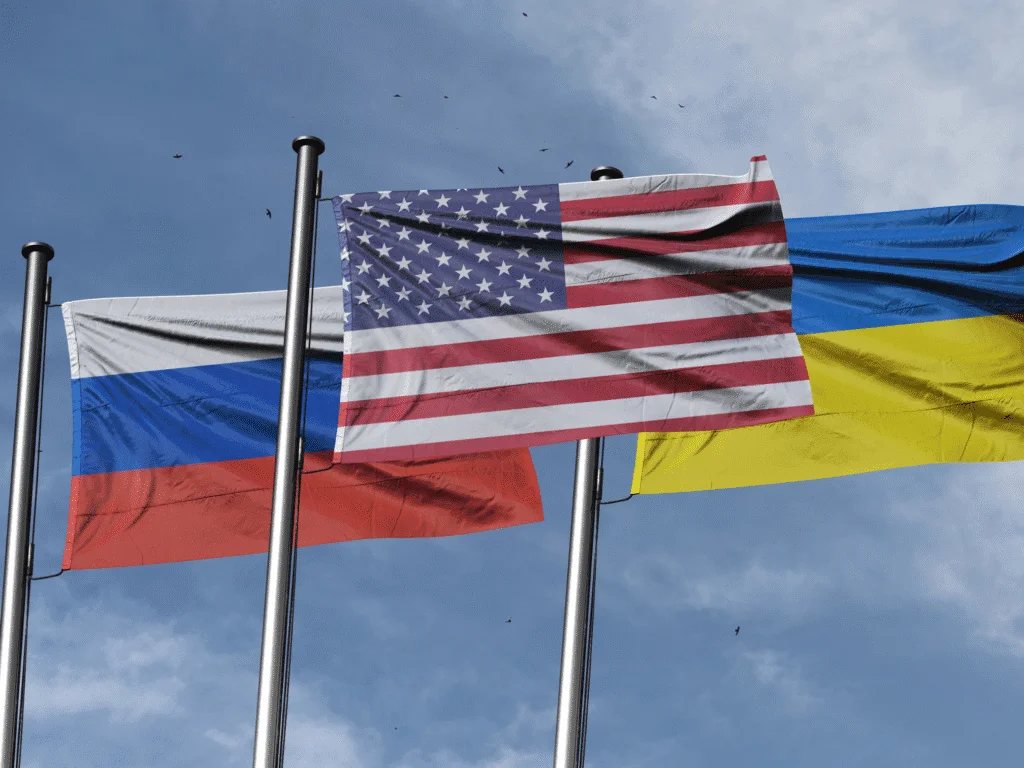
Ukraine Regional Update | March 2025 marked a turning point for Europe. Or so it seemed. The Trump administration threw a spanner in the works of the European security architecture. Since 1945, the European security architecture has been based on the (nuclear) backing of the United States.
But under this administration, that no longer seems a given. Trump is sowing doubt about the fulfilment of Article 5 of the NATO Treaty, thereby undermining transatlantic cooperation. Initially, a sense of urgency emerged in Europe. Real work needed to be done on European strategic autonomy. But two months later, that sense of urgency seems to have vanished like snow in the sun. Strategic autonomy – and thus charting a course independent of the United States – is, however, the only way for the European Union to hold its own. Certainly in the geopolitical order of 2025, where the law of the jungle is increasingly the guiding principle.
Zelensky
What exactly is going on?
This US administration leaves no room for doubt: it is anti-European. Take, for example, the leaked Signal messages from Vice-President Vance. This US administration wants to ‘resolve’ the war in Ukraine as quickly as possible. Trump seems to want to be rid of it as soon as possible. And now that this does not seem to be working, he is frustrated. Trump made ‘peace in Ukraine’ a key geopolitical priority in his first 100 days as president. Trump claimed he would get Putin and Zelensky to the negotiating table. But Zelensky seems to be proving right: Russia does not want peace, but a ceasefire. Russia, in fact, wants to wipe Ukraine off the map as a state. It seems the US president has now come to that conclusion as well.
Amateurism
Moreover, there was never really any question of negotiation. There was never any chance of a ceasefire. The US delegation mainly made concessions on behalf of Ukraine, and you cannot possibly call that serious negotiations. Russia, for its part, made hardly any concessions. What these negotiations did make clear is that the Trump administration appeared willing to make enormous sacrifices. However, these sacrifices were made on Ukraine’s behalf. As far as is known, Zelensky never gave his consent to this.
That speaks volumes!
Entirely in line with expectations, no deal was reached. The Trump administration appears to have gambled that Ukraine would back down and make major concessions to Russia. The most painful aspect of all was, of course, that the United States was putting pressure on Ukraine – not Russia – to make concessions. Fortunately, Zelensky stood his ground. Trump now also seems convinced that Putin is not prepared to make concessions.
Urgency fades
In March 2025, the message was clear: Europeans can no longer count on Washington in times of geopolitical crisis. In Brussels, that message seemed crystal clear and there really seemed to be a buzz about it. There was even talk of a European nuclear weapon, of Europe’s own weapons systems, and of suspending American defence orders. But a few months later, little has changed. The momentum seems to have faded again. Yes, there is talk and steps are being taken, but it is all happening too slowly.
Brussels wants to play a geopolitical role, and so the pace of defence investment and the actual acquisition of the necessary equipment will have to pick up. Trump’s stance remains unchanged, after all. Yet the sense of urgency seems to have vanished completely, and that makes the situation precarious. It is expected that most orders will only reach the European armed forces between 2028 and 2030.
Trump’s exit?
The prospect of the United States leaving NATO continues to hang over the market. Unless the pace of much-needed defence investment picks up, European strategic autonomy will not be strengthened within Trump’s term of office. Trump is due to attend the NATO summit in The Hague shortly. The United States will not be leaving NATO for the time being. But whether that is good news remains to be seen.
Trump can constantly threaten to leave NATO as a means of blackmail. That makes Europe vulnerable. That is why Brussels will have to strengthen its strategic position. That starts with an army that can respond to Russian aggression and provide adequate support to Ukraine. That is not the case at present. The mindset in Western Europe is still: it won’t come to that. Yet it is precisely now that urgency is needed. But that urgency seems to have vanished from the media and public debate.
A divided Europe
Tagging along behind Washington is no longer an option. This is because the interests of Brussels and Washington are far from aligned. The Trump administration is increasingly adopting the Russian narrative and is actively helping the far right come to power in Europe. The interests of Washington and Brussels are not only at odds, they are actually undermining one another. The United States does not want a united Europe; Brussels does. This is not necessarily a Trump thing. Most US administrations have not wanted a united Europe. Only the Trump administration is going the extra mile. This administration will not let the opportunity pass to destroy the Union from within.
The United States has not wanted a strong Europe since 1945. It wanted to prevent the emergence of a European leadership that could become an independent international player. That is why Washington wanted European armed forces to be and remain dependent on American technologies. But it is precisely that dependence that makes Europe vulnerable and Washington influential.
A strong Europe
We in Europe still have a positive view of the United States. But that no longer seems to be the case. They no longer behave like our ally or friend; rather, like a rival.
The United States is that nice uncle who has fallen on hard times. Over time, he has become increasingly drunk and displays aggressive behaviour. You want that uncle back. But that uncle is not coming back. That is why we, as Europeans, will have to say goodbye to the United States.
Laurens Dassen put it perfectly: the United States is changing at breakneck speed. Just as quickly as Germany turned into a dictatorship in the 1930s. We cannot accurately predict the scale to which the United States will develop. What we do know is that it is in our strategic interest to become independent of Washington.
And the bitter irony is that you cannot achieve that in a few months.
Investments made now will only bear fruit in a few years’ time. That is why there must be urgency now. For investments and strategic choices whose results will only be seen in a few years’ time. Especially when it comes to command structures and the development of our own weapons systems, it takes years to achieve this.
In the short term, Europeans must do everything in their power to enable Ukraine to continue the fight. One would expect that, given the Trump administration’s behaviour and its anti-European stance, the urgency for strategic thinking would be high on the agenda. Unfortunately, that is not the case.
Hidde Bouwmeester is a freelance historian specialising in international relations. He writes analyses and long-form articles on his website, which are made possible through donation models.
This article was translated, view the original here.