

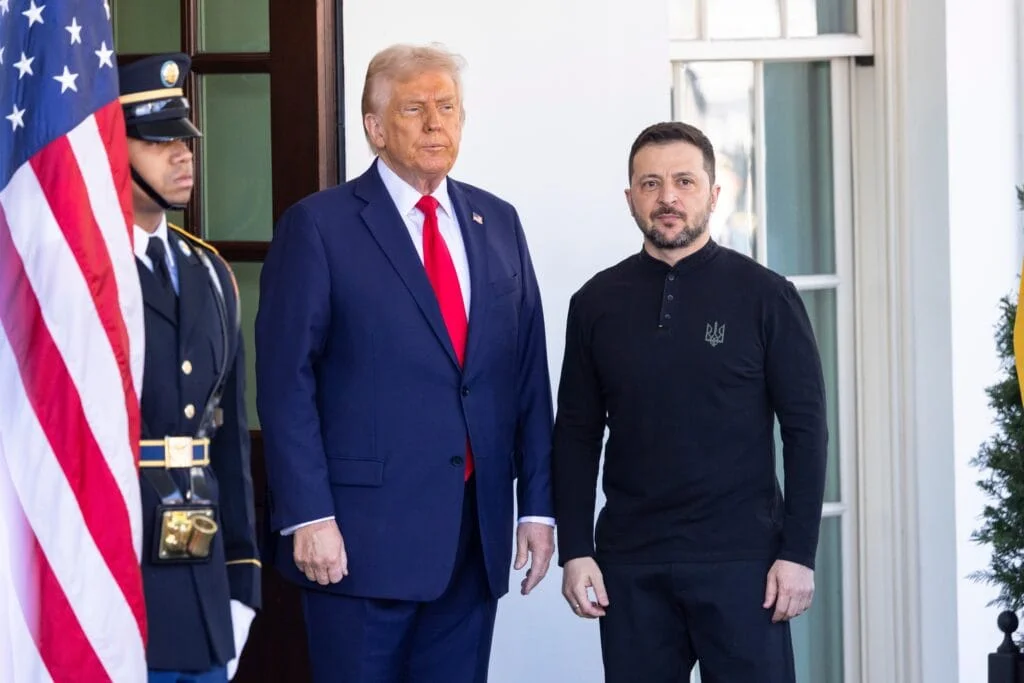
Ukraine regional update | Donald Trump wants to bring the war in Ukraine to an end as soon as possible. During his election campaign, he made bold claims, asserting that he would bring about peace within 24 hours. Based on the events of recent weeks, we can only conclude that the Trump administration is primarily putting pressure on Zelensky and hardly any on Putin.
It appeared that Trump and Zelensky intended to sign a mineral deal worth 350 billion on Friday 28 February 2025. A deal which, in Trump’s eyes, is primarily a raw materials deal through which Ukraine can repay the United States for its support. That is striking, given that under the Biden administration it was clearly a grant, and Starmer also confirmed to Trump that support for Ukraine consisted mainly of grants.
What happens next?
Yet it was not expected that the mineral deal would fall through. After all, it all seemed to be a done deal. According to the Republicans, this deal would be sufficient, on the one hand, to help Ukraine get back on its feet economically through investment. On the other hand, the deal was supposed to offer indirect security guarantees to Ukraine to prevent a Russian invasion.
Sounds fine, you might say? Not according to Zelensky. After all, Zelensky had already signed a ceasefire with Russia in 2019. On 24 February 2022, Russia violated this with its invasion of Ukraine. In the Oval Office, Zelensky therefore warned Trump and Vance that Russia’s word is worth little. After all, Putin has broken his word on previous occasions. Ukraine fears that Russia will violate such a treaty whenever it suits Moscow. Only, by then Russia will be better prepared and the Kremlin will have learnt from its mistakes. In other words: this could have fatal consequences and threaten Ukraine’s very existence.
Russian negotiating culture
Then there is another matter. Our Western European way of negotiating is almost the polar opposite of the Russian diplomatic tradition. In Western Europe, a political culture of consensus has developed over time. Although the interests and positions of different parties may diverge widely, ‘common ground’ is usually sought. We see this happening frequently in the Netherlands when drafting a coalition agreement, but also in the European Union, where the interests of different countries must be brought together into a clear compromise. Russia does not have such a ‘polder’ culture.
In Putin’s world, making concessions is a sign of weakness. That is also why backing down in the face of Russia has more often than not led to further escalation. In Russian politics, the law of the jungle prevails. Thus, making compromises is immediately interpreted as weakness. Especially if you are the first to propose compromises. That is why Trump making concessions in advance is also unwise.
Negotiating with Russia
Washington’s approach is therefore completely at odds with how one should negotiate with Russia. If you look at the diplomatic history between Russia and the United States, it is a particularly rich one. Here, we count Russia and the Soviet Union as part of the same diplomatic history. Moscow and Washington have negotiated on many issues. Things often got heated; think, for example, of the SALT agreements of the 1970s on nuclear arms control. However, it has never happened before that, before official negotiations had taken place, the United States had already made public commitments to Russia.
Michael McFaul, former US Ambassador to Moscow under Obama, is therefore highly critical of the way the Trump administration has handled this raw materials deal. He supports Zelensky’s assertion that people like Lavrov will always try to deceive you and that one should not assume sincerity. Moreover, making premature concessions is seen as a sign of weakness in Moscow. Former US President Ronald Reagan also said, regarding negotiations with Moscow: ‘trust but verify’.
Support for Ukraine
Germany’s prospective Chancellor, Friedrich Merz, said as much upon his election victory: ‘I have given up on the United States as an ally.’ He added: ‘The row between Zelensky and Trump on 28 February 2025 appears to have been staged.’ Merz was thus the first European leader (or leader-in-waiting) to not only express support for Ukraine, but also to speak out against Trump. I share Merz’s message: I too have given up on the United States as an ally, given that it no longer appears to stand behind Ukraine.
Trump decided last Monday evening (3 March 2025) to cut off all support for Ukraine. In effect, Trump is saying that Ukraine must sign the mineral deal, despite the fact that there will be no security guarantees from the United States. Otherwise, Kyiv will be left without American support. In doing so, the United States is pressuring Ukraine to sign this raw materials deal after all.
Europe and the US
The Trump administration claims that America has provided a huge amount of support to Ukraine. Of course, US support was hugely important. But if we look now at the number of weapons Ukraine is using, Trump and Vance are exaggerating the US share: since the war began, the European Union has supplied both more weapons and more financial support. Half of Ukraine’s weapons are even manufactured in Ukraine; 20 to 25 per cent are supplied by the United States and the rest by European and East Asian countries.
Should US arms support dry up, you will certainly see the consequences on the battlefield. There may well be renewed attacks on Kharkiv and around Dnipro, but a total collapse of the Ukrainian front seems unlikely.
Options for Ukraine
Trump claimed that Zelensky had little choice but to sign this raw materials deal. But what are Zelensky’s options, really? The first option is to apologise. Zelensky will have to get down on his knees and apologise to Trump in order to sign the mineral deal. But in Ukraine, people are convinced that a ceasefire without credible security guarantees will not last long. Moreover, it is highly doubtful whether the Ukrainian people, with an eye on post-war elections, will thank him for this.
The second option available to Ukraine is to ask its other allies to continue supplying weapons and to persist with their support and the fight. This would amount to betting that Russia cannot sustain this war economically for much longer, meaning that by 2026 Ukraine would be in a better position than it is now.
Another option is for Zelensky to urge his European allies to organise an alternative peace conference at which better security guarantees are promised to Ukraine. The starting point here would be a ceasefire, with security guarantees for Ukraine. In addition, Ukrainians in occupied territory must be able to return home, as must the abducted children.
A historic choice for Ukraine
These are, in fact, the three options available to Zelensky. It is an extremely difficult choice. With the United States withholding military aid, it seems more likely that the chances of success for option 1 have diminished significantly, and the question is whether a mineral deal can still be struck. My impression is that the withdrawal of military aid to Ukraine will more likely lead to Ukraine opting for an alternative peace conference or continuing the fight. After all, Ukrainians do not want to live in an occupied Ukraine and, above all, want a lasting peace. There is broad consensus on this in Ukraine. But it will be Zelensky who must make this choice and defend it in the presidential elections. It is an enormous dilemma and one of the most crucial choices facing the Ukrainian state.
This article was translated, find the original here.