

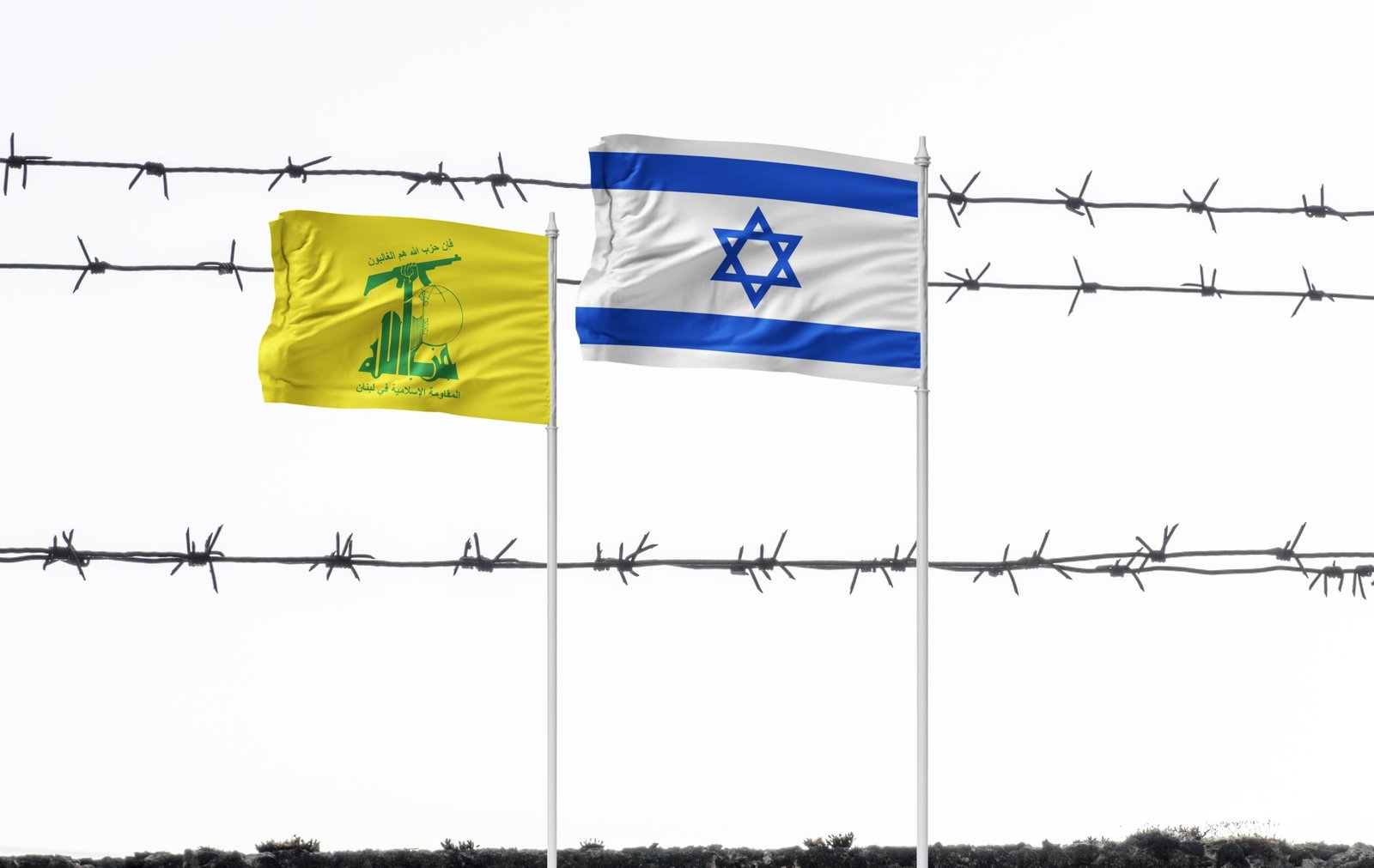
- Israel established a ‘buffer zone’ ten kilometres into Lebanese sovereign territory, fighting Hezbollah in parallel with its joint venture with the US in Iran.
- Peace talks are stagnating as Netanyahu ‘extends’ Israel’s stay in southern Lebanon, creating a stalemate as Hezbollah refuses to disarm, consistent with its longstanding resistance to Israeli presence.
- Israel’s escalation – also in areas not traditionally dominated by Hezbollah – raises questions about the temporality of the so-called buffer zone, suggesting objectives beyond the security realm.
If the chicken-or-the-egg dilemma were to have a play out, it would be the struggle between Israel and Hezbollah. Following a longstanding rivalry, the start of the Iran war marked the latest round of tit-for-tat strikes, as Israel desperately held on to its last bargaining chip on the negotiation table: Lebanon. Matters became particularly heated when Israel expanded its so-called ‘security zone’ stretching it ten kilometres into Lebanese sovereign territory. Yet, for Iran, a ceasefire in Lebanon is non-negotiable, seeking to protect its proxy – often framed as Tehran’s beating heart – Hezbollah. While a framework agreement was reached between Israeli and Lebanese diplomats in Washington, Israel voiced that it would ‘extend’ its stay in southern Lebanon, leading to Hezbollah’s refusal to disarm and conform to the requirements of the deal.
Besides fighting on multiple fronts, Israel’s widespread operations in the south and Beirut have not been limited to traditionally Hezbollah-dominated areas. In fact, Israel seems to think it has established a buffer zone in no man’s land rather than on Lebanese territory. Therefore, its refusal to leave goes beyond a desire to prolong a definitive deal with Tehran, begging the question: What drives Israel’s escalation? Are security reasons sufficient to explain what is happening on the ground, or are there other logics at play?
Lebanon as a strategic foothold for regional powers and conflict
Once known as the ‘Paris of the Middle East’, Lebanon has shed this alias, reflecting its lack of political leverage. The country is now described as a ‘ theater for regional conflict’, as since the 1970s “regional powers have used its territory for strategic gain” Arabist and anthropologist Leo Kwarten argues.
Lebanon’s geostrategic value is best explained in twofold. First, its geographic positioning bordering the Mediterranean Sea, Syria, and Israel, both of whom have had “a substantial influence on its domestic politics,” Kwarten recalls. Tensions with Syria run particularly high along the border ever since Lebanon’s independence from France split the countries decisively.
Second, its political organization is even more telling, as Kwarten refers to Lebanon’s confessional democracy. Domestically, Lebanon recognizes eighteen official sects, each of which is represented in parliament. While confessionalism has proven to be a way to unify religiously diverse countries, the model has a considerable downside: its structure invites external stakeholders to hold significant sway over certain groups that align with their ideological agendas. This is exemplified by the Kingdom of Saudi Arabia (KSA) and Iran, who are actively meddling in Lebanon’s domestic affairs. On the one hand, the KSA supports the Sunni community and seeks a political foothold through its ties with the Hariri family. On the other hand, Iran holds power through Hezbollah, who simultaneously functions as a legitimate political party in the Lebanese parliament.
Therefore, “the problem is Lebanon’s sectarianism. As long as division prevails, Lebanon will remain a weak state,” Kwarten argues. Lebanon’s inability to manage its challenges is evident in its ongoing struggles with external meddling and keeping Hezbollah in check. Hezbollah’s natural breeding ground, and therefore its support base, lies in the south, which comes as no surprise given it shares a border with Israel. Yet, “this implies the territory can consistently be deployed as a means to pressure Israel” Kwarten notes, explaining the continuous unrest and security layer to Israel’s threat perception.
Israel’s security calculus: Hezbollah as a threat or the sum of an excuse?
Israel’s security calculus is justifiable as the vulnerability at the northern front is a daily reality for its citizens. Kwarten explains that “Hezbollah stands head and shoulders above any other movement when it comes to alignment with Iran” provoking conflict with Israel either as a show of loyalty to Tehran or to pursue its broader ideological agenda which reads its rejection of the ‘Zionist Entity’ [Israel] as a legitimate state, and its aim for the complete destruction of Israel. A renowned correspondent in the region adds that while Hezbollah’s capacities have been weakened, “it is still able to carry out strikes on Israel on a daily basis.” Moreover, Hezbollah’s extreme hierarchy ensures that “for every loss of leadership, another member is ready to take its place.”
Even though guaranteeing Israel’s security is a substantial part of the conflict, a Dutch diplomat to Lebanon argues that while Hezbollah was the first to carry out strikes on March 2, 2026 – coinciding with the assaults on Tehran – “its strikes can hardly be designated as an invitation to war.” Naturally, Israel reserves the right to respond, but he did not recognize the danger of Hezbollah’s initial strike as ample for such a retaliation.
Moreover, the longstanding rivalry between Israel and Hezbollah needs to be evaluated through an additional lens. By regarding Israel’s security as principal in this dynamic it ignores Hezbollah’s fundamental ignition, responding to Israeli meddling and occupation in the first place. Therefore, the Dutch diplomat argues “by retracting instead of expanding into Lebanese territory, Israel has an opportunity to deprive Hezbollah from its resistance narrative and perceived necessity of its military arsenal altogether.”
Yet, Israel did exactly the opposite by expanding its so-called ‘buffer-zone’ demarcated by the ‘yellow line’ stretching ten kilometers into Lebanese territory, causing 55 villages and towns to be vacated.
Explorations beyond the security realm
A buffer zone for Israel’s northern citizens proves useful when responding to a far-right cabinet that promises “For every tear of an Israeli mother, a thousand Lebanese mothers must weep.” Both Kwarten and the Dutch diplomat recall Netanyahu’s interest in continuing the war due to the upcoming elections and prosecution once he is voted out of office.
While Hezbollah’s capabilities are deteriorating, Israeli military presence shows an influx as more troops are entering the south. Meanwhile the conflict has resulted in over 1 million displaced (> 20% of the country’s population) and over 4000 deaths. According to the Dutch diplomat Israel used March 2, 2026 as a pretext for the buffer zone. Mounting this with the disproportionate escalation both in the south and Beirut, the Dutch diplomat states, “Israel creates the enemies of tomorrow.”
While Kwarten doubts Israel’s intent to hold a grip on Lebanese territory in the long run, he notes that Israel’s seeming expansionist practices go beyond Lebanon alone. Apart from the Palestinian matter, Israeli presence in Syria has not gone unnoticed. “What stands out is the water-rich territory Israel is encroaching upon.” While there is no clear evidence that this is a main objective, fact is, water is a scarce commodity in the region, and the West Bank, the Golan Heights, and southern Lebanon are relatively water-rich areas, Kwarten argues.
Still, Hezbollah’s provocation carved out space for diplomacy, rather than military force according to the Dutch diplomat. The logic behind this lies in the Lebanese perception of Hezbollah. “By striking Israel, Hezbollah lost support from both its Lebanese counterparts in parliament as well as a substantial part of the Shia community as it immediately intruded on Lebanese interests.” Therefore, he states “Israel could have leveraged the disdain living among Hezbollah’s support base.” He continues “through proportionate retaliation, and subsequently exploiting Hezbollah’s isolation from its support system, Israel could have created a pressure point for the acceleration of disarmament.”
Simultaneously all three experts recognize that since October 7th, 2023 Israel’s security thinking has changed fundamentally leaving no space for threats in any volume, and seeing no salvation in diplomacy. “Coming to the table becomes that much harder as losses are mounting” the correspondent tells, adding that frustrations are a reality on either side. Hezbollah has grown increasingly angry as Lebanese counterparts in parliament regard the Israeli matter differently, and even its own support system seems to cast a vote mostly based on social security guarantees than on military endeavours.
Conclusion
Of course, this latest escalation could be another iteration in the ongoing conflict between the two actors as the correspondent regards Israeli expansion into Lebanon as “likely in the short term, yet highly unlikely in the long term,” adding that it fits the script of the perpetual struggle Israel and Hezbollah have engaged in. Yet, while Israel is not actively annexing the area “buffer zones are rarely temporary, and ideological actors cannot be eradicated by military force,” the Dutch diplomat states with the correspondent concluding that “there is no fundamental solution, only more complication.”