

Introduction
While Ukraine fights for its freedom and sovereignty, the EU and NATO member states on the eastern flank are working toward greater deterrence against a potential attack by Russia. The Baltic states are seen as the most vulnerable NATO allies due to a lack of geostrategic depth, lacking a strong land connection with surrounding allies in Scandinavia and Central Europe.
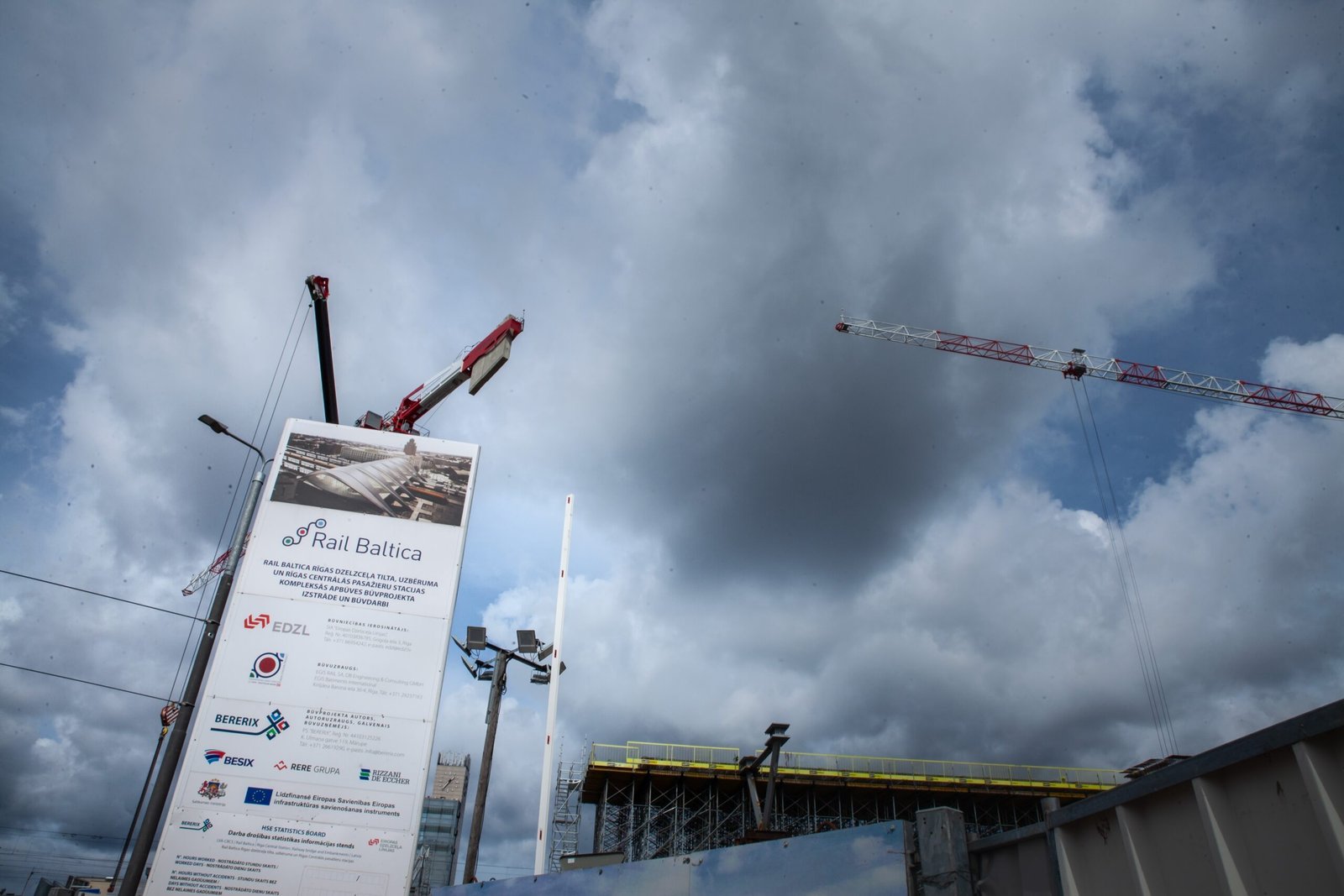
Infrastructure is essential, especially in times of conflict. Since 2017, the Rail Baltica railway line has been under construction, with its budget having nearly quadrupled compared to initial expectations. This railway line, intended to connect Tallinn, Riga, and Vilnius on the European standard gauge, offers a stronger economic and strategic-military land link with allies, given that most transport currently takes place via the Baltic Sea. Why is this railway connection relevant to the geopolitical striking power of the EU and NATO, and to the security of Estonia, Latvia, and Lithuania?
Relevance of a Stronger Connection
Besides various planned infrastructure works, such as renewing bridges and roads Rail Baltica is the largest project ever undertaken in the Baltic states. Russia expert and geopolitical analyst Isa Yusibov states that “since the Russian invasion of Ukraine, Baltic rail and port traffic in Latvia and Lithuania has been losing significant revenue.” He adds that “historically speaking, the region has a logistics sector that earned income from the transit of Russian and Belarusian bulk cargo and petrochemical products.” The new connection must generate new cash flows and strengthen economic integration with the rest of the EU. Research shows that connecting to the European rail network could increase the regional GDP of the Baltic countries by 0.5 to 0.7 percent annually. This stems from expected higher land prices, increased tourism, new business activity, improved productivity, and further urban development.
However, the primary argument for Rail Baltica is how it upgrades military infrastructure. Connecting Rail Baltica to the European standard gauge eliminates the transshipment requirement for military equipment, which was previously necessary due to the differing Soviet broad gauge. “As a result, heavy armored equipment can be moved continuously by rail from Germany and Poland without delay,” Yusibov adds.
Militarily, the Baltic states can strengthen their strategic position with new land connections. Yet, this remains limited due to the vulnerable location of the Baltic states and the Suwalki Corridor, a narrow strip of land between the Russian exclave of Kaliningrad and Belarus that connects Poland to Lithuania. In the event of a conflict, there is a high probability that Russia would aim to cut off this corridor.
Defense expert Nele Loorents from the Estonian International Centre for Defence and Security states that Rail Baltica’s infrastructure primarily functions as a vital supply route for defense equipment in the buildup to a conflict. During wartime, however, the line becomes less relevant, as railways are extremely vulnerable to sabotage and most military support would arrive by sea. She adds: “In a crisis scenario where NATO’s collective defense is invoked, the infrastructure on and around maritime routes is essential for defense.” “It is our Scandinavian allies who, as EU and NATO partners, could come to our aid fastest by sea.”
There has also been long-standing discussion regarding a potential Helsinki-Tallinn tunnel to connect Scandinavia with the Baltic states, but this is a costly project for which suitable investors have not yet been found. Nevertheless, the sea route via the Baltic Sea remains the best option for a potential evacuation of civilians. However, maritime connections also present challenges, given the small size of the Baltic Sea and the presence of heavy Russian weaponry in Kaliningrad. From a strategic-military standpoint, Rail Baltica primarily serves as an additional land connection in preparation for a potential conflict.
It remains important to emphasize that the Baltic states are difficult to defend from a NATO perspective. Historian and journalist Hidde Bouwmeester notes: “First, the question is whether we as NATO would defend the Baltic countries on the ground in an emergency, or whether horizontal escalation would be chosen instead.” “A response to a Russian test could, for example, be launched from Poland, Finland, or Romania, because the infrastructure there is broader and heavy equipment is difficult to transport through the narrow strip of land or across the Baltic Sea.” Furthermore, according to Bouwmeester, it is unclear whether infrastructure such as the narrow bridges in the Baltic states, is strong enough to carry heavy military equipment.
That Rail Baltica helps improve military mobility is beyond question, but the prompt remains: to what extent does it actually alter the region’s strategic depth? According to HIG Europe expert Michel Don Michaloliakos, strategic depth is “the physical distance between a country’s border and its vital core areas.” “This distance determines how much room a country has to retreat, execute maneuvers, and construct defensive fortifications.” Due to their geographic location and size, the Baltic states have very limited options in this regard. According to Yusibov, the current rail network consists mainly of Russian broad gauge, forcing heavy equipment to be transshipped or rerouted to the road network. Under time pressure, this forms a massive bottleneck that Rail Baltica can resolve. Moreover, integrating into the European standard gauge represents further integration with the European Union, making the EU stronger as a whole.
Europe’s Ambitions vs. Reality
The case of Rail Baltica is a textbook example of the so-called ‘expectations gap’ within the European Union: a contradiction between grand geopolitical and economic ambitions on one side, and harsh political and financial realities on the other. Rail Baltica suffers from severe cost overruns, driven by inflation and delayed procedures. The estimate for Phase I (planned completion in 2030) stands around €15.3 billion, while the entire double-track project is expected to cost over €23 billion. The current EU budget and the national budgets of the Baltic states cannot absorb these additional costs.
The Baltic countries are therefore lobbying during negotiations for the upcoming EU multi-year budget for an increase in funding within the Connecting Europe Facility, which allocates money for infrastructure. As it stands, the budget allocated by the European Commission will not cover the entire project. The European Court of Auditors indicates that the Baltic countries will have to substantially increase their own contributions if EU funds prove insufficient.
Don Michaloliakos emphasizes that EU funding is crucial for the realization of Rail Baltica. He continues: “The question is how important we truly consider Rail Baltica to be in geostrategic terms.” The delays and difficult financing painfully expose the answer so far. “Given the Russian threat to the Baltic states and the inadequate infrastructure, this is concerning.”
This necessitates tough choices in national budgets and securing favorable loans from institutions such as the European Investment Bank and the Nordic Investment Bank. Mario Draghi introduced the concept of a Regulatory Asset Base (RAB) in his report. This would guarantee a legally regulated return on invested capital for private parties, such as pension funds. Without such a guaranteed return, institutional investors are reluctant to bear the risk of such a megaproject. However, when financial investments are institutionally facilitated, the billions of capital present in Europe could become available for long-term investment and be deployed strategically. A combination of public and private funding should make mega-investments like Rail Baltica possible to safeguard Europe’s competitiveness and security.
Conclusion
For the EU, NATO, and the Baltic states, Rail Baltica is much more than just a logistical railway project. It plays a crucial role in decoupling the region from the historic Russian sphere of influence, reinforcing both economic integration with the EU and military mobility in preparation for potential threats. Although the land connection remains vulnerable in wartime and the project faces massive cost overruns and a financial ‘expectations gap,’ the ultimate value of the project transcends mere transport capacity. Above all, it is a test of Europe’s resolve: showing whether the Union is capable of deploying substantial financial resources to realize its strategic autonomy and credibility.