

Introduction
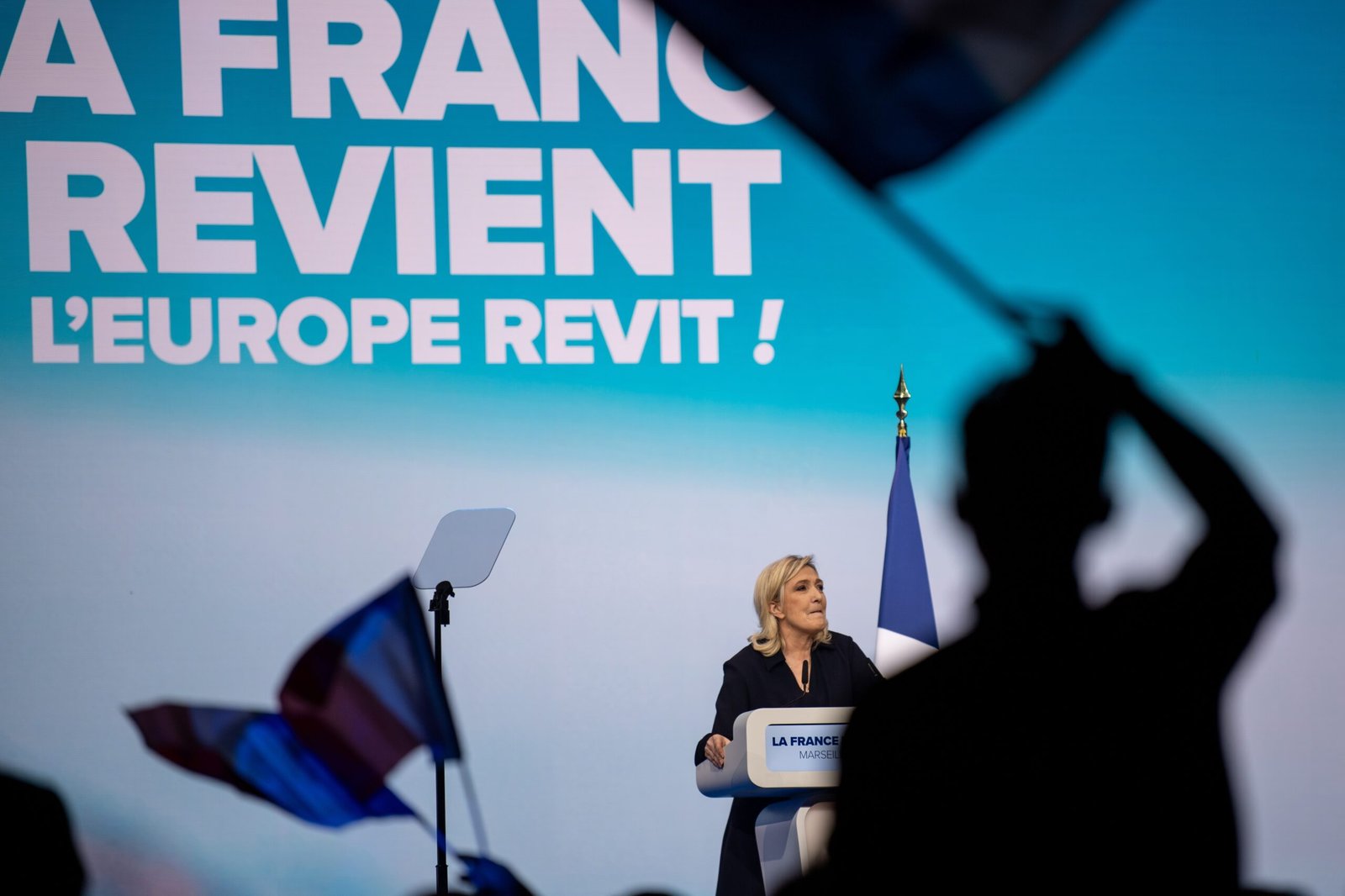
The European Union has weathered many crises over the decades, but a political shockwave in Paris would shake the Union to its foundations. With the continued rise of Rassemblement National (RN), the real possibility of a radical-right French government led by Marine Le Pen is growing. Where France within the Franco-German axis traditionally served as the driving engine behind European integration, the country now threatens to steer a more eurosceptic course.
From an impending clash with European fiscal rules to a shift in course regarding the war in Ukraine and the functioning of the Brussels administrative apparatus: an RN government brings a very different vision for Europe’s future. Yet, a right-wing populist Paris will not have free rein. The relentless discipline of financial markets, the fragile fiscal situation of the French state, and the enduring importance of the EU for France form a reality that even RN will find difficult to escape. The question this raises is: What are the implications of a Rassemblement National Presidency for Europe?
The Fiscal Reality
France faces a worrisome fiscal situation, with public debt trending toward 118% of GDP and a budget deficit well above the European maximum of 3%. The European Commission has already placed Paris under formal supervision via the Excessive Deficit Procedure (EDP) since 2024. Although the election manifesto will become clearer in the coming months, it is certain that a potential right-wing populist RN government led by Marine Le Pen enters a minefield if it seeks to deliver on generous campaign promises, such as lowering the retirement age and implementing large-scale tax cuts. A Le Pen presidency in particular will be defined by such a socio-economic agenda, as this forms the core of her appeal to voters.
If an RN cabinet breaks with European fiscal rules, financial markets will immediately demand a higher risk premium on French government bonds, potentially driving up borrowing costs sharply. For this reason, Michel Don Michaloliakos, Europe expert at HIG, argues that French politics simply lacks the financial room for maneuver to further expand social security. Don Michaloliakos continues that RN will inevitably have to scrap many of its campaign promises, if only to avoid losing the confidence of financial markets.
The Gaullist DNA and Ukraine
French foreign policy has been strongly shaped by Gaullism since the 1960s, Rassemblement National, like several other French parties, profiles itself as Gaullist.
With the withdrawal from the integrated NATO command structure in 1966 and the development of an independent nuclear deterrent, De Gaulle sought to safeguard French autonomy and prevent Anglo-Saxon dominance on European soil. Although France has been fully reintegrated into the NATO command structure since 2009, the French diplomatic tradition remains marked by a steadfast belief in sovereignty and European cooperation. Correspondent and Europe expert Stefan de Vries explains that French diplomacy has historically viewed the EU as a vehicle to project its own global influence. This was typically accompanied by a pro-European stance. Under Macron, a strong call for European strategic autonomy echoed from Paris, reflecting Gaullism through a powerful European Union. Under a government led by Marine Le Pen, however, a shift in emphasis would occur. According to De Vries, she places greater emphasis on strict national French sovereignty and a Europe of nation-states.
Under Macron, France positioned itself as a driver of further integration and the joint ‘Buy European’ doctrine. Yet Paris also faced criticism from other member states under his tenure. Critics pointed out that French support for Ukraine, particularly at the beginning of the war, consisted primarily of words. This supports the argument made by professor and Europe expert Marc De Vos of the Brussels think tank Itinera and Ghent University, who stresses that nuance must be maintained. Even under Macron, French policy regarding Europe and Ukraine was not always strictly pro-EU, but rather pro-France through the EU.
Nevertheless, an RN president would likely be even more hesitant in supporting Ukraine. RN promises in its platform to withdraw from the NATO command structure once again and pushes for de-escalation. Don Michaloliakos expects RN to dig its heels in regarding aid to Kyiv. He notes that statements by prominent RN figures like Bardella and Le Pen place the emphasis on a diplomatic solution, which is simply another way of saying they are abandoning the Ukrainians. De Vries similarly expects a Le Pen government to prefer normalizing relations with the Kremlin once the conflict subsides.
Macron is attempting to create fait accompli during his remaining term to insulate Europe’s trajectory. According to De Vos, if Macron succeeds in locking in the future path for Ukraine and integration, Le Pen may be dissatisfied with this but will not be able to easily reverse it. An example of this is the European Multiannual Financial Framework (MFF), which will be established before a new president takes office. This is the 7-year financial framework in which member states set long-term planning for agriculture, innovation, and other EU priorities. Furthermore, Macron can press within the European Council to accelerate the opening and securing of the 35 negotiation chapters for Ukraine’s integration into the EU.
The Radical-Right’s Position in Brussels
Where France was traditionally the motor for European integration within the Franco-German axis, an RN government will approach the EU primarily from an instrumentalist stance. Under Le Pen, the emphasis shifts from shared European integration toward protecting national self-interest within a fragmented market.
RN seeks to utilize the EU mainly for direct national economic gain. For instance, the party advocates for a French electricity price based exclusively on its own cheap nuclear energy and wants to shield French agriculture by ignoring European climate regulations. Undermining the Green Deal and European climate targets not only clashes legally with existing EU treaties, but also directly impacts European industrial competitiveness. This concerns precisely the kind of structural reform and scaling-up deemed necessary for the Union’s future by the Draghi report. Additionally, RN rejects the EU Migration Pact as an infringement on sovereignty. However, Marc De Vos expects many of these intentions to be primarily political theater for the public stage and symbolism around French supremacy, rather than a direct, legally viable change of course.
As a founding member and the second-largest economy of the Union, a French RN cabinet will not directly push for a break with Brussels. However, this direction introduces deep uncertainty regarding future sanction packages and financial or military support for Ukraine. Key reform agendas, such as the Letta and Draghi plans for a capital markets union and an innovation surge, risk stalling under this nationalist political posture.
At the same time, right-wing populist leaders will also recognize that French interests remain served through the Union, which could lead to a further Europeanization of the radical right. Instead of exiting the Union, the core foundations and culture of the EU could undergo significant change. Expert of European History and France Anne-Isabelle Richard notes that the frameworks are gradually shifting to the right, and the more such parties come to power across the EU, the more the EU’s fundamental character will transform.
Richard emphasizes how essential the EU remains for France: “All European countries, and certainly France, have supported European cooperation because it was in their direct self-interest. They have also sought to push the character of European cooperation in a direction that suited them.” The decisive question remains how far that willingness extends for the French RN. As De Vos concludes, the primary concern lies with subjects that are not yet decided, such as open questions surrounding required integration and the accession of Ukraine to the EU and NATO.
Conclusion
A power takeover by Rassemblement National will shake the EU to its core, but the situation will not prove quite as explosive in practice as feared. The discipline of bond markets and reliance on ECB mechanisms will compel an RN cabinet toward fiscal restraint. Populist promises quickly collide with raw financial reality.
There will be no total rupture with Europe. France simply no longer holds an isolated power position and relies just as heavily on the Union for its economy and security as the Union does on France.
The real danger therefore lies in the gradual erosion of European capacity and effectiveness over the long term. While Macron will attempt to safeguard key dossiers, such as the MFF and sustained support for Ukraine, RN can severely hamper decision-making and foreign policy. By minimizing support for Ukraine and complicating accession processes, a dangerous precedent threatens to emerge. Together with like-minded member states, a radical-right presidency could initiate a transition from within, gradually shifting the Union from an engine of integration into a fragmented bloc of nation-states. Precisely when major reforms are vital such as in defense, innovation, and the capital markets union—a hesitant Paris paves the way for a weakened geopolitical Europe.