

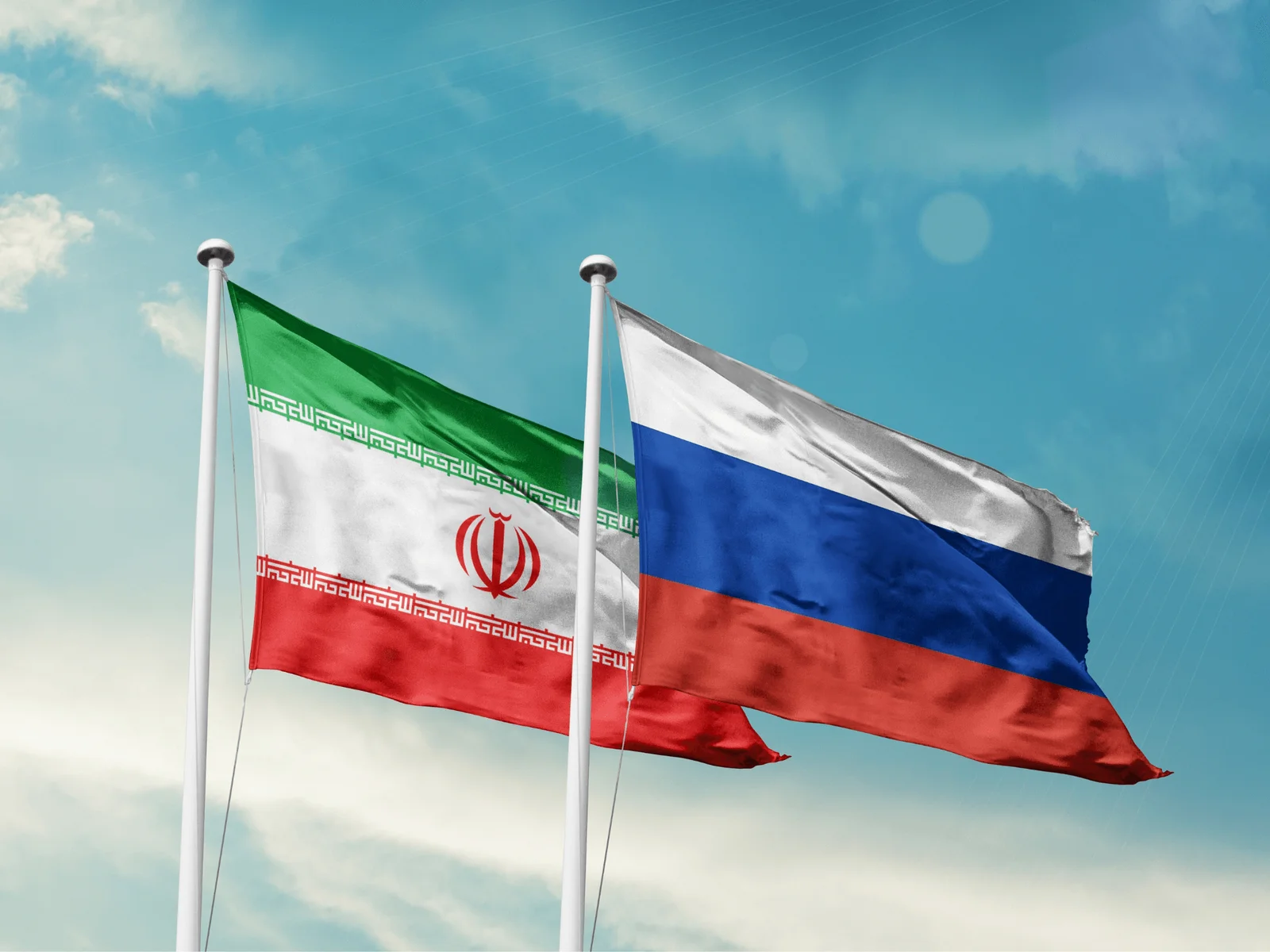
Regional update: Iran | Since 2022, Iranian military support for Russia has been aimed at undermining European geostrategic security. This has increased since NATO backed Israel’s attacks on Iran. The recent strike by a kamikaze drone featuring ‘Iranian technology’ on NATO territory highlights the security risks and deepens the geostrategic fault lines within the international world order.
For the first time, an Iranian-made kamikaze drone has violated the airspace of a NATO member state. This must be interpreted as a warning signal from Tehran and Moscow directed at both NATO and the national security of Poland and the European Union.
Last week, a kamikaze drone incorporating Iranian technology crashed in eastern Poland. NATO and Polish officials regarded it as a “potential provocation” and a new strategic threat to Eastern European security. The incident has reignited the debate on NATO security and the possible reintroduction of sanctions against Iran.
The attack on Osiny: more than just an incident
On the evening of 19 August 2025, a military drone crashed and exploded in the village of Osiny, in the Lublin Voivodeship. The explosion took place near the highly flammable nitrogen plant in Puławy. This was not an isolated incident, but a significant signal regarding European security.
In Russia’s war against Ukraine, previous incidents—such as airspace violations in Romania, Latvia, Moldova and Lithuania—usually involved missile or drone debris falling near active conflict zones or during large-scale bombardments. The incident in Osiny, however, involved an operational Iranian drone, fitted with a Chinese engine, bearing North Korean markings and presumably of Russian manufacture, which entered Polish airspace from Belarus.
Iranian drone technology as a game-changer
Western security sources and international media reported that the crashed aircraft bears a strong resemblance to Russian drones based on the design of the popular Iranian Shahed models. The effectiveness of these drones prompted the Pentagon to produce a 1:1 replica of the Shahed-136 for the US Air Force. These cost-effective unmanned aerial vehicles have enabled Russia to turn military losses in the war in Ukraine into tactical victories. This has come at the cost of tens of thousands of civilian casualties in Ukraine.
According to Ukrainian military intelligence, the Alabuga drone factory, located some 1,000 kilometres east of Moscow, now produces more than 5,500 units per month — a fourteen-fold increase compared with just a year ago.
The strategic impact of Iranian drones, following the successful attack on Aramco, Saudi Arabia’s state-owned oil company, in 2019, had previously been noted by Israel. In the war in Ukraine, drones have created a stalemate reminiscent of the static artillery front in the First World War. The use of drones, a revolution in warfare, is becoming even more decisive as AI guides these flying weapons with terminal control.
As a result, Russia can now deploy up to a thousand drones per night to overwhelm Ukrainian air defences and undermine public morale. These drones can also be used as decoys to divert or provoke NATO air defences, as may have been the case in Osiny, according to analyses by the Polish army.
Iran and Belarus threaten Europe
According to the Polish public prosecutor, initial investigations suggest that the drone likely flew from Belarus, although a Russian origin or even internal sabotage have not yet been ruled out.
The strategic crux of this incident is that the lethal drone did not enter the territory of NATO member state Poland from Russia or Ukraine, but from Belarus. That is strange, but not coincidental.
Belarus and Iran — two countries that support Russia’s war in Ukraine — intend to further deepen their bilateral relations across all areas, including military cooperation. Their presidents stated this last week during talks in Minsk. “In these turbulent geopolitical times, Minsk and Tehran are taking consistent and balanced steps to expand their cooperation. They are working hard to turn every new challenge into an opportunity,” said President Lukashenko.
Both countries, which are subject to severe Western sanctions and international isolation, discussed in Minsk the possible formation of a joint defence pact on Europe’s eastern flank. Tehran has expressed interest in Belarus’s assistance in restoring its air defence systems and electronic warfare capabilities, which were damaged during recent escalations with Israel.
The incident in Osiny suggests that Minsk is attempting to master Iranian drone and missile technology. This strengthens Russia’s power and undermines the geostrategic security of European NATO member states. The painful question is whether the Trump administration, which is critical of Europe, might not actually welcome this pressure on Europe.
The presence of Iranian drones — and possibly missiles too — on Europe’s eastern border, within the context of Russia’s proxy war, poses a clear security threat to NATO and will inevitably provoke a response from the alliance. The incident in Osiny has rightly caused concern within NATO, to which European allies have since responded.
In this context, the Netherlands has announced that, from December until June next year, it will station two Patriot air defence systems and approximately 300 military personnel on Polish territory. This measure underlines that the incident in Osiny is not a local occurrence, but is viewed as a threat to the collective security of the alliance.
Iranian escalation against Europe pays off
Iran regards Europe as weak and geostrategically irrelevant. It views the EU as largely subordinate to the United States when it comes to exerting strategic influence. The rationale is that a calculated Iranian escalation against Europe entails few strategic drawbacks, whilst strengthening cooperation with Russia and China.
As far as Iran is concerned, the European NATO member states have not only expressed political support for the recent Israeli air strikes on Iranian territory, but have also provided support to Israel via logistical channels—often in collaboration with certain Arab states. This reinforces the perception in Tehran that Iran was not only attacked by Israel and the United States, but that this 12-day war was waged against Iran by NATO. The strategic conclusion to be drawn from this is that the survival of the Iranian regime depends on Tehran’s ability to forge strategic coalitions with major players such as Moscow and Beijing, as well as with smaller revisionist players such as Belarus and North Korea. If there is a need for de-escalation, even with Europe, it is more effective to talk to Moscow and Beijing than to Brussels.
A recent example is the European response to Iran’s nuclear programme. This week, Europeans are discussing the reintroduction of UN sanctions (snapback) and the possible referral of Iran under Chapter VII, whereby the UN Security Council can designate Iran as a threat to international peace and security and take action using non-military or even military means (!) to restore stability. Iran warned Europe of “consequences” should it invoke the snapback.
In this geopolitical arena, the alliance between Ayatollah Khamenei and President Putin is deepening the structural fractures in the international order. Iranian drone technology, deployed as a geostrategic weapon by Russia against European security, is just one example. For the time being, Europe is standing by and watching, whilst in the Oval Office, Putin’s most powerful Western admirer, President Trump – like a king – sits at the table opposite his European subjects, who are neatly lined up.
The reimposition of UN sanctions and Europe’s stance on further escalations between Iran and Israel will determine how Europe can safeguard its own sovereignty.