

Key Facts
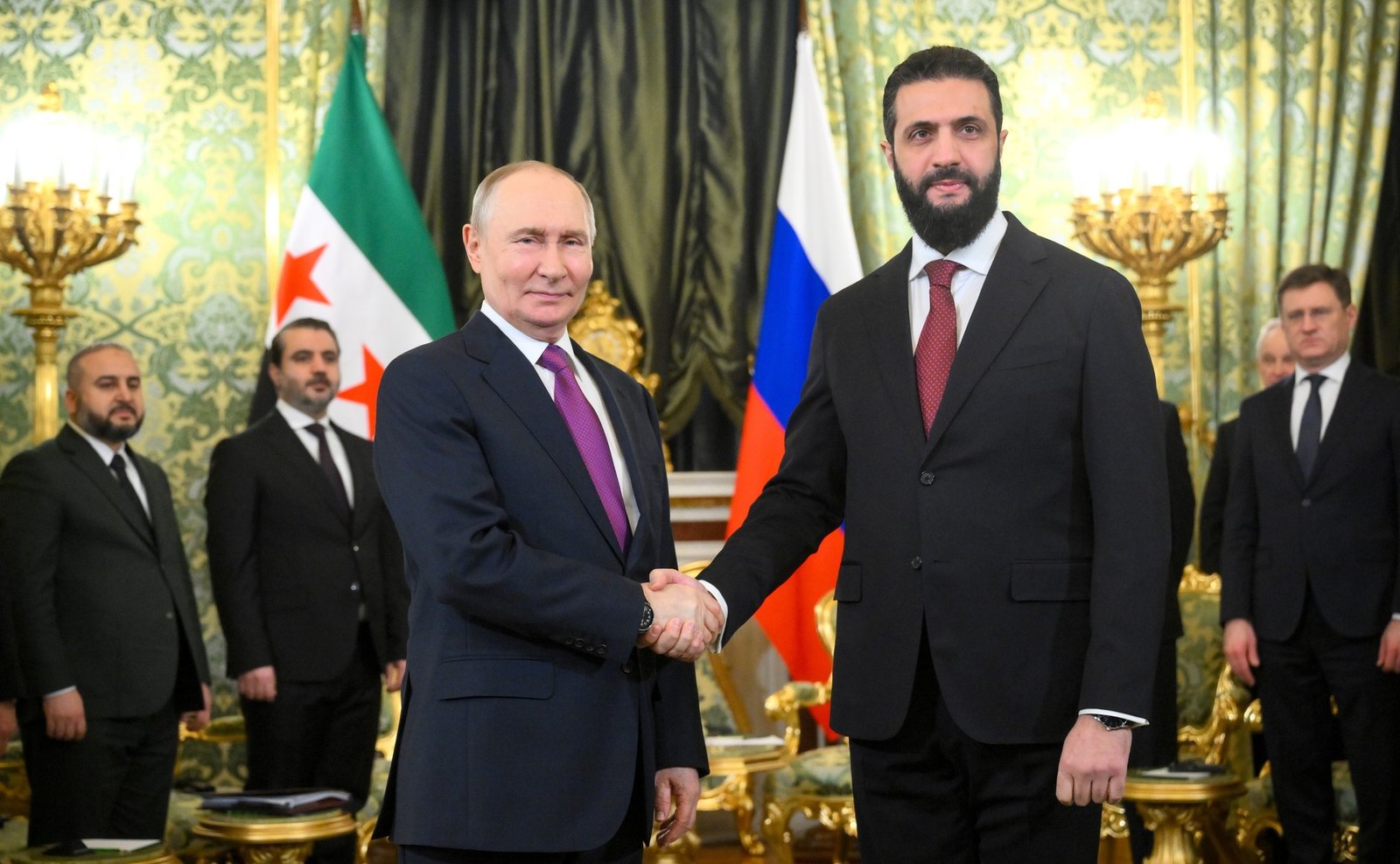
On 9 August 2026, Syria and Russia reached a new agreement over the future of Moscow’s military presence at Tartus and Hmeimim, redefining a relationship that had been built around Russia’s support for Bashar al-Assad. Syria’s new leadership has therefore allowed Russia to stay, but under different terms that give Damascus greater control over the two facilities.
For Moscow, continued access to Tartus preserves a strategic foothold in the Mediterranean at a time when its position in Syria has been weakened by Assad’s fall. On the other hand, al-Sharaa and his government are trying to maintain ties with Moscow while dealing with Türkiye’s growing influence and seeking greater international recognition.
Russia’s decision to stay raises two questions: what does Syria still offer Moscow in the Mediterranean, and what does Damascus gain from keeping Russia around?
Russia stays, but on different terms
The new agreement shows that the position Russia had under Bashar al-Assad has changed. The 2017 agreement granted Moscow extensive privileges at its military facilities in Syria, allowing Russia to operate with quite some autonomy. Assad’s fall therefore placed the future of Russia’s presence, particularly the facilities at Tartus and Hmeimim, into question.
The new deal provides an answer, but not a total return to the previous situation. Syria will take administrative control of the civilian side of Hmeimim airport and the commercial section of Tartus, while the military components will become joint Syrian-Russian training and qualification centres. The agreement therefore maintains a Russian presence while placing it under significantly greater Syrian control.
Ruslan Trad, a non-resident fellow at the Atlantic Council’s Digital Forensic Research Lab, specialising in Russia and the Middle East, describes the outcome as “less a Russian retreat than a managed downgrade.” Damascus can present the new terms as a sign of regained Syrian control over its own territory. Russia, at the same time, loses the privileges it enjoyed under Assad but is not completely removed from the picture. As Trad puts it, Russia keeps a foothold “on Syrian terms”, referring to a reduced presence that keeps strategically important access.
However, Al Abdallah, freelance journalist and analyst who contributes, among all, to NRT and De Volkskrant, warns against claiming that Damascus has achieved a victory. “We still do not know exactly how many Russian forces will remain, what powers they will retain, or whether the military and legal privileges Moscow received under Assad have actually been removed or simply renegotiated.”
Russia’s Mediterranean Foothold
Russia’s determination to maintain its presence in Syria is closely related to the strategic access to the Mediterranean. Tartus has provided Moscow with its only permanent naval facility outside the former Soviet space, allowing Russian forces to operate in the Mediterranean without relying exclusively on bases in the Black Sea. Access from the Black Sea also depends on passage through the Turkish-controlled Bosphorus and Dardanelles, where the movement of warships is regulated by the Montreux Convention.
However, the importance of Syria is not only about maintaining a naval presence in the Mediterranean. Tartus and Hmeimim have supported Russia’s ability to push military power further south, particularly towards Libya and parts of Africa. As Trad explains, Syria functions as “connective tissue in a chain that runs from the Black Sea through the eastern Mediterranean to Libya, the Sahel and the Red Sea.” In his words, Syria is “the hinge, not the destination”.
Russia has already looked for alternatives. Following Assad’s fall, Moscow transferred some military assets from Syria towards eastern Libya, where it maintains close relations with forces controlled by Khalifa Haftar. Yet Libya cannot fully reproduce the advantages of Syria. Russian access there depends heavily on Haftar, rather than an agreement with a recognised state government, making it a less reliable platform. Even reduced access to Tartus and Hmeimim therefore matters to Moscow as Syria represents an important link in its military influence across the Mediterranean and Africa.
Damascus between Moscow and Ankara
Russia is only one part of al-Sharaa’s foreign policy problem as Türkiye is also quite essential. Ankara’s role has changed considerably since Assad’s fall. Where its influence previously operated largely through opposition factions, military deployments and networks in northern Syria, Türkiye now deals directly with the government in Damascus and has taken a role in training and supporting Syria’s armed forces. Al Abdallah describes the emerging relationship as “close but unequal.” Türkiye, he argues, is currently “very difficult to do without” for Damascus, given its military presence, political and security networks, economic influence and shared border. However, this dependence also presents al-Sharaa with a dilemma: “the challenge for al-Sharaa is to benefit from this relationship without allowing Syria to move from Russian and Iranian dominance under Assad into a new dependence on Ankara”, Al Abdallah says.
Keeping Moscow close could give Damascus more room to deal with Ankara. But Al Abdallah does not believe Russia can serve as a real counterweight to Türkiye. “Russia gives al-Sharaa an additional option, not an alternative to Ankara,” he says. Moscow instead provides political and military channels that do not pass through Türkiye, making Syria less dependent on the country. But this strategy should not be mistaken for full strategic autonomy. “If Damascus needs one foreign power in order to limit the influence of another, that does not necessarily mean Syria has become more independent,” Al Abdallah cautions. “It may simply mean that the government is trying to create room for itself by balancing different forms of external dependence.”
Marina Calculli, Assistant Professor in International Relations at Leiden University, places Türkiye similarly at the centre of this narrative calling it “arguably the most important regional actor in the construction of al-Sharaa’s vision.” Yet she gives a different emphasis on Russia: in her view, Moscow provides Damascus with greater leverage primarily in its relationship with the United States. Syria, then, is not simply balancing one power against another. It is trying to create more room for itself by navigating between stronger actors.
Al-Sharaa’s Diplomacy and International Legitimacy
Moscow and Ankara are not the only relationships that Al-Sharaa is trying to manage. Since taking power, his government has promoted relations with Western and Arab states while continuing to negotiate with Russia, despite Moscow’s role in supporting Assad in the past. At the same time, Syria has also made sure of receiving sanctions relief and promoting international engagement.
For Calculli, such diplomacy is essential to al-Sharaa’s effort to establish himself as a legitimate figure. He is seeking to demonstrate that he is no longer simply “the representative of the victorious faction of an armed movement,” but “the head of a state capable of conducting diplomacy and manage relations with competing external powers.”
Al Abdallah goes further by questioning what kind of legitimacy al-Sharaa is actually gaining. “His growing international acceptance is not primarily a reward for democratisation or political inclusiveness,” he argues. Instead, many regional and international actors currently see his government “as the most workable option for preventing the return of ISIS, limiting Iranian influence, reducing regional instability and managing Syria’s relationship with Israel.” This also helps explain why continued relations with Russia have not damaged al-Sharaa’s international rehabilitation. “Continued relations with Moscow are clearly not a red line for Washington,” Al Abdallah says, although “that does not mean Washington is indifferent to the scale of Russian influence.” The question is how much military, economic and strategic freedom Moscow retains under the new arrangement.
For Al Abdallah, the distinction is crucial: “al-Sharaa’s international legitimacy currently depends less on distancing himself from Russia as such, and more on whether he can convince his main external partners that Syria will not again become a base for forces they consider threatening.”
In conclusion, Al-Sharaa seems to be moving Syria away from depending on a single foreign power, while keeping several external partners in play. This gives Damascus more room to negotiate, but it does not make Syria independent of outside powers. These relationships continue to place limits on Syrian sovereignty. For Europe, these changes also raise a question about what role it can play in the Middle East where other powers, such as Russia and the United States, compete for influence.