

On April 12, Péter Magyar won the Hungarian general election, bringing an end to Viktor Orbán’s 16-year regime. The President of the Republic, Tamás Sulyok, has already made a statement that he will nominate Magyar for the office of Prime Minister at the inaugural session of the National Assembly. At his first international press conference following the victory, Magyar addressed key issues, including the fact that while Hungary will not contribute financially, it would lift the veto on the €90 billion EU support loan intended for Ukraine. This is a significant first sign that the new Hungarian government intends to consolidate Hungarian-Ukrainian relations, which in recent years have suffered staggering damage due to various government representatives and state propaganda.
Furthermore, the Orbán government made the topic of Ukraine and the war a central issue during the campaign, and so one of the most pressing questions following the elections becomes: how will the Hungarian-Ukrainian relationship change after Orbán? Three Hungarian experts, István Szent-Iványi, Zsolt Kerner and Péter Krekó helped analyze what will possibly happen after the new government forms.
Historical Conflict Points
Hungarian-Ukrainian relations have long been historically fraught, primarily due to Transcarpathia, a region in western Ukraine located in the Western Carpathians. Its territorial status changed frequently throughout the 20th century: Transcarpathia was part of the Hungarian state from the founding of the Hungarian Kingdom until 1918, when, following World War I, it became part of Czechoslovakia; after World War II, it was part of the Soviet Union. Since Ukraine’s independence, it has belonged to Ukraine.
There is still an ethnic Hungarian minority of approximately 80,000 to 90,000 people living in the region, whose rights give rise to recurring conflicts between the two countries; according to Krekó, Orbán used the Hungarians of Transcarpathia as a weapon against the Ukrainian government. He points out that protecting Hungarian minorities beyond the borders will naturally be important for Magyar and his national conservative government as well, especially given that the opposition (consisting of Orbán’s Fidesz and the ultra-nationalist Mi Hazánk) is even more nationalist and conservative than Magyar and his party.
In fact, Magyar recently met with Zoltán Babják, the mayor of Berehove (a town in Transcarpathia, home to the largest Hungarian community). After the meeting he made two promising statements: “We agreed that it is in the interest of Hungarians living in Transcarpathia to put relations between Hungary and Ukraine on a new footing”. Furthermore, he announced that he plans to initiate a meeting with Ukrainian President Volodymyr Zelenskyy in early June, symbolically in Berehove, with the purpose of improving the situation of Hungarians in Transcarpathia.
Impact of the Election Campaigns
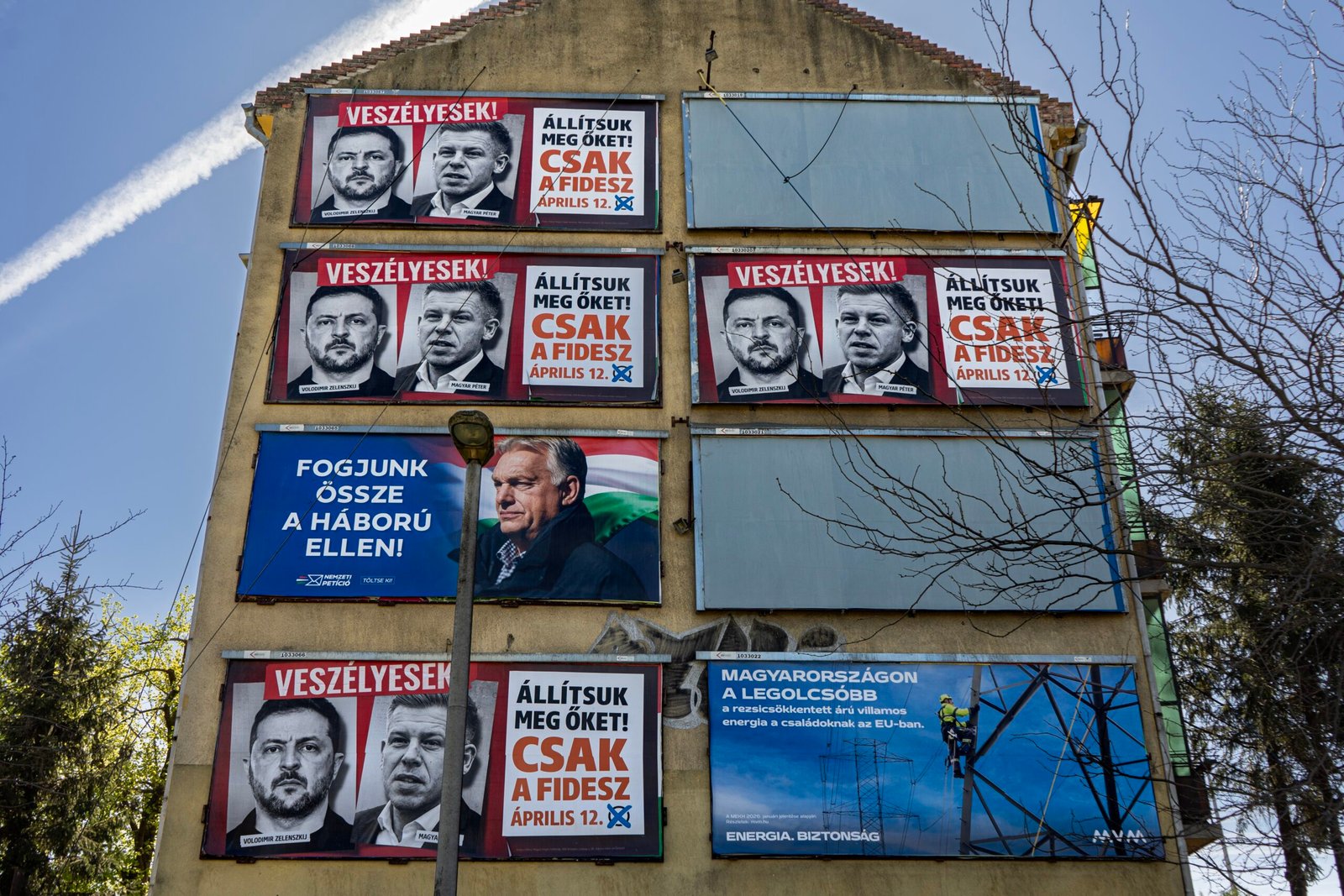
Already during the final phase of the 2022 campaign, following Russia’s full-scale war, Fidesz essentially waged a “post-truth campaign” that labeled the entire opposition (and especially the main challenger for prime minister) as “pro-war”, which, in their understanding, meant that they had been supportive of helping Ukraine continue its defence.
In the Hungarian media landscape, dominated by Orbán and Fidesz, Ukraine (instead of Russia) has been portrayed as the main threat looming over the country. Zsolt Kerner cites three main reasons for this: “The Orbán government sought out the majority opinion on every issue and tried to go along with it. At the start of the war, polls showed that Hungarians were afraid of the war, which is why they used the “security (Orbán and Fidesz) vs. danger” narrative.”
He continues that Orbán had been saying from the beginning that ‘Russia cannot be defeated’, and therefore the fact that the war (and thus the fear in people’s life) is still ongoing is due to Ukrainians’ perseverance. According to Kerner, this image of Orbán as a geopolitical “oracle” had to be kept alive at all costs as compensation for his growing domestic political missteps. Additionally, as a third reason, he cites the obvious sympathy toward Russia and dependence on Russian energy suppliers.
The 2022 campaign already had a clear impact on public opinion: the Hungarian public showed low sympathy toward Ukrainians and was the least supportive of Ukraine’s accession to NATO. By 2024, government propaganda had succeeded in convincing 44 percent of its own voters that Russia had launched the war in self-defense. Interestingly, however, Putin and Zelenskyy are the foreign leaders Hungarians disapprove (almost to an equal extent) the most.
During the campaign leading up to the 2026 election, government propaganda fomented hatred against Zelenskyy, Ukraine and Ukrainians on an unprecedented scale. Szent-Iványi claims that the government’s propaganda was “incredibly soul-poisoning” for vast numbers of people. It is therefore not surprising that Hungarian society became deeply divided on the issue of Ukraine. According to a recent survey, 44 percent of respondents would support Ukraine with financial and humanitarian aid, while 42 percent would provide no support whatsoever.
Transformation Period
Szent-Iványi states that since the day after the election, Ukraine has not been a topic of discussion either in the public media or in other media outlets close to Orbán, and that “the state-generated war psychosis is over”. Two days after the elections, the Hungarian Armed Forces announced the withdrawal of soldiers from guarding critical energy infrastructure, which is another sign of the collapse of Orbán’s false war narrative. The troops were deployed in February after Serbian authorities had found explosives near the Turkish Stream pipeline.
All three interviewees agreed that change and normalization will be a long process. Szent-Iványi argues, “we need to repair a relationship marked by incredible toxicity over the past 1–2 years, which is like curing a serious illness,” as he believes we must take into account the negative stereotypes regarding Ukrainians that have taken root in a segment of society. Furthermore, he believes that it may take years for Orbán’s core supporters to come to their senses, but the less fanatical among them will realize within a few months that the entire narrative was a lie and that Péter Magyar will not drag Hungary into the war.
Krekó sees little chance that, with the end of state propaganda, those influenced by it will realize that the war scare had no basis and will turn away from Orbán for good. In his view, “tribal logic” will prevail instead; Fidesz’s own, smaller-scale communication channels will remain, and those influenced by them will not let the issue go.
Kerner draws attention to an interesting data: the majority of Hungarian society actually supports Ukraine joining the EU after the war ends, provided Ukraine meets all criteria. However, he assumes that Péter Magyar wants to ensure that the former government’s propaganda that “Péter Magyar is Zelenskyy’s man” is not proven true in hindsight, “though of course this also depends on how much Orbán remains in the picture,” he adds.
And lastly, both Krekó and Kerner note that the legitimate resentment and mistrust that have developed among Ukrainians will not make normalization easier. Despite the difficulties, Krekó believes that the Magyar’s government will inevitably lean towards the European mainstream view, if only to secure the return of EU funds, and he notes that it will be the new government’s task to explain why supporting Ukraine is necessary and important. At the same time, Krekó says, “the best course of action would be to depoliticize the issue”.
A New Hope?
All three experts agreed that the conflict has escalated so much, especially in recent months, that it is in everyone’s best interest to consolidate Hungarian-Ukrainian relations. Szent-Iványi said it would be characterized by a willingness to compromise, while Krekó expects it to be “transactional”.
In addition to the bilateral meeting planned by Péter Magyar, as mentioned earlier, there are other positive signs that the new Hungarian government will be much more constructive regarding Ukraine. A good starting point is that while Péter Magyar did not take a stance at the beginning of the campaign, he very much did so by the end of the “Europe vs. Russia” axis. According to Kerner, he realized that Hungarians fear being kicked out of the EU, so he made it clear that he is committed to Europe (and consequently stands against Russia).
Furthermore, in his victory speech, Magyar mentioned that his first foreign visit will be to Poland. The normalization and prioritization of Polish-Hungarian relations, among other things, could help reinforce a more open stance against Russia.
Regarding specific decisions related to Ukraine, Szent-Iványi says the following will happen: the release of the €90 billion package, approving military support through the European Peace Facility (EPF), and the adoption of the 20th sanctions package. At the same time, the new Hungarian government will likely not support fast-track EU membership, and it is likely that the shipment or transit of any weapons will continue to be prohibited.
Conclusion
In conclusion, all three experts agreed on two key points that summarise the possible future of Hungarian-Ukrainian relations. On the one hand, Ukraine can expect a significantly less confrontational Hungary; the new government will, most likely, continue to refrain from providing direct aid, while it will not actively obstruct any EU-level support. On the other hand, only consolidation is in prospect, a 180 degree turn is not due in part to the impact of Orbán’s years-long propaganda campaign and the unresolved issue of minority rights in Transcarpathia.