

An old quote attributed to Porfirio Díaz goes: “Poor Mexico, so far from God, so close to the United States.” Though specific to the Mexican context, it speaks to a reality pervasive throughout Latin America: the enduring shadow of American intervention. Historically, this has meant Cold War interventions, support for military dictatorships, economic coercion and repeated incursions justified in the name of regional stability. Although methods have changed, the underlying logic remains that Latin America is a matter of direct American concern and, therefore, potential American intervention.
The latest expression of that logic might be designating Latin American organised crime groups as terrorist organisations. Through Executive Order 14157, the Trump administration directed federal agencies to pursue the designation of cartels and transnational criminal organisations as terrorist entities. In Brazil, this approach has been extended to the Primeiro Comando da Capital (PCC) and Comando Vermelho (CV), Brazil’s largest criminal organisations with activities spanning drug trafficking, money laundering, and extortion, with potential consequences deriving from existing counterterrorism authorities established under Executive Order 13224. The move was presented as a response to organised crime, since the United States remains one of the world’s largest consumers of cocaine and Brazilian criminal organisations have become increasingly embedded in transnational illicit markets. Ana Maura Tomesani, public safety expert at the Peace and Conflict Studies Center from Universidade de São Paulo (CCP/NUPRI/USP), warns against conflating organised crime and terrorism, “Though PCC and CV operate transnationally, they do not pose a terrorist threat to the United States. I don’t see anything positive in this designation.” This begs the question: if the organisations themselves do not constitute a terrorist threat, why is Washington seeking to label them as terrorists?
The Story
The answer is in the political power of the terrorist label. Unlike organised crime, terrorism evokes an existential threat that legitimises extraordinary measures, expands legal authorities and lowers the threshold for external involvement. In Venezuela, for instance, portrayal of the country as a hub for narcoterrorism gradually legitimised a more interventionist posture towards the Maduro regime. As Jelle van der Wal, geopolitical analyst on Latin America at HIG, notes, “history is repetitive: security arguments are once again being used to get involved in sovereign states.” Intervention itself is not necessarily the objective, but the possibility of it becomes a strategic asset: by framing Brazil as increasingly unable to manage its own security challenges, Washington expands its room for manoeuvre and normalises a broader range of future policy options, from increased policing cooperation to economic sanctions and diplomatic pressure. Once such a perception is established, these options become politically acceptable. In a world increasingly shaped by great-power competition, maintaining influence is often less about acquiring resources than preventing competitors from accessing them. Natural resources and financial infrastructures thus become pieces in a larger geopolitical game.
Spheres of Influence
Following that logic, Washington’s interest in Brazil is that it no longer sits comfortably within the traditional American sphere of influence. Over the past decade, Brazil has diversified its partnerships through BRICS, strengthened trade relations with China and pursued agreements such as the Mercosur-EU deal. Even domestic innovations such as PIX, Brazil’s instant payment system, reflect broader ambitions of financial autonomy.
Jelle van der Wal says ‘’During the Cold War, competition was primarily ideological. Today, it seems increasingly viewed through a realist, zero-sum lens: influence lost by the United States will be gained by someone else.’’ In that sense, the terrorist designation can be interpreted as part of a broader strategy to preserve American influence.
Legitimacy & Interventionism
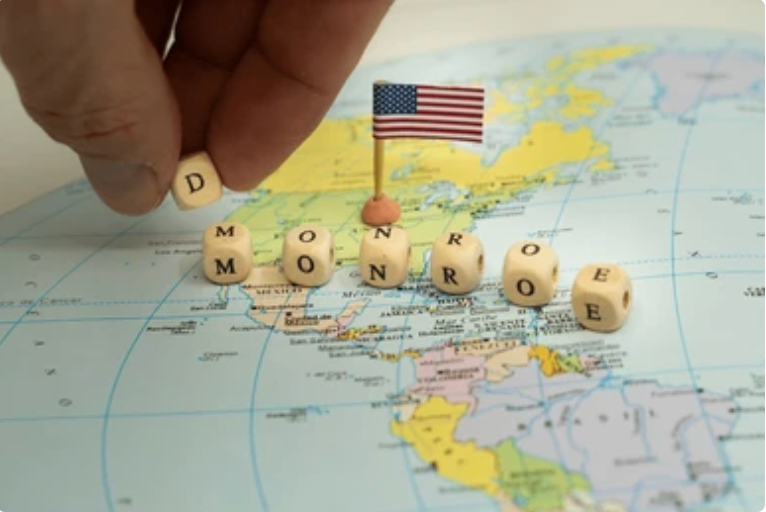
Brazil’s growing autonomy may explain why historical comparisons have resurfaced. At first glance, invoking the Monroe Doctrine may seem excessive. After all, it was designed to keep European powers out of the Western Hemisphere, whereas today’s geopolitical landscape is globalised and multipolar. However, the Doctrine’s assumption for intervention, Latin America being a region whose stability, security and politics are matters of direct American interest, continues to shape aspects of U.S. foreign policy. Some observers argue that this represents a twenty-first-century adaptation of the Monroe Doctrine, reinterpreted through an increasingly zero-sum understanding of great-power competition. That shift is important to understanding the potential effects of Executive Order 13224, which may not be classic military occupation.
When it comes to combating organized crime, something the designation seeks to do, Brazil already has a strategy. Ana Maura Tomesani explains “Organized crime is not an issue of terrorism, but of illicit markets, which Brazil is already addressing through focus on financial suffocation of criminal organizations by targeting money laundering schemes, freezing assets and dismantling the legitimate businesses through which PCC and CV operate.”
This goes against the narrative accompanying the designation efforts, which implicitly frame PCC and CV’s security challenges as existential, exceeding Brazil’s capacity to address them alone, thereby opening the door to external involvement. The importance of this narrative is tied to another potential strategic objective of the policies: legitimacy. Ana Maura says “There already is extensive cooperation between the Brazilian policing organs and American counterparts, like the DEA, but a counter-terrorism framework may create a dangerous precedent that legitimises expanded American policing presence in Brazil and less control retained by the Brazilian state.’’
The policy thus operates as a tool to legitimise future intervention under different frameworks, not necessarily limited to military occupation. In fact, the contemporary Monroe Doctrine may utilize economic, legal and financial pressure. André Nunes Chaib, specialising in international law, contends ‘’The greatest danger may not be military intervention itself but the secondary sanctions that accompany terrorist designations. Once organizations are labelled as terrorists, banks, companies and international partners become vulnerable to sanctions if they are found to have even indirect links to those groups, which impacts banking and economics as compliance costs rise and investing becomes more expensive and risky.’’ The result is a subtler form of influence than direct intervention that may prove equally effective. Whatever shape the pressure ultimately takes, the measure does its real work simply by reinforcing a climate of securitisation, in which American strategic interests in Latin America are served by pre-emptively justifying the erosion of another state’s sovereignty.
Although we may be watching history repeat itself embodied in the return of the Monroe Doctrine, the larger context in Latin America today is vastly different. Unlike previous eras, countries such as Brazil possess significantly more agency through diversified economies, multiple trading partners and greater diplomatic leverage. The challenge is no longer to resist overt intervention, but to navigate a world in which domestic security problems can quickly be transformed into geopolitical instruments.