

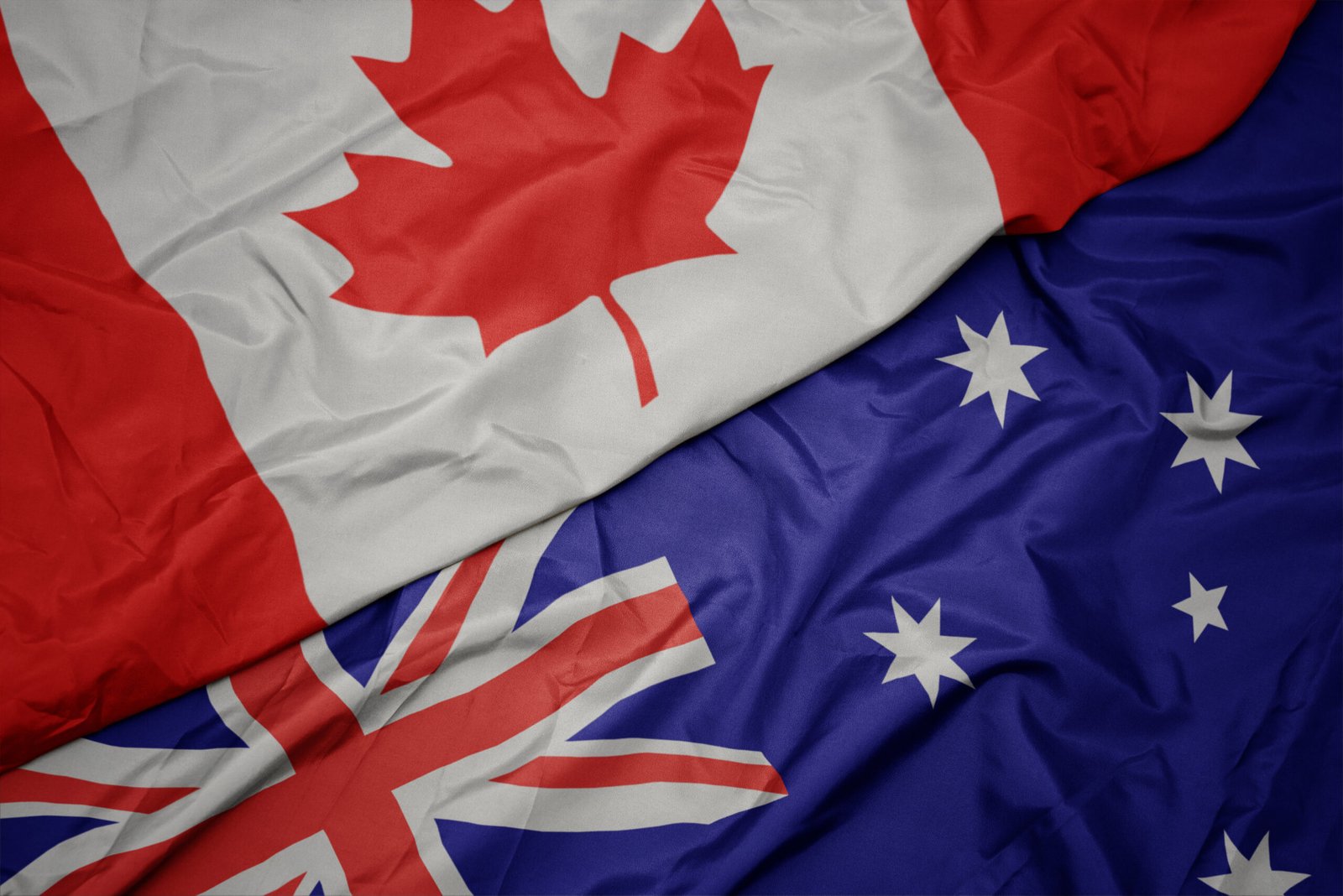
Canada’s Prime Minister, Mark Carney, made the journey to Australia in early March to continue his efforts to promote greater middle power cooperation between Canada and other nations. Carney’s vision aligns with HIG’s mission to bring middle powers closer together in a fragmenting world order. During his visit, he approached topics of defence and maritime security, critical materials, and trade. Australia and Canada have fostered diplomatic relations for many years, both sharing a similar colonial history and Commonwealth status, however, beyond this, their collaboration is minimal. Carney has pushed for greater cooperation between the two countries, stressing that “middle powers must act together, because if we’re not at the table, we’re on the menu”, and it’s time for them both to develop greater strategic autonomy. However, Australia and Canada’s security infrastructure have developed differently due to their varying threat perceptions. Therefore, to what extent does Carney’s (and HIG’s) vision for greater middle power collaboration align with Australia’s security reality?
Understanding Threat Perceptions
To better understand the security realities of both Australia and Canada, it is essential to first assess the variations in their threat perceptions. Due to Australia’s location in the Indo-Pacific, China remains one of their biggest concerns, particularly given its expansionist project beyond the South China Sea and into the South Pacific. Justin Burke, Senior Policy Advisor at ANU National Security College, mentioned that there has also been a number of recent incidents between the Chinese military and Australian aircraft and ships, which has been a cause for “heightened anxieties”.
However, Australia is also geographically isolated and heavily dependent on maritime trade routes, making them concerned about any disruptions to supply chains. As Grant Wyeth, freelance analyst and columnist at The Diplomat, explained “Australia’s defence strategy makes note that security is not solely about defence of the homeland, but defending Australia’s ‘way of life’ too. This way of life is the prosperity that flows from the open sea lines of communication in the Indo-Pacific”. The United States has provided Australia with the security of defence support and intelligence for deterrence, keeping the threat from China at bay while allowing them to maintain positive trade relations.
On the other hand, Christian Leuprecht, Professor at the Royal Military College of Canada, shared that Canada has three main spheres to its strategic environment: the Arctic, the Atlantic, and the Indo-Pacific. The Arctic region remains the main focus for Canada, particularly with threats coming from other Arctic actors, such as Russia. As per Leuprecht, “Canada finds its strategic environment very difficult to manage, and it will never have the means to cover all three strategic spheres on its own”. He elaborated that Canada traditionally has not been very present in finding their threats, partially because it is a relatively young country that has not developed a strong strategic culture.
Australia’s Security Infrastructure
As per Justin Burke, “Australia has always relied on an alliance with the great power of the day to augment its capabilities”. He elaborates that because Australia’s geographical size and maritime domain far outweigh its population, it hasn’t had the means to protect its interests and obligations on its own.
Wyeth mentions that the recent ideological shift of the US under Trump 2.0 has led to some issues of trust in their security relations, however, despite this there is still a sense in Canberra that Australia’s interests are tied to US hegemony. While there has been a continued deepening of alliance integration and commitments to capability upgrades with the US, as Wyeth explains, Australia has also been working to “diversify elements of its defence industrial base”, and security partnerships with regional and European partners.
Burke states that the US doesn’t want Australia to become more dependent on them, but rather wants them to become more capable. Australia also aids the US in a number of ways, from hosting US forces and marines, to “decades-long cooperation in intelligence gathering and sharing from facilities”, therefore, there are clear incentives from both sides to maintain a positive and productive relationship.
Australia continues to face persistent challenges, with Wyeth explaining that its security vulnerabilities largely come from its “geography, infrastructure exposure and reliance on external supply chains”. As per Leuprecht, Australia has a strong strategic culture and thinking compared to Canada. However, while this remains true, their preparedness has been lacking. Australia is currently experiencing the consequences of this due to major maritime supply chain disruptions as a result of the war in Iran. “Right now, with war in the Middle East, Australia is starting to wake up to key trade dependencies such as imported refined fuels, specifically aviation fuel, which principally comes from China.” – Justin Burke.
Canada’s Security Infrastructure
Canada faces a significantly different security reality to Australia, partially due to their different threat perceptions, but also due to their varied strategic cultures. Where Australia has capitalised on its relationship with the US, leading it to be mutually beneficial, Canada’s mindset has traditionally been more hostile toward its southern neighbour. As per Leuprecht, Canada has always attempted to maintain a counterbalance to the US as a partner. They have been weary of the US coming to help them as they don’t want to lose their sovereignty. This is where Canada’s membership in NATO has provided them with a sense of security, as “they have used it to balance US unilateralism, and it has allowed them to punch above their weight for many years”. However, as Leuprecht mentioned, Canada has made some missteps which has isolated them from both the US and from European partners for periods of time.
Geographical proximity makes the ideological shift in the US, and the subsequent growing lack of trust, a more pressing issue for Canada than Australia. However, Leuprecht explained that the issues raised with Canada by the Trump administration are problems that were also raised by the Biden administration. These are homemade problems, such as underinvestment in hydrocarbon infrastructure and mining of raw materials, and have left Canada in a poor physical situation. Even with Carney as the new prime minister, many of the people that have created these strategic issues still sit in offices in Ottawa.
Ultimately, Canada continues to live in a “highly constructed ideological world”, which stops them from increasing and diversifying investments in their defence infrastructure. Leuprecht elaborates that “Canada currently isn’t well positioned to adapt to the world”. As per Wyeth, “there is little appetite within Australia to know more about Canada, and without sustained interest, the drive towards greater cooperation will be absent”.
Conclusion
The ideological mismatch between Canada and Australia makes it difficult for them to align their visions in the way that Carney may hope. While they are likely to increase cooperation, particularly as Canada begins to pivot more towards the Indo-Pacific region and can learn from Australia’s relationship with China, the extent of their strategic relationship is unlikely to provide a bulwark against the US. Australia is beginning to diversify their security relations in the region, but middle power cooperation alone can’t offer them what they need currently given their strategic interests and obligations. The two may, however, begin to build a solid foundation in other spheres, such as stronger economic and diplomatic ties, to pave the way for more substantial defence cooperation in the future.