

The Houthis’ quest for geopolitical influence
In early July, the Houthis sank the cargo ships Eternity C and Magic Seas in the Red Sea. Following the weakening of Iran, the Houthis’ main pillar of support, they sought to assert themselves on the international stage. Domestic discontent in Yemen also appears to have played a significant role in the circumstances surrounding the attack. By standing up for ‘the Palestinian cause’, the Houthis hope to strengthen the regime’s domestic legitimacy.
The exact role of Iran in the latest Houthi attacks remains unclear. On the one hand, in early May it encouraged the Houthis to conclude a ceasefire with the US, in exchange for an American withdrawal from the Red Sea region. On the other hand, it is possible that the Ayatollah regime sought to step up the pressure on nuclear negotiations with the US, following the Israeli-American attack on Iran in June.
Western interventions are falling short
The success of the attack makes it clear that Western interventions are falling short. Apart from the Houthi-US ceasefire, the small-scale EU maritime mission Aspides and the air strikes by the US, the UK and Israel appear insufficient to make the Red Sea a safe haven. Aspides, with an average of fewer than one warship available per day, is completely inadequate for protecting merchant ships in the Red Sea. Furthermore, the Houthis combine guerrilla tactics – such as decentralising power, personnel and resources – with advanced weapon systems and a functional bureaucracy. This makes it virtually impossible to deliver a decisive blow through air strikes alone – ground troops are essential. In short, despite Western intervention, the Houthis remain capable of making the Red Sea unsafe.
A costly disruption to trade for Europe
The attacks were carefully timed. The first Houthi attacks in late 2023 caused freight traffic to fall by as much as 60 per cent – from around 72 to 75 ships per day to 20 to 23 at the low point in the summer of 2024. It subsequently recovered to 36 to 37 ships per day by June 2025. Certainly since the ceasefire between the Houthis and the US in May, several shipping companies had been considering a return to the Red Sea. The latest Houthi attacks have caused them to abandon that plan.
Insurance premiums for passage through the Red Sea have now risen from 0.3 per cent to 1 per cent of a ship’s cargo value. Some insurance companies are even refusing cover, whilst many shipping companies are now avoiding the Red Sea. This is a painful realisation, given that around 40 per cent of European trade – amounting to some one thousand billion euros’ worth of cargo per year – was shipped via the Red Sea until October 2023. The alternative trade routes are more expensive, less sustainable and significantly increase transit times. This results in inflation and less resilient supply chains in Europe.
A costly disruption to trade for Europe, a cheap means of blackmail for the Houthis. It highlights the shifting balance of power in the Middle East. The unrest in the Red Sea lays bare Europe’s significant geo-economic vulnerability. Nevertheless, this issue is a low priority on the political agenda, which is dominated by Ukraine. However understandable that may be, Europe cannot afford to play a marginal role in the security architecture of our most important trade routes. This security architecture is linked to the new security order taking shape in the Middle East, where Europe is also conspicuous by its absence.
IMEC: a geopolitical must
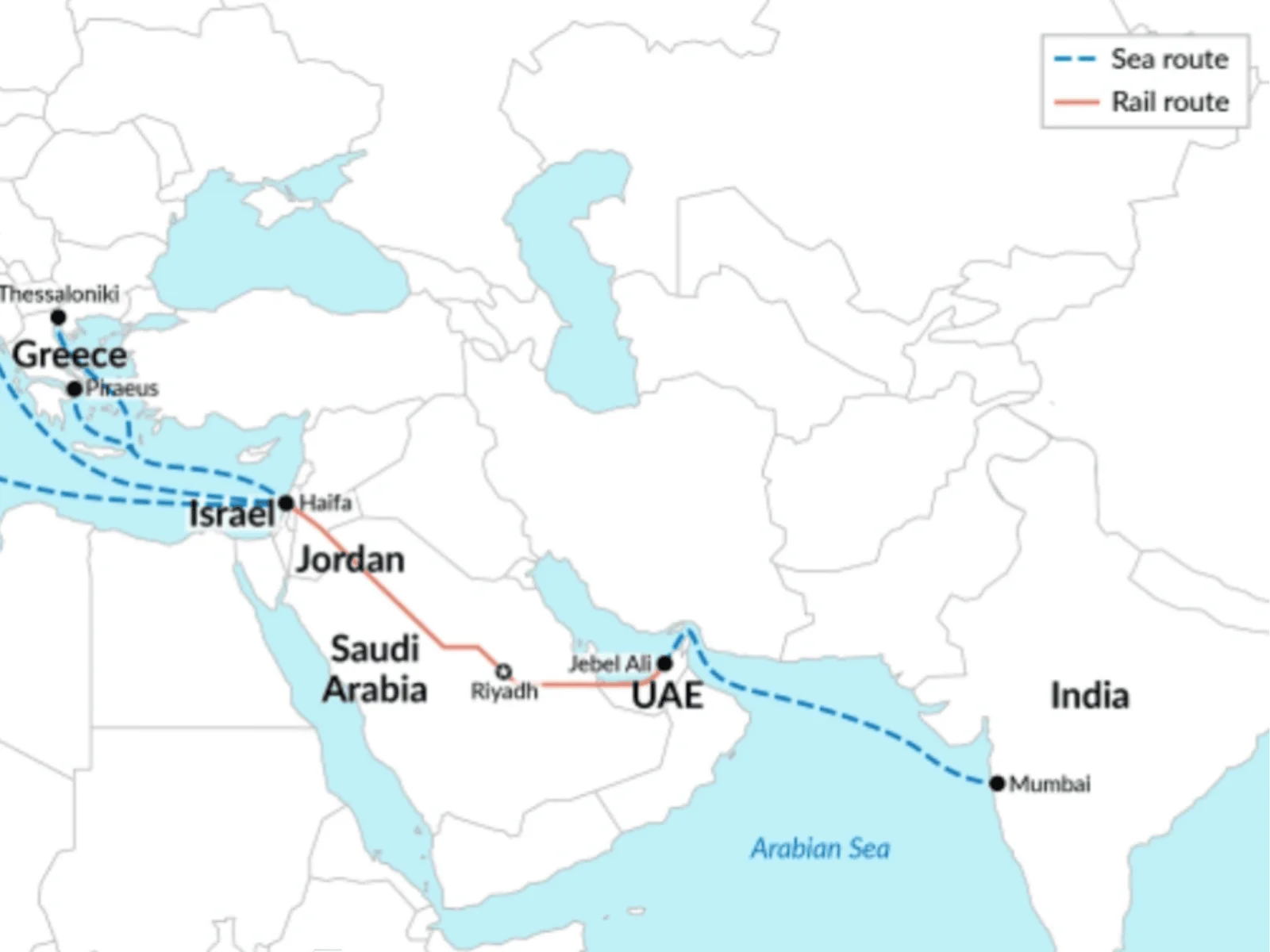
Europe must become the architect of its own trade routes, especially now that the US is proving unreliable as a regional ‘security provider’. IMEC (India-Middle East-Europe Economic Corridor) is regarded as the leading contender for a new trade route. This geopolitical mega-project connects India, the Middle East and Europe: economically, digitally and in terms of energy infrastructure. Running east to west, the IMEC extends by sea from India to the United Arab Emirates, before continuing by rail through Saudi Arabia and Jordan to Israel, after which it reaches its final overseas destinations in Greece, Italy and/or France. IMEC was presented as an alternative to China’s Belt and Road Initiative (BRI) at the G20 summit in September 2023. Whilst the BRI may have been the original impetus for IMEC, the Houthis have provided the catalyst for significantly accelerating the pace of its development.
Whilst IMEC does face some criticism regarding its financial and economic viability, its supporters point to the potential 30 per cent lower transport costs and 40 per cent shorter transit times compared to the route through the Red Sea and the Suez Canal. In this geopolitical context, Europe actually has no choice but to be a supporter, advocate and initiator. IMEC not only offers more robust trade routes but also ensures a firm foothold in the new geo-economic order. Europe must therefore use its financial and economic clout to get IMEC off the ground, followed by the establishment of a joint security architecture by the participating countries.
Leaving Europe at the mercy of the Houthis, Iran or Erdogan is a sign of geopolitical apathy that we cannot afford.
It is important for European policymakers to:
- Raise the profile of IMEC on the political agenda and strengthen the political will within Europe itself and among participating countries.
- Mobilise sufficient private and public investment to finance all infrastructure projects.
- Achieve digital, legal (customs) and logistical standardisation across all participating countries.
Dutch policymakers would do well to:
- Identify the risks and opportunities for the Port of Rotterdam. Marseille, in particular, could become a competitor as a key IMEC gateway to Europe.