

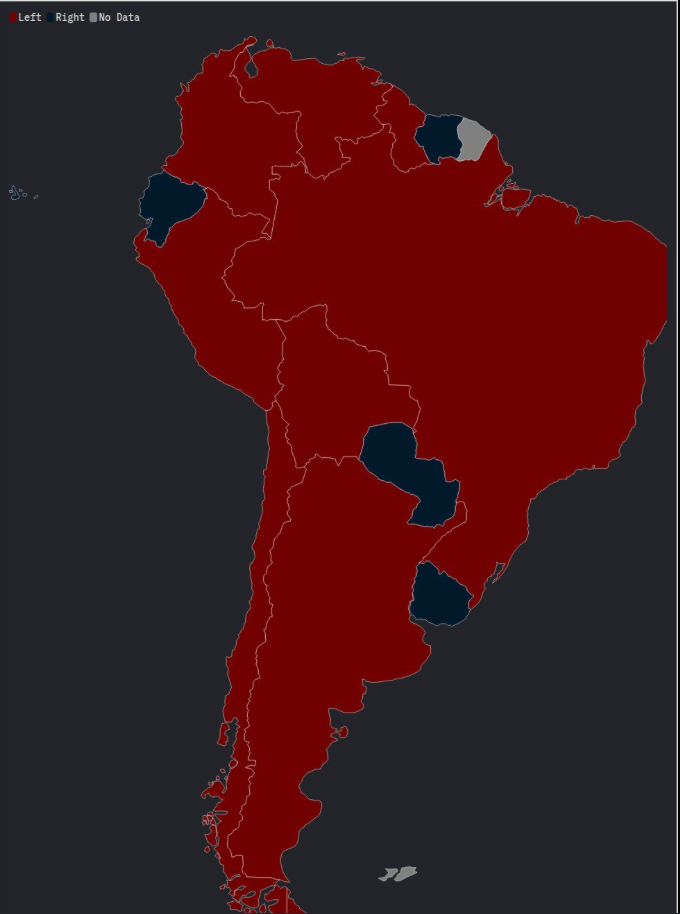
The previous article in this series analysed how the metaphor of the pendulum falls short of explaining electoral shifts in Latin America, which ideology alone does not account for, and questioned the very architecture of analysis based on the left-right wing taxonomy, which experts contend may be reductionist for the political reality of Latin America. Now, this article moves beyond the questioning to explaining what is potentially behind these political shifts based on the expert insights of Rossana Castiglioni, Full Professor of Political Science at Universidad Diego Portales and Co-Editor of the Journal of Politics in Latin America; María Gabriela Palacio, Assistant Professor of Development Studies at Leiden University; and Vinícius Vieira, Research Associate at the University of São Paulo and Associate Professor in Economics and International Relations at the Fundação Armando Alvares Penteado (FAAP).
After all, if not just ideology, what shapes elections?
If perhaps the right-left wing taxonomy does not sufficiently account for these political changes, Palacio points out that the economy, for instance, might play a part. “The material conditions of Latin America deteriorated badly after the pandemic… unemployment increased, informality increased, unpaid care work increased, many countries accumulated more debt, and governments struggled to offer a steady economic recovery. I find that a much more convincing explanation for today’s political shifts. A lot of the right-wing argument has been that the left’s economic model made people poorer. Whether that is true or not, it became a powerful political message.”
Public security has become equally important. Across much of Latin America, rising concerns about organised crime, violence and public safety have fundamentally altered electoral priorities. In that sense, candidates promising stronger responses to crime and identifying with the mano dura approach have gained significant electoral traction, reflecting voters’ immediate concerns rather than long-standing ideological commitments. As Vieira put it, “What still largely explains the rise of the right… is the security agenda. It has gained enormous traction because of organised crime. Security used to be at the bottom of voters’ priorities; today it’s at the top.” Similarly, Palacio says “The left has been unable to provide a clear and effective answer to insecurity. That vacuum has been filled by right-leaning discourse.”
The way politics is conducted has also changed. Social media platforms have transformed election campaigns, reducing the influence of traditional party organisations while allowing political movements to mobilise supporters directly. Palacio highlighted that “campaigning during the Pink Tide still happened in the territories. Today you just need an aggressive TikTok campaign, a few hashtags and rage bait. Politics is much more accessible through your phone. I see social media as the real battleground.” Similarly, Castiglioni recounts “In Chile, there was one presidential candidate, Franco Parisi, who did very well in the last election while living abroad, without a campaign budget, conducting almost his entire campaign through social media.”
As the means of campaigning alter the landscape of political competition, so too do the political currents shift. Vieira explains that “before, a classic right-wing was institutionalized, and following the end of the dictatorships in Latin America, the left was also institutionalized. Meanwhile, an extreme-right wing discourse featuring elements of fascism, white supremacy and generally heavy-handed on racial identity that had been marginalized has become institutionalized via social media, which gave them a space history had previously denied. Thus, online networks have enabled political movements to organise outside conventional party structures, amplifying narratives that spread rapidly and change national identities key to politics.”
These developments suggest that today’s political competition is increasingly driven by changing voter priorities, new forms of political mobilisation and dissatisfaction with incumbent governments rather than straightforward ideological realignment. In fact, Vieira also argued that identification and alignment are incredibly nuanced: “Chinese demand has driven a cycle of commodities… Coincidentally, the left governed during part of that cycle, but those who benefited the most economically, the commodity exporters, don’t acknowledge the left’s role in this process; they want right-wing governments. This shows that economic interests alone cannot explain voting behaviour, and the rise of Bolsonarismo, particularly associated with the rise of the evangelical movement, illustrates that competing political projects are increasingly based on different notions of nationhood, especially religion, rather than purely economic interests.”
And geopolitics?
Evidently, these domestic transformations don’t happen in a vacuum, but are unfolding within an international environment that has itself changed dramatically.
Geopolitics influences politics not simply through foreign policy, but through competing visions of national development. As Vieira explained, “depending on what the nation is, whether it is Christian, Western or part of the Global South, you will see preferences for different ideological alignments and competing definitions of sovereignty and other key political concepts.” The traditional right has generally favoured closer ties with the United States, while the left has sought greater strategic autonomy and more diversified partnerships.
He also argues that the so-called Second Cold War has intensified these dynamics. “As China’s economic presence expanded across Latin America, particularly through commodity demand and infrastructure investment, Washington renewed its efforts to strengthen alliances in the region. Rather than replacing domestic politics, this geopolitical rivalry increasingly shapes the incentives available to political elites and movements.”
Palacio situated the current moment within broader historical cycles: “Today’s geopolitical competition increasingly revolves around control over digital infrastructure, information and narratives, not only trade or military power. Who gets to tell the truth, control it and disseminate it? That has become a central geopolitical question, particularly as AI and social media platforms reshape political debate.”
Finally, a factor is Latin American governments retain limited room for manoeuvre. As Palacio noted, most countries remain structurally dependent on commodity exports, foreign investment and external finance, meaning that their political choices are made within constraints imposed by the international economy rather than in complete autonomy.”
Beyond the pendulum
Overall, maybe the image of Latin America as a political pendulum remains a useful shorthand for describing alternating electoral victories, but it tells us relatively little about the nature of these shifts and leaves something to be desired when it comes to explaining them.
Today’s political landscape is shaped by economic uncertainty after the pandemic, growing public concern over security, fragmented party systems, rapidly evolving digital technologies and an increasingly competitive geopolitical environment. Understanding these forces requires moving beyond the assumption that Latin American politics can be reduced to swings between the left and the right.
For European observers, this matters for another reason. Many of the dynamics reshaping Latin American democracies are becoming increasingly visible in Europe as well, and it seems current analytical tools are falling short of the complexity of the scenario. Rather than viewing Latin America as an exceptional region caught in endless ideological oscillation, it may be more useful to see it as a window into the changing nature of democratic politics in an increasingly contested international order.