

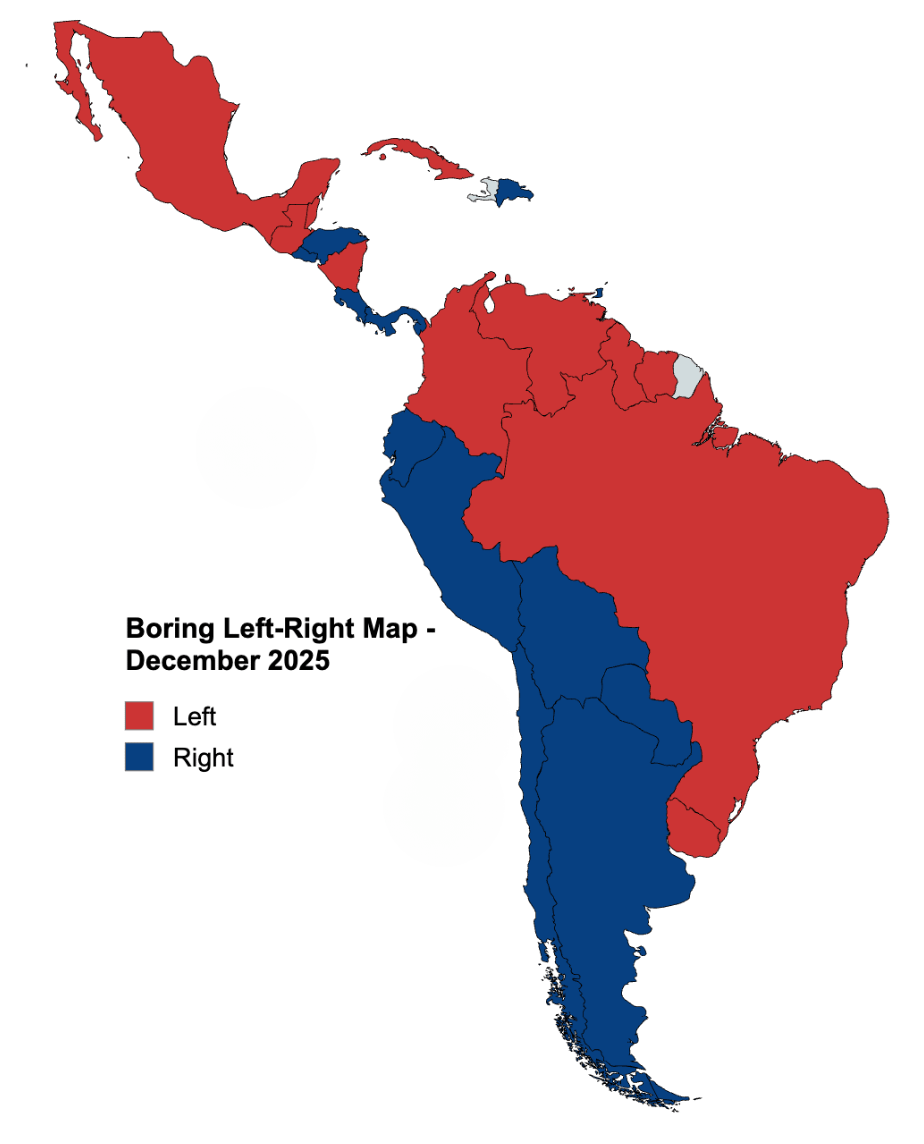
In his Nobel Prize speech, Gabriel García Márquez said, about the perceptions of Latin America, “The interpretation of our reality through patterns not our own, serves only to make us ever more unknown, ever less free, ever more solitary.” The quote alludes to the troubles of understanding, from a European perspective, a region with a history and social fabric so distinct from the European one. When it comes to politics, which, perhaps more than any other sphere, brings those differences into sharp relief, every election cycle across Latin America seems to revive the narrative that it swings like a pendulum, from the left to the right, and back again. The rise of the Pink Tide in the early 2000s, the return of conservative governments across several countries during the mid-to-late 2010s, and the recent victories of progressive governments have all reinforced the image of a region marked by cyclical ideological change.
Indeed, the pendulum is an appealing metaphor in simplifying a politically diverse and complex region into an easily understandable story. As such, it does accurately portray Latin American politics…to an extent. As Rossana Castiglioni, Full Professor of Political Science at Universidad Diego Portales and Co-Editor of the Journal of Politics in Latin America, explains, “It is an empirical, observable fact that there is a pendular movement in electoral outcomes across Latin America, but the explanation for that movement is not simply the traditional left-right divide. Classifying parties as right or left-wing to begin with should be done according to the policies they pursue, and the kind of connection they establish with voters – if it’s programmatic or clientelist, for example – matters. At the same time, understanding electoral dynamics requires looking beyond parties to the broader social, institutional and legal factors that are reshaping democratic politics across the region.”
Moreover, the perceived division between left and right is also not as straight-forward as a pendulum suggests. María Gabriela Palacio, Assistant Professor of Development Studies at Leiden University, says “A lot of the elections, like the ones in Colombia, Bolivia and Peru, were very tight. In some cases the difference was so small it was barely statistically significant. That means the electorate is not fully embracing the right; there is still deep polarisation and debate.” It seems that today’s political landscape and in turn elections are shaped by more than ideological shifts alone. Economic insecurity, public safety, digital technologies, fragmented political systems and renewed geopolitical competition increasingly explain electoral outcomes better than the traditional left-right divide.
Given the complexities of electoral choices and political tides, it seems that Latin America is not simply swinging from left to right; or, better yet, that is a partial description of the political landscape there. What is, then, the whole truth? How can we truly understand the right and left-wing divide in Latin America?
A useful (but incomplete?) metaphor
Nonetheless, the pendulum metaphor emerged for a reason. Following the debt crises and market-oriented reforms of the 1980s and 1990s, a wave of left-wing governments came to power across much of the region. Rising commodity prices enabled many of these governments to expand social programmes and reduce poverty. As economic growth slowed, corruption scandals multiplied and public dissatisfaction increased, conservative governments gained ground in countries such as Argentina, Brazil and Chile. More recently, progressive leaders have once again won elections across the region, seemingly confirming another swing of the pendulum.
But this neat sequence of events is only part of the story. Vinícius Vieira, a Research Associate at the University of São Paulo and an Associate Professor in Economics and International Relations at the Fundação Armando Alvares Penteado (FAAP), explains that “democratic alternation is hardly unique to Latin America. Governments lose elections, opposition parties win, and voters regularly punish incumbents for poor performance. Similar patterns can be observed across Europe, where traditional parties have also struggled to maintain long-term electoral dominance. Rather than demonstrating an exceptional Latin American tendency toward ideological volatility, electoral alternation is a feature of democracies.”
More importantly, however, Vieira suggests that “political parties may be an altogether inadequate unit of political analysis in the Latin American context.” Unlike many European democracies, several Latin American countries have fragmented and fluid party systems in which political parties frequently reorganise, merge, or shift ideological positions. Looking only at parties can therefore produce a misleading picture of political change. “Instead, broader political movements such as Bolsonarismo in Brazil often provide a better lens through which to understand political competition and why people vote the way they do.”
Castiglioni similarly argues that “Though political parties can remain an important object of analysis, they can no longer be understood through ideological labels alone, nor be used as the sole explanatory factor to look at politics. More important is to have social policies as key to any analysis. In some countries, party competition remains largely programmatic, with voters rewarding or punishing governments according to whether they fulfil their electoral promises. In others, clientelistic relationships continue to play a much larger role, meaning that ideological programmes matter less than personalised networks of political exchange. These differences make it increasingly difficult to interpret Latin American politics through a single left-right framework.”
The problem, then, is not that the left-right divide has disappeared, but that it no longer maps onto policies and political competition as neatly as it once did. According to Castiglioni, “Conditional cash transfer programmes like Bolsa Família are sometimes inaccurately attributed to the left, but they actually emerged under centre-right and right-wing governments. The right has never had a problem with reducing extreme poverty; its disagreement has been about redistribution and the expansion of public services. Giving people money is simple, inexpensive and politically visible, whereas expanding healthcare or education is a very different kind of welfare policy.”
Palacio indeed agrees that “conventional left and right categories do not always map neatly onto actual policy choices in Latin America, with conservative administrations expanding social assistance programmes while left-wing governments embracing fiscal restraint or tougher security policies. The political landscape has become more pragmatic and contradictory than a simple left-right taxonomy suggests.”
If the scenario suggests that ideology no longer explains these outcomes, what does? That will be explained in part two of this article, drawing on the insights of the same experts we talked to above. You can click here to read it.