

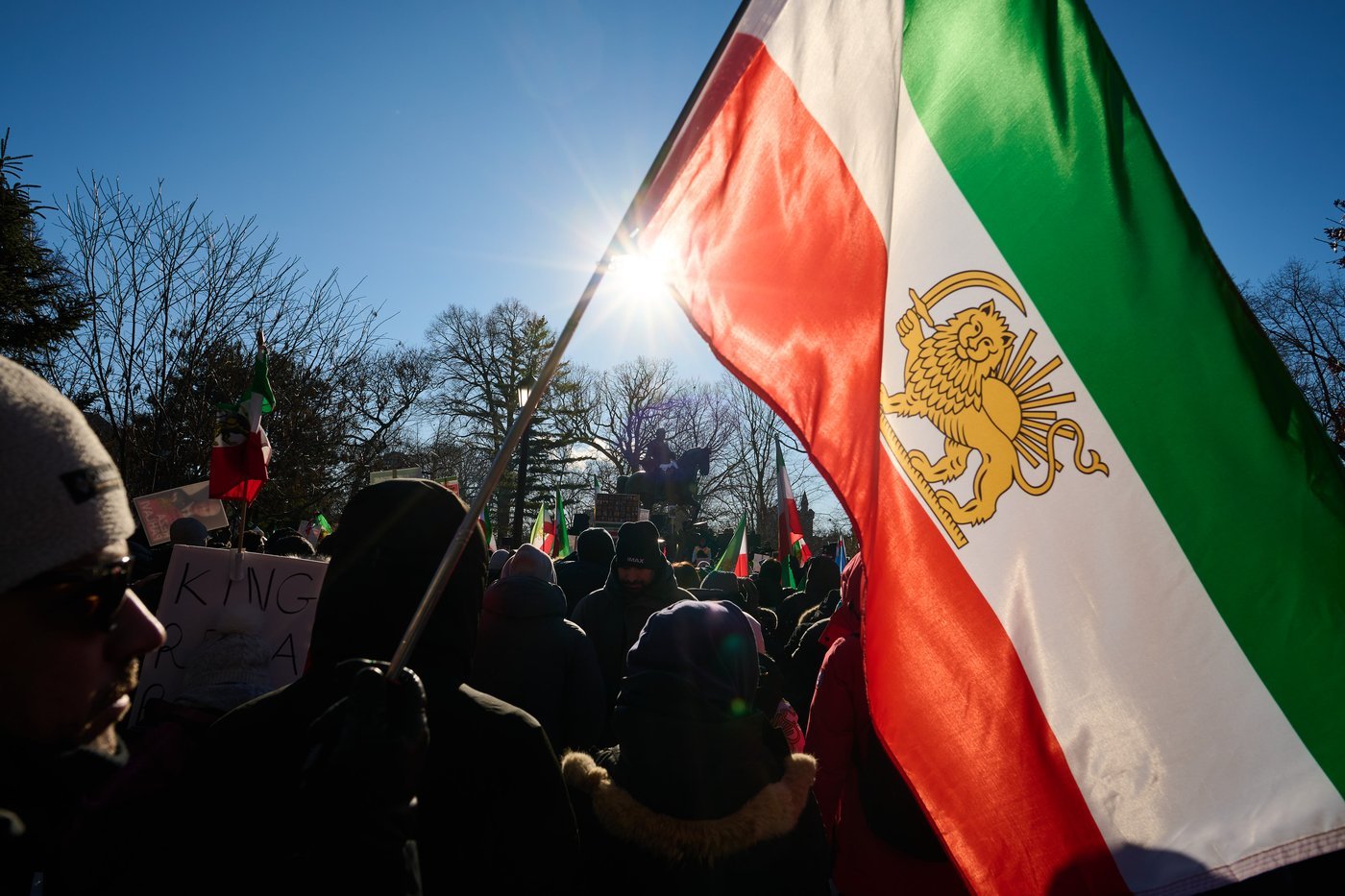
Among Iranian intellectuals, the verdict has crystallised that not its tyrannical rulers, but the spirit of Iran as a civilisation won the war against the Epic Fury of world’s Superpower. In those circles, the Simorḡ, Persian mythical eagle symbolising endurance, is invoked not as allegory but as prophecy. Today, the discourse is not about being but becoming. It is to transcend that victory into something more. In Niccolò Machiavelli’s words it is as a skilful archer ought to aim “well above” the “destined mark”. The destined mark is lasting international peace and sincere national reconciliation. The aim above it, is to become a global power. History teaches us that once Iran imposes its civilisational genius upon its regime, its destiny will be singular. That is to emerge as the twenty-first century’s consequential hinge power—the pivot between a post-hegemonic West, a rising Global East, and an ascending Global South. And to that end, it needs our help!
Iran is an idea
Iran is among the few civilisations on earth to have preserved its defining idea across empires, invasions, revolutions, and prolonged wars. Over two and a half millennia, empires fell into historical darkness. Persia bore light. Because its Geist, as Hegel argued, illuminates differences rather than destroying it.
Iran survives, because it adapts. It endures, because it remembers. It inspires, because it does not merely conquer history—it constitutes it. In times, as in the past half century, she burns in her own flames, to rise from her own ashes—yet never dies.
From its origins as the ancient world’s largest empire—the first order to govern dozens of nations under a single sovereignty—Iran has carried one identity above all: to inspire. Its spiritual message and ancient model of governance have illuminated history. The founders of the American democracy drew from that light. Every Iranian sovereign remembered for greatness, Shah or Sheikh, has obeyed the same civilisational imperative: a destiny to serve humanity with its Spirit.
The unfolding global disorder, in search of stability, needs the spirit of Iran. And the critics who see in Iran merely a regime, not the idea, suffer from historical myopia.
Power in our era
In our era of interdependence, power crowns neither endurance alone, nor arms and wealth, but those who write the world’s terms of engagement and order. The unfolding strategic reality has one name — Iran, a hinge power pivoting between global players, ready to craft a new global order.
So, engage Iran to co-write the new world order.
The table disciplines its regime along a path of sincere national reconciliation — the condition of its own survival. Its outcome? A nation-state under the rule of law, the long struggle of five generations of Iranians to form their destiny. The compass is there: half a century of European integration after two world wars. Even containment as a tactical policy will lead, in time, to coercion and war.
Tactical gains against Iran’s destiny—whether from within, by the Islamic revolution’s own constraints, or from without, by the imperial legacies of Britain, France and America—have strategically failed. From without, no superpower succeeds in dictating its terms. From within, no Iranian sovereign can project power abroad on thin legitimacy at home. The systemic institutional repression of a few, on so many for so long has extinguished the fire of Islamic republic’s legitimacy in an irreversible way. Indeed, as The Economist covered it more than a decade ago: “The revolution is over.”
Therefore, only as custodians of a civilisational state, rather than a revolutionary cause, can legitimacy be thickened. Eventually this truth and the spirit of Iran will impose its light upon its new rulers. Those rulers who defied that truth drank the chalice of poison or were buried under rubbles. Ali Khamenei’s fate bears that out.
The absurdity of War
War is politics in motion. In asymmetric conflicts, it unfolds absurd outcomes in favour of the weak. America has a track record of strengthening the very foe it sought to crush. What was meant to break Tehran has done the opposite. It has revealed Iran’s amazing grip on global shipping and world economy. Two decades ago, Bush’s Axis of Evil speech demonising Iran energised the Axis of Resistance. Five decades ago, Arab backing for Saddam’s war energised Shia minorities across the region against those Arabs. Today, where Washington once imagined regime change and threatened with bombing Iran to “stone-age”, the superpower now begs for status quo ante a reset through negotiations it cannot conclude. With success Tehran project power from Persian Gulf to the Mediterranean coast. Israel under the pressure of Washington accepts a ceasefire to protect Iran’s Axis of Resistance.
The lesson is plain: the absurdity of war has unfolded new realities that will influence the regional security architecture.
Iran as a Hinge Power
Tehran has two hinge-power aims. Hormuz sovereignty on Iranian terms, and obstruction of American redeployment and Israeli influence among Kurdish separatists in western Iran. Washington wants the pre-war order. Tehran will resist. In its calculus, time and escalation favour Iran.
Tehran’s Fujairah strikes were not isolated provocations but strategic escalations serving Beijing. Again, Iran sets the terms. Their target: IMEC, the India-Europe corridor through the UAE and Israel, bypassing Hormuz, Bab el-Mandeb, and Suez. The Abu Dhabi nuclear-plant drone strike aimed to hammer the emirate’s resolve.
Yet the regional dimension constitutes only part of a larger grand strategy emerging in Tehran. Iranian policymakers increasingly seek to position the country as a pivotal hinge power within an evolving multipolar international order—bridging the Eastern bloc of China to the Western axis of the United States and Europe. The projection of power through strategic control over critical global chokepoints is effective.
Yet the regional dimension is only part of Tehran’s grand strategy. Iran seeks a role in a multipolar order, bridging China’s Eastern bloc to the Transatlantic Western axis. A hinge-power that bridges the East to the West.
Iran’s instrument is escalation dominance over global shipping, and the US proves it by the effort it must expend to contain it.
Marco Rubio’s post‑ceasefire briefing set the White House line: “no country can claim an international shipping lane.” Yet the claim outruns the balance of power it presumes. Two months earlier, Iran’s new supreme leader had already urged using “blocking the Strait of Hormuz”, because the U.S. is “particularly vulnerable”. The implication is now plain: the world’s naval superpower has not constrained Iran’s rules of engagement over Hormuz. Each day this holds, US supremacy degrades before allies and adversaries.
The American priority is no longer the obliteration of Iran’s nuclear and missile capabilities, but the preservation of maritime supremacy. This shift is historic. For more than seven decades, particularly since the decline of the British Empire, American hegemony has rested on maritime dominance, with economic expansion through the dollar, military projection across some thousand overseas bases in roughly eighty countries, and deterrence all grounded in control of strategic sea lanes.
The escalation in Hormuz, despite fragile ceasefires and amorphous negotiations, marks a microcosm of a geopolitical contest over the future architecture of global maritime order, with Iran as the southern front of China and its allies vis‑à‑vis the United States and its transatlantic partners. This explains the warning by Trump’s Secretary of State.
Iran extends beyond the region, turning control of two critical chokepoints into structural power that sanctions cannot neutralise, with escalation dominance over global supply chains. Western diplomacy has reinforced that leverage: France concedes Hormuz can only reopen “in concert with Iran,” while German public admissions of American “humiliation” and UN maritime engagement further entrench Tehran’s position. The result is a shift in deterrence, not a nuclear WMD, but a “weapon of mass disruption” grounded in Iran’s capacity to unsettle global trade and maritime order.
Consequently, Washington’s objectives have shifted from military decimation of Tehran to global economic normalisation. The US strives to go back in time, as Iran seeks to go back to the future.
Yet, back to the future, Tehran’s emergence as an international power depends on legitimacy at home. Daily executions and relentless inflation will not restore it. Strategic international engagement must by-design motivate the regime into national reconciliation of any credible role it seeks to claim.
The way forward for national reconciliation
It is evident that Tehran’s new rulers grasp the constraint: with thin legitimacy, cast by the bloodiest mass killing of civilians in the nation’s history in January 2026 and entrenched corruption, they cannot convert post‑war leverage into durable power. Nor can they resolve the country’s central national security risk, economic malaise, the driver of repeated uprisings over the past decade, most violently five months ago. A drastic change from reign of Terror to national reconciliation.
State repression erodes the human capital required for great‑power ambition. Iran’s ninety‑two million people, more than three‑quarters under forty, are increasingly detached from the ideology of 1979. A society marked by generational alienation cannot sustain an ambitious civilisational project imposed by coercion.
Iran’s rise demands more than chokepoints or deterrence; it demands legitimacy. Isolation and permanent confrontation expose its limits. To become a durable pivot in a multipolar order, Iran must secure peace abroad and reconcile at home.
The choices are stark. They need courage! the task is not easy because the regime and its opposition have put the own interests over the unity of Iranians. This is the time to say National Reconciliation is the unity of “children of war” who defended the territorial integrity of the country and those brave children who went to the streets demanding liberty. Leaders should be pressured to accept that Iran should be above petty political interests and gains.
In the International arena, Transatlantic Alliances can play a positive role. They can invite Iran to the table and bind it to reform or contain it and drift towards coercion and war. History offers the model, Europe’s post‑war integration. Iran’s future turns on the same principle: power anchored in legitimacy, or power that fails.
For Tehran, to marry imperial ambition with Islamic fervour is to invite collision, not only with the United States but with a world, China included, that prizes order over upheaval; such a pursuit cannot endure. The answer lies in our proposition.
For Iranians, the task is to awaken the deeper spirit of Iran, so that its civilisational genius may at last fall upon the state and cast light into the darkness the regime has made of the nation. This is Iran’s historical moment, to rise from its ashes and emerge as one of the twenty-first century’s consequential powers.♦