

From Homer’s Iliad and Virgil’s Aeneid to Cold War radio broadcasts, war has never been confined to the battlefield; it has always required a narrative. City-states before and nations today do not fight over territory, airspace, or sea lanes alone. They fight over meaning: who is the aggressor, who is the victim, what makes violence legitimate, and what victory is supposed to achieve. In ancient times, war was transformed into epic and myth; in the twentieth century, it travelled through radio, music, cinema, and television, and was alchemised into ideology, culture, and mass persuasion. In the digital age, war is also fought online through memes, AI-generated videos, and algorithmic manipulation. As Paul van Hooft, research leader at RAND Europe, notes “shaping the story has always been central to war, from Churchill to Roosevelt’s Fireside chats. The digital battlefield is therefore not a break with the past, but an acceleration of a much older relationship between war, communication, and political legitimacy.”
The Iran war, like many conflicts before it, belongs to this long history. But it also marks a new threshold in modern warfare, one where access to effective propaganda dissemination has never been easier or faster. As Dr. Thompson, lecturer in the American Studies department at UvA, explains, “we have entered an era when the ability to engage in strategic communications has been democratized by tools such as social media.”
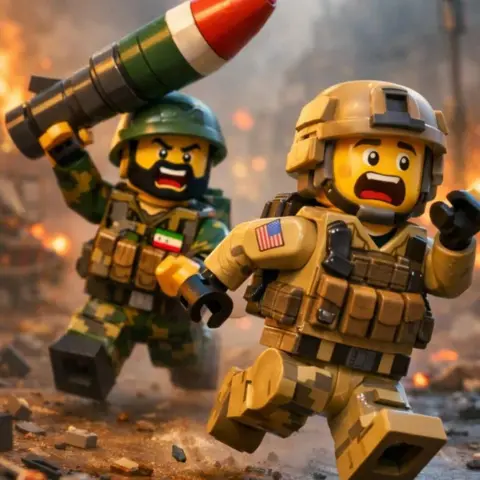
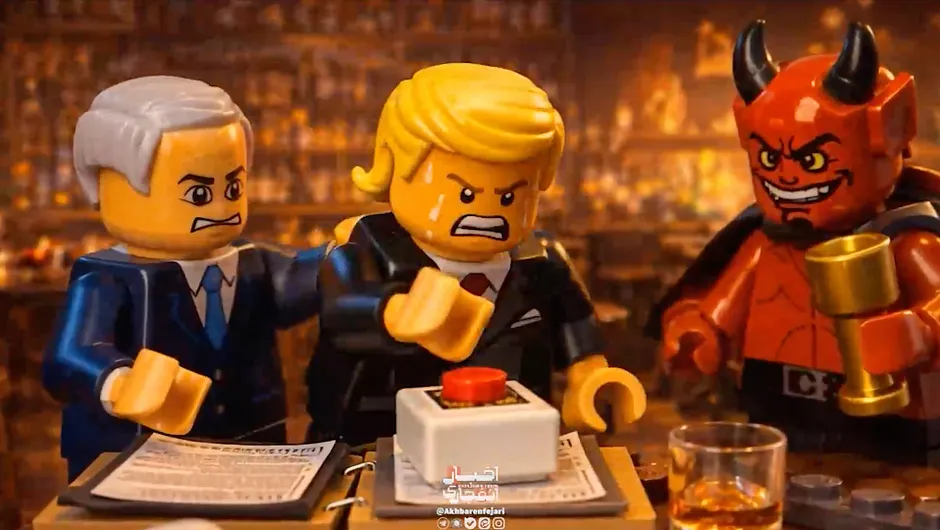
The conflict is being fought through conventional means such as missiles, drones, cyber operations, naval pressure, and economic disruption. But it is also being fought through images, tweets, targeted disinformation, and psychological warfare. The Iranian government and pro-Iranian actors have used generative AI to produce memes and LEGO-style videos to mock U.S. and Israeli leaders, exploit anti-war sentiment, and present Iran as the defiant underdog against a more powerful aggressor. While these videos may appear unserious and inconsequential because of their satirical nature, they have proven to be remarkably effective. One could argue that it is precisely their unseriousness that makes them strategically efficient: they spread quickly, reduce complex topics into easy-to-digest content, and lower the audience’s instinctive defences. The circulation of these videos suggests that this new wartime meme strategy is a more agile and culturally fluent form of propaganda than Tehran’s older and more rigid messaging style.
This article argues that Iran’s memetic warfare should be understood as an extension of its broader asymmetric approach. From a hard-power standpoint, Iran cannot match the United States; therefore, it has to compete through other disruptive tools, namely drones, proxies, maritime pressure, and now AI-enabled “slopaganda,” which are low-cost, scalable, difficult to intercept, and designed to overwhelm even the most sophisticated systems of defence. While asymmetric warfare is not new, what makes this war significant is not that propaganda or AI are entirely new, but that they are increasingly integrated into the same multi-domain battlefield as drones, cyber operations, maritime pressure, and kinetic force. In today’s information domain, an actor does not need to fully convince its audience. It only needs to flood the space with enough ridicule, doubt, and moral ambiguity to make the adversary harder to understand, defend, and trust.
Iran’s Asymmetric Logic: Competing Without Dominating
Tehran’s strategic choices are shaped by a structural imbalance: Iran cannot defeat the United States and Israel in conventional military terms. Washington and Tel Aviv retain overwhelming advantages in airpower, intelligence, missile defence, precision strike capabilities, and alliance networks. Iran therefore avoids competing symmetrically and shifts the conflict into domains where disruption, ambiguity, and saturation can impose disproportionate costs.
Asymmetric warfare refers to the strategic use of indirect, lower-cost, and often deniable instruments by a conventionally weaker actor to offset an adversary’s military superiority. Rather than seeking battlefield domination, it exploits political, psychological, operational, or informational vulnerabilities through cheaper and more flexible tools. In Iran’s case, this logic has long shaped its use of drones, missiles, proxies, cyber operations, maritime pressure, and calibrated escalation. The objective is not to overpower the United States, but rather to weaken its credibility and perceived infallibility. Iran does not necessarily need to win the war; it only needs to outlast the current operations and raise the cost of action for the U.S. This is why Iran’s asymmetric toolkit should be understood as a system rather than a collection of isolated tactics. Drones create military pressure and weaken the U.S. security umbrella in the region; proxies expand the battlefield geographically and politically, forcing the enemy to disperse energy across multiple fronts; cyber operations target infrastructure, communication, and trust; maritime pressure threatens trade and energy flows and disrupts global economic stability. Finally, online propaganda shapes how all these actions are perceived domestically and abroad. When combined, these tools force the U.S. and its allies to respond on multiple fronts at once.
In this multi-domain pressure system, information warfare becomes a psychological extension of asymmetry. Once Iran’s strategy is understood as cumulative disruption, this level of online propaganda stops looking like secondary “online noise.” Memes and AI-generated “LEGO” videos help Iran and pro-Iranian actors shape the narrative. They mock the current administration and Israel’s government, but they also frame the war as illegal, reckless, and hypocritical. In doing so, they amplify anti-war sentiment and galvanise opposition at the international level. From a narrative perspective, they reposition Iran within the rhetorical topos of the underdog: a nation under siege, resisting a far stronger aggressor in the name of freedom and self-determination.
The intended audience is the public, but the target of the attack is political authority. These videos seek to erode trust in the administration, weaken the legitimacy of military action, and separate ordinary citizens from the leaders acting in their name. In the specific case of the United States, the objective is even more profound and finds its roots in the 1978-1979 revolution: to delegitimise a national myth 250 years in the making, that of the “shining city upon a hill,” the self-appointed defender of freedom, democracy, liberty, and peace. Thus, memetic warfare is not separate from other forms of Iran’s asymmetric strategy.
From Drones to Memes
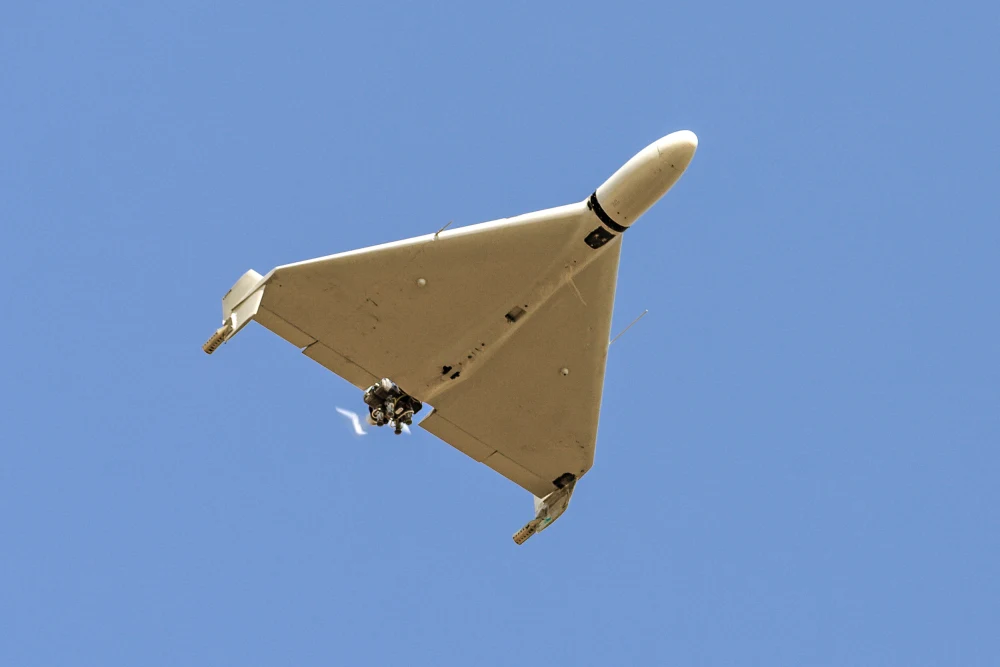
From an efficiency standpoint, drones and memes share many similarities. On the battlefield, drones are useful because they are low-cost, scalable, easy to produce, difficult to fully intercept, and able to force expensive defence responses. Iranian Shahed drones are estimated to cost between twenty and fifty thousand dollars, while a Patriot interceptor used to stop them can cost around four million dollars. Their value is not limited to whether they hit their target or how cheap they are; it is also found in what they force the opponent to do. A drone does not need to reach its target to impose costs; it can also exhaust attention, resources, and defensive capacity.
Similarly, memes and AI videos follow the same asymmetric strategy in the information space: they are extremely cheap to produce, easy to adapt, fast to distribute, and impossible to contain once released into the digital ecosystem. In the case of the LEGO videos, their power lies less in technological sophistication and more in their cultural “intimacy.” The LEGO videos work so well because they speak a language familiar to Western audiences. They borrow from rap, internet humour, nostalgia, and American pop culture. By embedding political messaging within familiar cultural forms, such content lowers the audience’s instinctive defences and makes propaganda harder to recognise as propaganda. Much like one drone cannot win a war but swarms of them can overwhelm attention and resources, waves of memes can flood the online space, muddy the waters, and weaken trust in government. The goal is not domination, but saturation.
There are multiple key aspects that make memes and LEGO videos so perniciously effective in their simplicity:
- From a rhetorical standpoint, they compress complex military and historical facts into easy-to-digest entertainment.
- They make audiences feel before they can even analyse the content. A meme or AI video can instantly frame one side as aggressor, victim, bully, underdog, tyrant, and so on.
- They are produced quickly and spread even faster. Unlike government channels that need to verify, coordinate, provide proof, and speak to different audiences, memes are straightforward and do not need to support their argument. Their objective is not to convince everyone, but to create doubt and distrust.
- They reward platform logic: humour, rage-bait, ridicule, irony, and virtue signalling travel well online.
What is particularly relevant about Iran’s strategy with these AI-generated videos is the clear distinction they draw between the American people and the current administration. Ordinary Americans, with a focus on minorities, are portrayed less as enemies and more as victims: citizens oppressed and sacrificed by their government.
Narratively and strategically, this is remarkably sophisticated. It inverts a rhetorical framework previously employed by the United States against the Iranian regime itself: the distinction between a hostile and corrupt government and a population yearning to be free. Thus, Iran turns the language of democratic legitimacy and oppression back against Washington, recasting itself not just as the adversary, but as an actor seemingly capable of empathising with the American public against its ruling elites. This framing is effective precisely because it attaches itself to real grievances and existing distrust, given the multiple cases of corruption of this administration.
Kinetic Power and Its Limits as Narrative Vulnerability
Tactical success is not synonymous with strategic success. A strike can eliminate targets, decapitate leadership, disrupt infrastructure, or impose economic pain, but it can still fail to produce the desired political outcome. This distinction matters because, historically, American power did not rest solely on its military might, but on the perception of the United States as a “benevolent empire” whose stewardship combined strength and persuasion, diplomacy and ideological legitimacy. Much of Washington’s postwar influence derived not from coercion alone, but also from the ability to convince allies and even adversaries that American power abroad served a broader liberal order.
Trump 2.0 has proven to prefer a more military-driven approach to foreign affairs and diplomatic disputes. In Iran, this distinction between tactical and strategic success is crucial. Operation “Epic Fury” succeeded in killing senior regime figures, yet the regime itself endures and may now be even more dominated by hardliners than before. This is where tactical success becomes short-lived, risky, and narratively vulnerable: if U.S. pressure fails to produce compliance, Tehran can frame endurance itself as victory.
Narrative Failure Matters Today More Than Ever
Narrative defeat is not just reputational; it can affect alliance cohesion, domestic support, deterrence, and escalation control. Van Hooft’s caution is important here: “A militarily superior actor can lose narrative ground. However, a decisive material victory is still victory, although victories on the battlefield do not necessarily translate into a strategic or political victory.”
If Washington cannot explain the war clearly, it loses political room for manoeuvre, the moral high ground, and its reputation as a security guarantor in the region.
In addition, narrative failure can make military escalation appear like the only way to regain control. As Dr. Thompson argues, “the Trump administration’s problem was not only military or diplomatic, but narrative; it failed to provide a convincing explanation for launching the war or for what a successful endgame would look like.” That gap matters because memetic warfare thrives where official narratives are vague and contradictory.
Conclusion
Iran’s memetic warfare does not show that Tehran is stronger than the U.S. or Israel. It does highlight how weaker actors can still compete by shifting conflict into domains where conventional superiority is less decisive. Propaganda is not new, but the form and speed of this specific kind of “slopaganda” are. As Van Hooft reminds us “the story has always mattered, but material victory still matters too. The point is not that memes decide wars on their own, but that they increasingly shape the political meaning of military action.” Recognising the effectiveness of this propaganda does not mean endorsing it; even when it exploits real weaknesses and highlights injustices, it remains a tool of an authoritarian regime. For Europe, and the democratic world at large, this matters because information warfare does not stop at American borders; it shapes public opinion worldwide and is already targeting other democratic countries.
The next question is historical as much as strategic: how did the West, once so effective at using culture and media as instruments of power, reach a point where its own cultural grammar and tools could be turned against it? Part two will explore that reversal.