

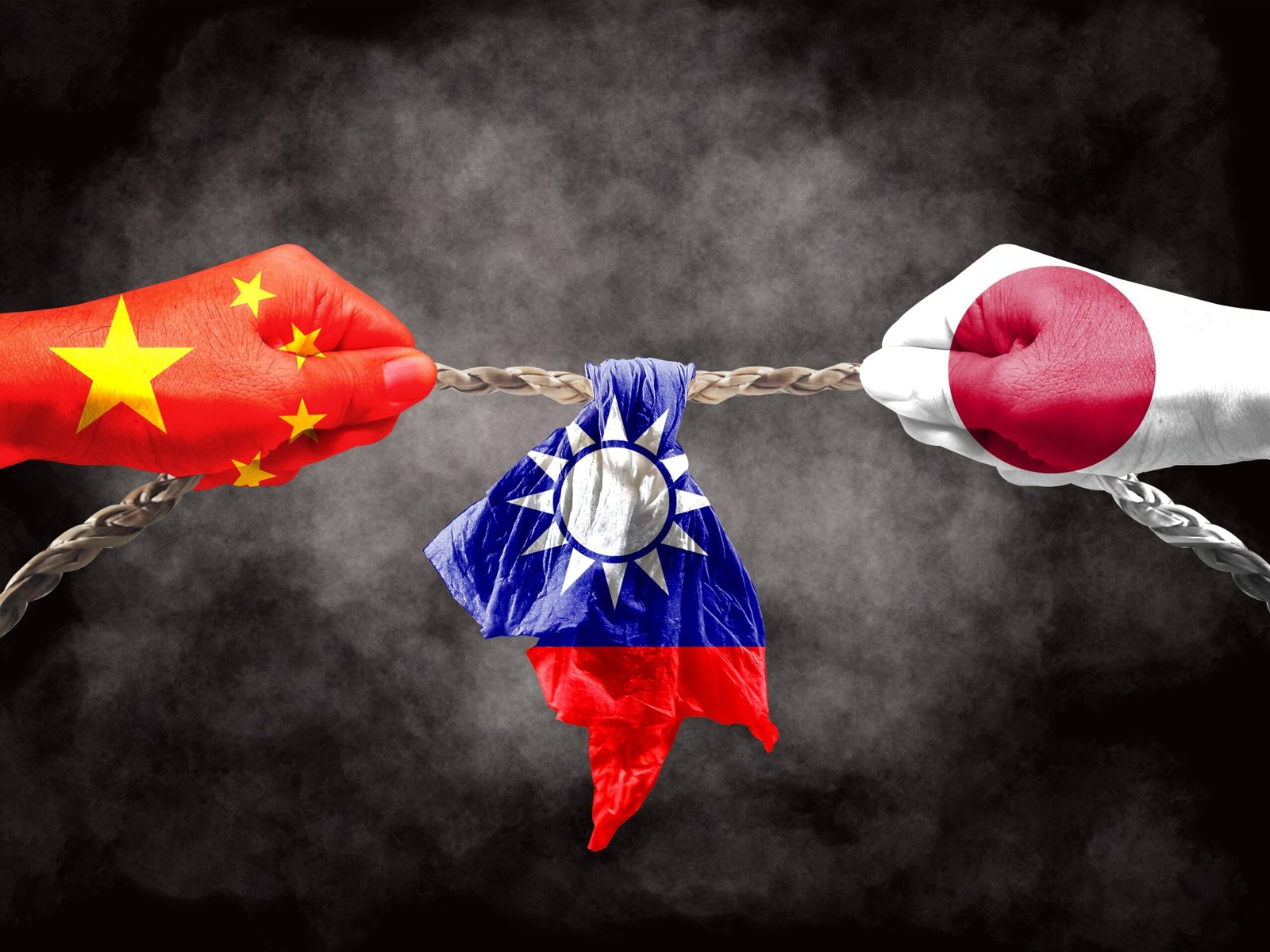
On November 7, 2025, Prime Minister Sanae Takaichi responded to a question in the Japanese parliament by stating that Chinese military force against Taiwan could lead to a “survival-threatening situation” for Japan. While this statement is in line with the law of the Act on the Peace and Independence of Japan and Maintenance of the Security of the Nation and the People in Armed Attack Situations, this led to immediate backlash from China, with Foreign Minister Wang Yi clarifying that Japan has “crossed a red line” with Takaichi’s “shocking” response, which sent out the wrong signals.
This situation involves not only China and Japan but also Taiwan, due to its history with both countries and its geostrategic position, the US, being Japan’s most important ally, and other allies siding with either China or the US.
Many papers have proposed that the current conflict between Japan and China is approaching a new Cold War, due to worsening ties, such as Japan being expected to downgrade its description of ties with China from “one of its most important” in its diplomatic bluebook 2026 to a “strategic” and “mutually beneficial” neighbour. Moreover, Japan’s increase in defence spending, economic coercion, and Japan’s decreased dependence on China, as well as the conflict over Taiwan, resemble Cold War-like tensions. Therefore, this poses the question:
To what extent are the increasing tensions between China and Japan resembling a Cold War?
The Taiwan dilemma
The conflict between China and Japan surrounding Taiwan dates back to Japan’s historical “original sin”, as Japan, according to Wang Yi, “stole” the island from China in 1895. Therefore, he claims that it is Japan’s international obligation as a defeated nation as of 1945 to continue to abide by its pacifism.
Furthermore, the first island Chain, connecting Japan, Taiwan, Indonesia and portions of the Philippines, has geostrategic importance for both the US and China, as it serves as a US defensive barrier against Chinese naval expansion, whilst for China, breaking through it would open further access to the Pacific Ocean and important trade routes.
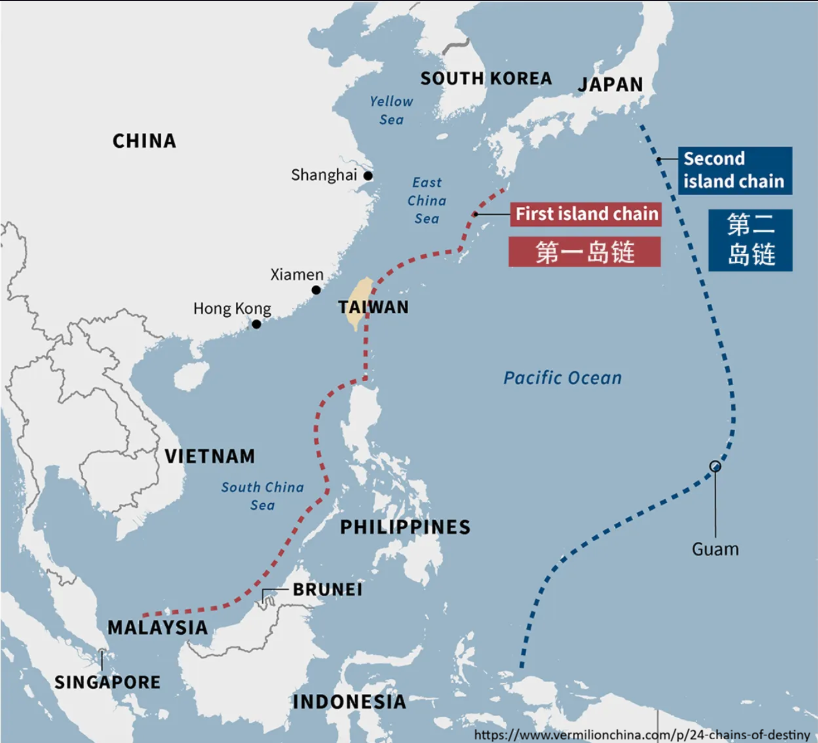
Due to Taiwan’s geostrategic position and considering its interlinked history with China, Xi Jinping has talked about reunifying with the island under the One China policy. There have been some assessments made by US intelligence suggesting an invasion of Taiwan in 2027. However, according to more recent reports and experts, a full-scale amphibious invasion of Taiwan in 2027 would be extremely challenging and risky, especially with US intervention.
On the other hand, Casper Wits, HIG East Asia expert and lecturer at Leiden University, explained that “There is speculation that the purging of the important general Zhang Youxia was because he was more sceptical of a Taiwan invasion, therefore his reluctance clashed with Xi Jinping’s desires. (…) There are fewer people now that can tell Xi Jinping that it’s not a good idea, (…) which is a similar situation Putin was in before invading Ukraine.”
Economic ties
China is Japan‘s largest trading partner and one of the largest investment destinations for Japanese companies. Therefore, both countries mutually benefit from economic cooperation and people-to-people contact, and pursue collaboration in areas such as green technologies, as well as medical care, nursing care and healthcare, crucial to Japan’sand China´s ageing population. China’s economic coercion, including agriculture, food and beverage, such as a ban on Japanese seafood, as well as export restrictions for rare earths, has been added on top of Japan’s already struggling economy. Japan’s economy already has an extremely high debt-to-GDP ratio. Another coercive measure concerns tourism, as Chinese tourists have been warned to avoid travelling to Japan, which has been Japan’s largest customer, potentially affecting Japan’s real GDP by up to 0.5%.
All experts agree that while China and Japan’s economies are intertwined, making it difficult to decouple, Japan is striving to diversify its economy. Wits argues that Japan’s main concern is critical resources, such as rare earths. Since 2010, Japan has engaged more with other countries, especially Australia, to diversify its critical resources network. China’s economic coercion pushes Tokyo towards a middle-power coalition for more robust supply chains and less dependency on China.
Strikingly, disregarding the increasing political tensions, Japanese firms are investing heavily in high-end manufacturing and R&D within China, such as Honda’s deep partnership with a Chinese company in 2025.
Worsening political relationship
The current Sino-Japanese relationship has been characterised by cold strategic calculation, periodic economic coercion, and military incidents purposely testing each other’s resolve. Regarding the recent framing of the Sino-Japanese relationship as a new Cold War, Yun Sun, Chief of the National Security Policy Division at the National Institute for Defence Studies, says:
“I do not quite agree, primarily because China is a geoeconomic challenge globally, and a geopolitical challenge primarily in Asia at the current stage. Another distinction is that in 2026, the US and China are looking at a serious opportunity to improve their relations, and that is not quite similar to the Cold War.”
Analyst at the Mercator Institution for China Studies, Claus Soong, argues that while the mindset is Cold War-like, it remains different due to the deep Sino-Japanese economic ties. In line with the increasing tensions, Takaichi decided to raise the defence budget to around 2% GDP by the end of this fiscal year, two years ahead of schedule, demonstrating the urgency of strengthening the defence.
On the other hand, Japan has not officially declared China a direct threat in formal diplomatic documents.
“It is highly likely that we will not call out China as a threat in the coming strategic document. (…) It’s kind of a self-fulfilling prophecy: if we call China a threat, then it will probably become a real threat. (…) That will close our chances of actually negotiating with China.” – Katsuya Tsukamoto, Chief of the National Security Policy Division at the National Institute for Defence Studies
Conclusion
In light of the increasing tensions between China and Japan, Soong states that “The meeting between Xi Jinping and Donald Trump will be crucial to China and Japan’s future, as Japan’s only plan is to rely on US support, which it is currently investing in.”
Especially with Washington only supporting Japan in the face of China’s “coercion,” there are growing concerns that Beijing is successfully exploiting recent openings (Trump 2.0’s National Security Strategy of November 2025 and National Defence Strategy of January 2026). Trump reportedly urged Takaichi to de-escalate the dispute, reinforcing a narrative of a more equal US-China relationship.
Furthermore, all experts agree that there is no positive outlook for the near future of the Sino-Japanese relationship. The Cold War-like tensions will continue as Takaichi is backed by her country’s support.