

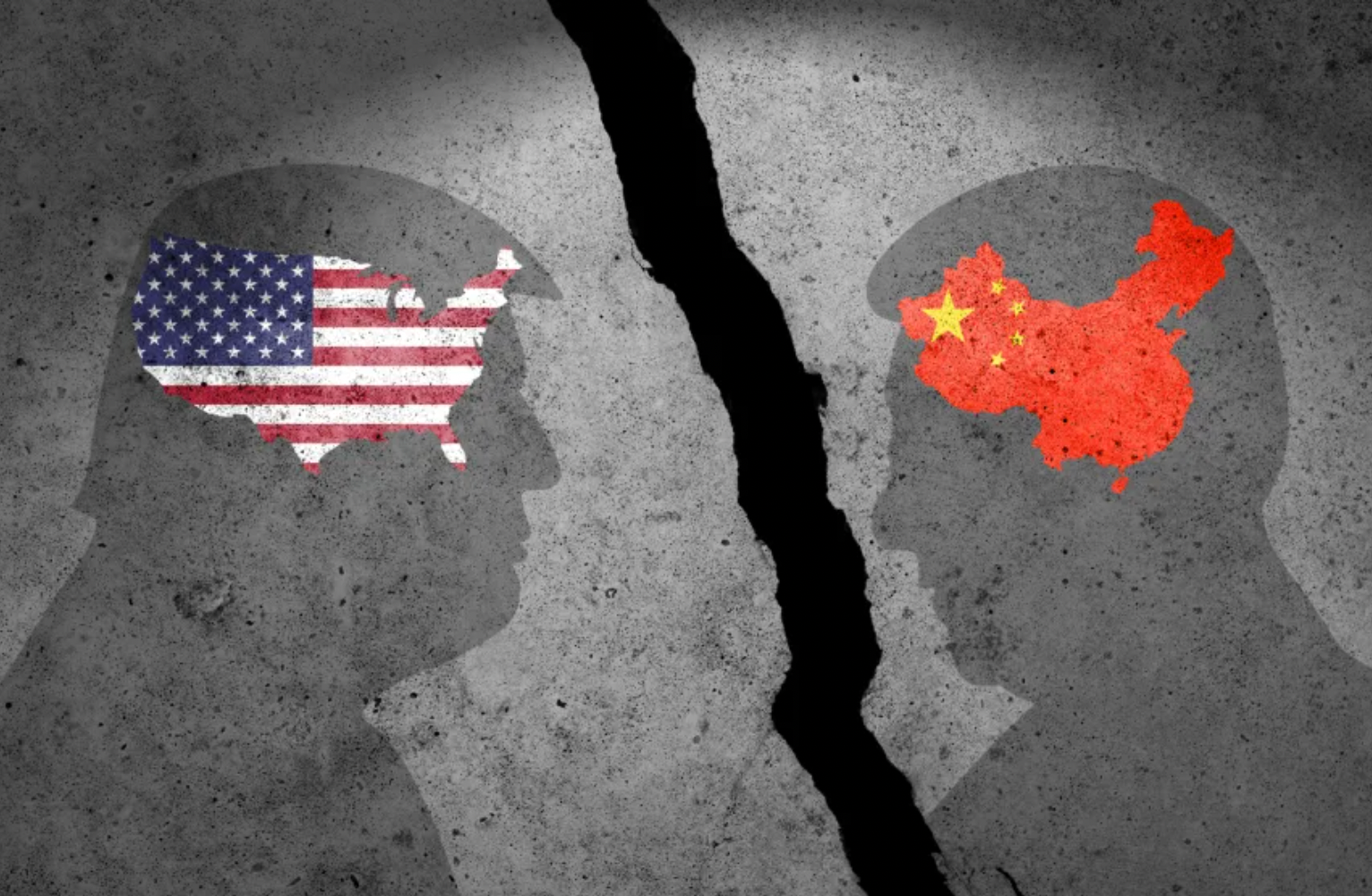
Regional Update Europe and the Mediterranean | China and the US, as great powers, may well abound in differences, but by now they are standing shoulder to shoulder in their excellence at aggressive unilateralism. The growing aggression keeps pace with the autocratic tendencies of their leaders. From government to regime; from national interest to regime preservation. Geopolitical capriciousness guaranteed. Yet a more structural cause can also be identified: the inflated state of the Chinese production model and the American consumption model.
Taken together, the American and Chinese model constitute the geo-economic configuration of the fragmenting world order. This forces multilateral democratic middle powers into a geopolitical TINA (There is no alternative): a far-reaching intensification of mutual cooperation in order to shift the geo-economic and geopolitical centre of gravity. Europe could – because of its large consumer market, capital and technological know-how – serve as the architect of this shift.
The unsustainability of the Chinese and American economic model reinforces the necessity of this. Partly as a consequence of this unsustainability, both the US and China are increasingly using their economic and military preponderance to abuse the global trading system at will, subordinating territorial integrity to self-interest and refusing to commit to effective multilateralism.
The Chinese model: industry and export
The power of the CCP is based on (economic) performance legitimacy. In its social contract with the Chinese people, the CCP guarantees employment, rising wages and “a better life for Chinese than that of their parents”. In return, the Chinese people were and are expected to sacrifice political participation. The CCP honoured these economic promises by going all-in on investment, industrialisation and export, resulting in structurally large surpluses on the trade balance.
For decades this model was extraordinarily successful. China industrialised at an unprecedented pace, reaching record highs of roughly 32% manufacturing as a share of Chinese GDP between 2006 and 2010. China also became the factory of the world – initially for basic products, but by now as a leading producer of high-end industrial goods. This development not only lifted hundreds of millions of Chinese out of poverty at breakneck speed, but also turned global geo-economic and industrial relations upside down. In 2023, China accounted for just under 30% of global industrial output.
China’s industrial expansion facilitated a substantial increase in military expenditure, which has reinforced Chinese aggression. Consider the violations of Taiwanese airspace and China’s maritime aggression in the South China Sea. In short, the industrial superpower is also asserting itself militarily and geopolitically. The recently imposed export restrictions on rare metals fit this trend.
Unsustainable, unaffordable and unreformable(?)
The CCP, however, risks becoming a victim of its own export success. The Chinese economic model is gasping for reform – due, among other things, to overcapacity, insufficient domestic consumption, rising wages, ageing, declining industrial investment and the changed geo-economic context: a service-based economy with a high degree of domestic consumption and further economic diversification beckons.
This economic transition often marks the beginning of far-reaching political reforms, even of democratisation. The CCP may well regard this as an existential threat to the continuity of its own power. That would explain why all attempts by the CCP to reform the economy have so far fallen short. To consolidate its power, the CCP seems to be opting instead for the preservation and expansion of the export model through extensive support for firms, such as wage moderation, large-scale state aid and continued currency manipulation. The sacrifice of economic growth is accepted as part of the bargain, in support of its domestic and geopolitical ambitions.
This policy may come at a price. China’s total debt burden – private and public combined – is increasing at an unprecedented pace. According to some estimates, it has now risen to more than 300% of GDP and exceeds that of the US. Expensive as it is to massively and increasingly support loss-making industries.
The Chinese economic model is unsustainable, unaffordable and even appears unreformable. It is doubtful whether the CCP will thoroughly reform the Chinese economy. It is more likely that it will look for an alternative to economic performance-based legitimacy. The world would do well to consider itself warned.
Be that as it may, the rest of the world is now functioning as the geo-economic floodplain for the Chinese industrial export model, with a record breaking one trillion dollar trade surplus.
Petrodollar puts industry under pressure
The American economy, by contrast, has both benefited from and suffered under Chinese industrial expansion. For decades, American multinationals moved production to China, with Apple as the most eye-catching example. They took advantage of the more favourable business climate, such as laxer environmental regulations, lower wages/production costs and thus higher profits. This took place against the backdrop of China’s accession to the WTO in 2001 and economic globalisation.
On top of that, American industry seems to have suffered severely from the crushing value of the petrodollar as the world’s reserve currency. The substantially overvalued dollar priced American industry out of the world market, led to large deficits on the trade balance and ushered in decades-long deindustrialisation – from around 24% of GDP in 1970 to some 10% today. This has resulted in a ramped-up model of domestic consumption.
The dominance of the dollar has, to be sure, brought and continues to bring the US many advantages – such as higher purchasing power, more investment opportunities, high-end industries, easier attraction of foreign talent, monetary power and the export of inflation. Yet the development sketched above is geopolitically very painful, now that China is threatening American hegemony.
After all, who wins the war and the geo-economic struggle for you?
Exactly: industry.
It is in that light that American attempts at reindustrialisation must be viewed.
American attempts at reindustrialisation: escalation of aggressive unilateralism
In order to protect its industry, economic strength and geopolitical power, successive American presidents are turning to escalating unilateralism. Trump I sought to strengthen domestic industry by imposing tariffs on China. President Biden attempted to jump-start the reindustrialisation of the US with the Inflation Reduction Act (IRA), through which, via public guarantees and subsidies, hundreds of billions of dollars in private investment were unlocked. Europe may have praised the IRA’s green ambitions, but labelled it “discriminatory” for European companies and saw it as part of a global subsidy race.
Trump II, however, is breaking with Biden’s policy. At the instigation of Treasury Secretary Bessent, the US is trying to spur the reindustrialisation of the US through unilaterally imposed tariffs on friend and foe alike. A substantial escalation. The tariffs, however, will mainly produce negative effects for the American economy: inflation, falling purchasing power, industrial disruptions and less investment – not to mention the weakened position of the dollar, the scant empirical evidence for “reshoring” industry and the deteriorated relationship with allies. It will prove to be a recipe for economic problems and self-reinforcing unilateral aggression.
Inevitable industrial struggle compels geopolitical TINA
In short, the rest of the world risks being swallowed up by the struggle between these two great powers – reinforced by (the unsustainability of) their economic models. That is, incidentally, by no means exceptional in world history. After all, great powers have dominated the world (order): a historical law of sorts. As such, they appropriated the determination of other peoples’ destinies. They decided when the flute of peace gave way to the drum of war. They crushed the aspirations of sovereign nations and peoples. They dictated the terms of trade and geo-economic relations.
Now that the US and China are becoming ever more aggressive – and may even be heading towards the Thucydides Trap[1] – a break with world history is needed more than ever. Otherwise our peace, security and prosperity will fall on the altar of this unleashed industrial and geopolitical struggle, and the most unfavourable yet unavoidable sacrifice of sovereignty will be all that remains for all other countries.
For trade, AI regulation, digitalisation, product standards, cross-border production chains and infrastructure, the protection of trade routes, climate change mitigation, environmental measures, tourism and people-to-people contacts all compel countries to sacrifice sovereignty. The only question leaders worldwide must answer is: how are we going to sacrifice our sovereignty?
Unilateralism versus multilateralism
With the US and China, there are now two unilateral answers, full of aggression, on offer, which demand an unfavourable sacrifice of sovereignty from all other countries in the world. The US–EU trade deal is a telling example. Even America’s most loyal ally, Europe, does not escape the American unilateral dance, as is clear from Trump’s total disregard for Ukrainian and European security interests.
Multilateral democratic middle powers – such as Australia, Brazil, Canada, the EU, Indonesia, India, Japan, Mexico, the UK and South Korea – can either resign themselves to unilateral coercion by the US and China, or develop a more favourable alternative through far-reaching intensification of their mutual cooperation. Only in that way can the geo-economic configuration of the fragmenting world order be undone.
Assertive multilateralism by middle powers is the only antidote to aggressive unilateralism, and wrests the hegemonic illusion from the hands of China and the US – including for the eventual “winner” in the Indo-Pacific. In my view, it is also our only chance of avoiding the Thucydides Trap.
A joint stand against Trump’s tariffs, Xi’s dumping and aggressive unilateralism is a good first step. Europe holds the best cards to take the lead here. Our economy offers what other middle powers and also the Global South are craving: a large consumer market, technology and capital for investment.
[1] The ancient wisdom that states that war between a rising and established power is inevitable