

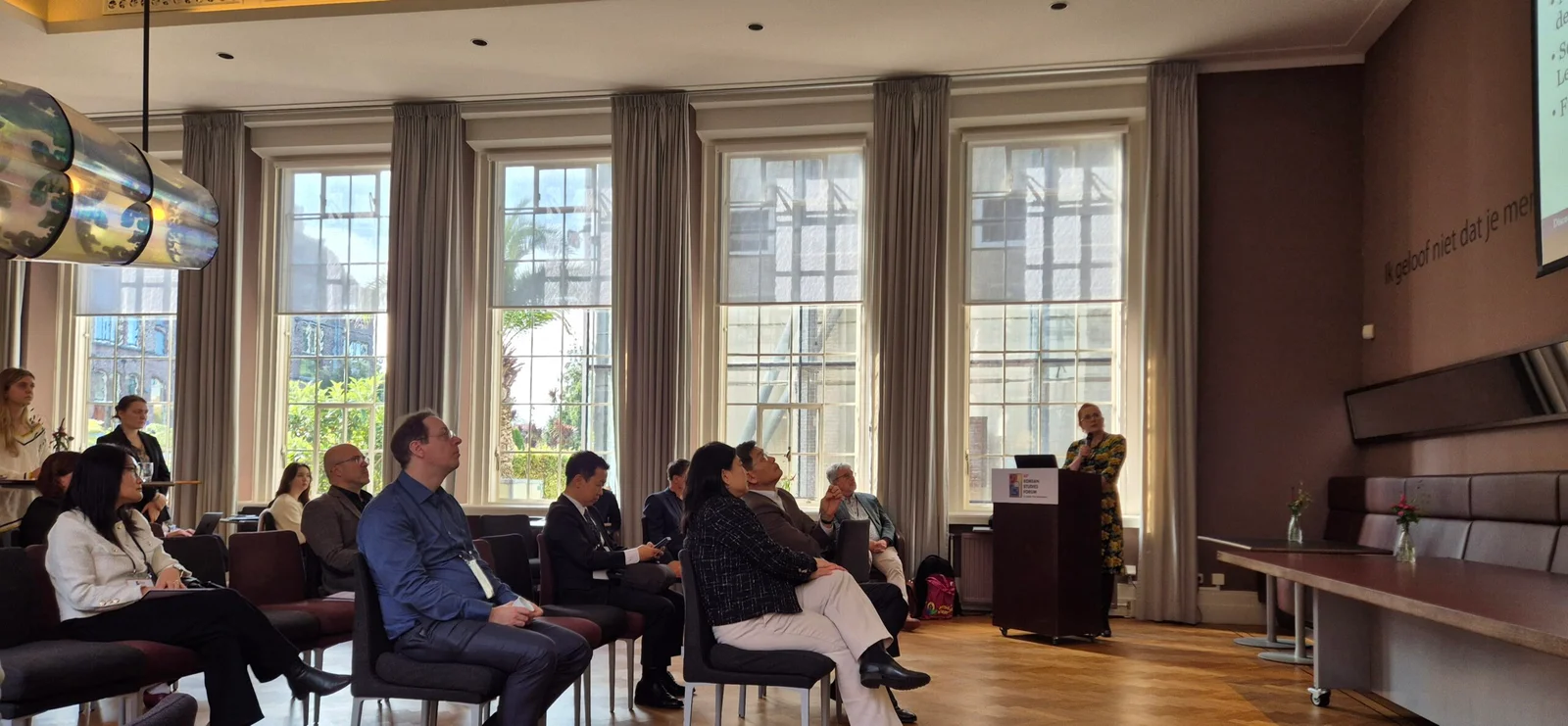
On Friday morning, 18 October, Rector Magnificus Hester Bijl and Professor Remco Breuker welcomed Gheewan Kim, President of the Korea Foundation.
They had a constructive discussion about the Korea Foundation’s support for Korean Studies. The Korea Foundation has a broad focus. Kim indicated that the foundation also supports research in technical fields, public-private partnerships and the arts. Kim noted that Leiden is the largest and most important hub for Korean Studies in Europe. Breuker responded by saying that the situation for the humanities does not look very favourable, despite the social relevance that the humanities offer.
Forum
After the meeting, Bijl and Kim opened the forum on Korean Studies that took place that day. During the forum, European and Korean experts discussed strengthening Korean Studies in Europe and forming a consortium of university libraries with Korean Studies. The forum was organised with the support of the Korea Foundation, Leiden Korea Studies and the University Library.
Conference focused on geopolitics
At this year’s Korea conference, which focuses on the latest developments in Korean Studies, there is a particular focus on the geopolitics of the Korean peninsula. Given the growing geopolitical tensions and Trump’s imminent election victory, this focus is more than understandable. After all, North and South are not only archrivals, but also mark the global divide between democracy and autocracy.
Against this backdrop, Michel Don Michaloliákos, at the request of Professor of Korean Studies Remco Breuker, outlined an outsider’s perspective on the geopolitics of Korea. The following quote from his speech sums up what a difficult task this is:
“If complexity science did not already exist, it would have been invented for South Korea. In all its (geo)political complexity, South Korea risks stumbling into the “transactional trap” out of fear of the “alignment trap”. The far-reaching transactionalism in its foreign policy prevents South Korea from establishing deep relationships and anchoring itself in a multilateral security architecture.
Its northern neighbour is its arch-enemy, but also its brother nation. A division that – to me as an outsider – seems to cut through the Korean soul and identity, and seems to burden South Korea with a latent identity crisis.
The US is indeed its most important protector, but it considers China to be the greatest threat and rival. South Korea, in turn, needs China to keep “mad man” North Korea under control. Moreover, China is South Korea’s largest trading partner. This is a difficult balancing act now that tensions between the US and China are reaching a peak.
Moreover, South Korea appears to be a geopolitical prisoner of history. Geopolitically, Japan and South Korea are condemned to each other: as democratic overseas neighbours sheltering under the American security umbrella, they see the dark clouds of aggressive and autocratic states approaching. There are few partners more suited to each other.
At least, that is what one would think.
Unfortunately, Korean traumas from the Japanese imperial era prevent rapprochement between the two countries. As a result, South Korea sometimes risks becoming a drowning man being dragged into the deep sea by the ebb of the past, with the coast in sight.
Curious about how we can contribute ideas to your organisation? Click here for more information.