
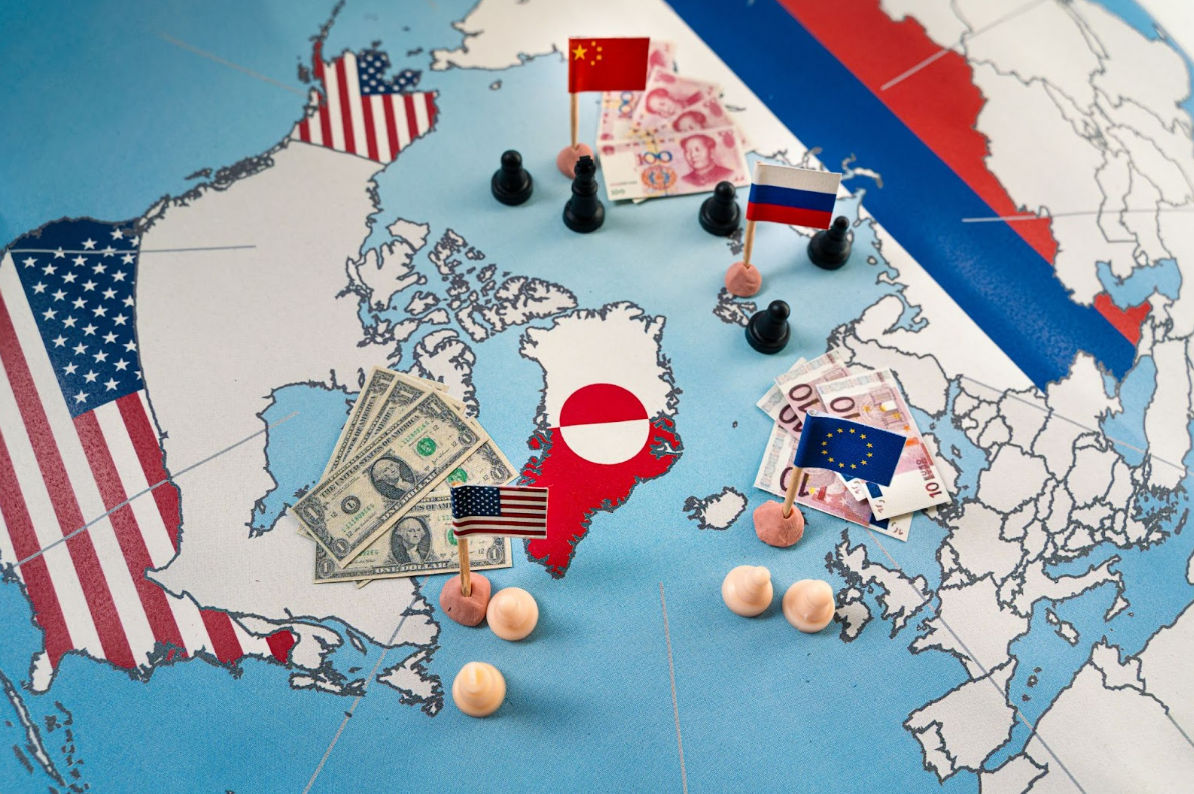
Regional Update Europe and the Mediterranean Sea |At the beginning of January, U.S. President Donald Trump once again put the stability of the transatlantic relationship under pressure. On 6 January, he escalated his rhetoric on Greenland by refusing to rule out military annexation. This came despite a trade agreement highly favorable to the United States, through which European governments had hoped to secure transatlantic stability, and in particular the American security umbrella.
Several European governments, including the Netherlands, responded with firm support for Denmark and announced a joint exploratory mission for an exercise in Greenland. Trump then threatened new import tariffs, causing the dispute to expand from geopolitics into trade.
At a meeting on 21 January in Davos, further escalation was avoided. After consultations with NATO Secretary General Mark Rutte, Trump withdrew the announced tariffs against eight EU countries and declared that he would not use military force. The agreements remained limited and contained no structural guarantees.
These events prompted reconsideration in European capitals. According to nearly a dozen European diplomats and officials quoted by the Financial Times, the existing approach toward Trump was no longer sustainable.
“It appears that the days of trying to appease Trump are over,” said a senior European official. “The approach to dealing with Trump 2.0 does not work,” a second added.
The Davos deal did little to alter that realization. Instead, it made clearer what many analysts had already been pointing out for some time. The relationship between Washington and its allies is increasingly mediated less through fixed agreements and more through coercion. Threats, the exploitation of economic and security dependencies, and asymmetry now determine the pace and direction of negotiations. Trump explained his approach in an interview with The New York Times, in which he stated that his power as commander in chief is limited only by “his own morality,” in other words: “L’ordre mondial, c’est moi.”
“Not an era of change, but a change of era”
In this light, the Greenland episode is not an incident but a symptom of an interregnum. The old order is dying, while a new one has not yet been born. In the meantime, phenomena that had long been simmering beneath the surface are becoming more visible. Power relations and opportunism are coming out into the open. The mask has come off. The central question is therefore not how this structural crisis is managed, but what it reveals about Europe’s position in an international environment without a stable frame of reference.
From this broader perspective, Alex Krijger, geopolitical adviser and lecturer in Geoeconomics at Leiden University, and Michel Don Michaloliákos, in-house Europe analyst at HIG, reflect on the situation. They place the Greenland crisis within the structural transformation of the world order and outline the strategic implications for Europe and the Netherlands, as well as for the conduct of politicians, civil servants, media, and analysts.
Krijger explicitly places the current confrontation in historical perspective. Europe, he says, “still is not truly standing on its own feet, 81 years after the end of the Second World War.” Over the past ten years, he argues, this vulnerability has repeatedly become apparent. Not because dependencies suddenly emerged, but because they only became visible once they were put under pressure.
The war in Ukraine since 2014, the coronavirus pandemic, and the energy crisis have each served as wake-up calls about European dependencies. First, these concerned industrial and medical dependence on China, then the strategic vulnerability associated with Russian gas, and now increasingly dependence on American gas exports and security. Greenland fits into this series of wake-up calls, according to Krijger. “This is not an era of change,” he says, “but a change of era.”
Stop fatalism and reactivity, and look at what is possible
Precisely because these signals are accumulating, he is critical of the reactive way in which the debate is conducted in the Netherlands. Instead of translating these developments into a strategic reorientation, analysts and columnists, he argues, remain stuck in moral outrage over Trump. “That sentiment runs so deep that it blinds us and makes us geopolitically short-sighted,” says Krijger. “If you are obsessively focused on indignation, you miss larger trends and spend time and energy on something that yields nothing.”
He also finds the opposite extreme misleading. Not moral outrage but fatalism can be just as paralyzing. Analyses that write off the transatlantic relationship as definitively lost, according to Krijger, conceal a lack of practical agency rather than strategic realism. This is ironic, given that these analysts usually call themselves “realists.”
“The transatlantic relationship is larger than the leaders of our countries,” Krijger argues. “The cultural and economic ties are enormous.” The world order is shifting, he acknowledges, but this does not imply a rupture. It does imply the need for a different attitude.
A change in mindset
Michaloliákos likewise concludes that a change in mindset is necessary. In European capitals, he says, there is deep division over how the United States should be interpreted. He distinguishes three camps: one that still sees the U.S. government as a conventional government serving national interests; one that views Trump as a regime in the making but believes the transatlantic relationship can be saved by appeasing him and adapting to his agenda; and a third group, to which he himself belongs, that goes further. “This is no longer a normal government,” he says, “but a regime in the making that acts in its own power interest and is also hostile toward Europe.” “Therefore,” he concludes, “Europe must support the opposition in the United States as strongly as possible, while it still can.”
This distinction is essential, he argues, because it determines how Europe responds. “A government remains, however imperfect, broadly bound by the rule of law and existing rules of the game,” he explains. “A regime emerges when those in power actively change those rules in order to remain in power.” According to Michaloliákos, that is the direction in which the United States is moving, which makes this phase “so erratic and unpredictable.”
This analysis translates, in his view, into a strategic dilemma. Part of Europe, especially on the right and center-right, is inclined to align itself with Trump’s agenda in the hope of preserving the relationship. “But that hope is misplaced,” he says. At the same time, he does not believe in total confrontation. Like Krijger, he argues “explicitly not for breaking the transatlantic relationship.” “The point is precisely to save that relationship by recreating it.” What this requires is “targeted pressure,” not symbolic or moral, but strategic, applied where it has effect. In short, the language of power.
How should European neglect be addressed?
Both analysts also point out that European vulnerability is not solely the result of American assertiveness. Europe itself has left strategic dossiers unresolved for too long. Krijger points to defense, industry, and energy, where plans have been written but scarcely implemented. Of the industrial agenda advocated, among others, by Mario Draghi, he says “only about 11 percent has been implemented.” “How many wake-up calls do we still need?” he asks.
He does not see institutional reform as the first step. “There is simply no time left to keep seeking consensus among all 27 member states.” What does work is coalition building. “A coalition of the willing,” he says. Large countries that set the pace and take Europe with them. For the Netherlands, this does not necessarily mean leading from the front, but rather thinking about “how we can contribute constructively to a stronger and safer Europe.”
Krijger emphasizes that this reorientation is also moral. Anyone who continues to speak of a “rules-based order” will have to adopt a different attitude toward the Global South. “Three quarters of the people in the Global South have already accepted that this world order is over,” he says. If Europe continues to hesitate, the message elsewhere is simple: “fine, then we will create our own system.” Credibility, in his view, requires moral consistency and the abandonment of old reflexes.
Michaloliákos likewise stresses that European reorientation is not only about new measures, but also about political legitimacy and a shared self-image. In his view, it is essential “to make a collective European (civilizational) identity perceptible in order to legitimize more unified action.” At the same time, Europe must expand its geopolitical room for maneuver by “shifting the center of gravity through more intensive cooperation with multilateral, democratic middle powers.”
A similar diagnosis was voiced at a meeting where Joris Luyendijk spoke, attended by HIG. Luyendijk referred to what he called the “colonization of the European mind,” a combination of administrative inertia, intellectual complacency, and the outsourcing of responsibility. In that context, he argued that the current phase leaves little room for passivity. There is, he said, no time for “laziness and mediocrity.” Those who cling to them should “step aside” for those willing to take responsibility.
Luyendijk also warned that regaining European capacity for action will not be painless. Strategic autonomy, he argued, inevitably requires sacrifices: higher defense spending, political choices that provoke short-term resistance, and a redistribution of costs that have long been postponed. Avoiding that pain, he suggested, has contributed to the colonization of European thinking, in which security, energy, and strategic policy were structurally outsourced.
Like Alex Krijger, Luyendijk linked this analysis to the need to break free from paralyzing procedures and slow-moving bureaucratic structures. Not because rules are unnecessary, but because clinging to existing processes in an accelerating power environment itself becomes a form of risk. He too emphasized that the answer does not lie in imitating authoritarian leaders, but in regaining the capacity to act. This requires a form of patriotism that does not coincide with admiration for figures such as Trump or Putin, but is directed toward collective resilience, European independence, and the ability to make choices.
At the same time, Luyendijk qualified the call for speed. Rules and rule-of-law safeguards exist for a reason, he argued, but in exceptional circumstances a state of emergency is needed in which decisions can be taken more quickly, carefully recorded, and later reviewed. Speed and accountability do not have to exclude one another.
Conclusion: decolonize the European mind
The succession of wake-up calls has made painfully clear how deeply European paralysis and postponement have become entrenched. At the same time, they create the conditions for renewal: a decolonization of the European mind. The Greenland crisis functions as yet another icy bucket of water, forcing Europeans to wake up from administrative inertia and mental complacency. The question is not whether Europe possesses the strength to act, but whether it finally dares to mobilize that strength.