

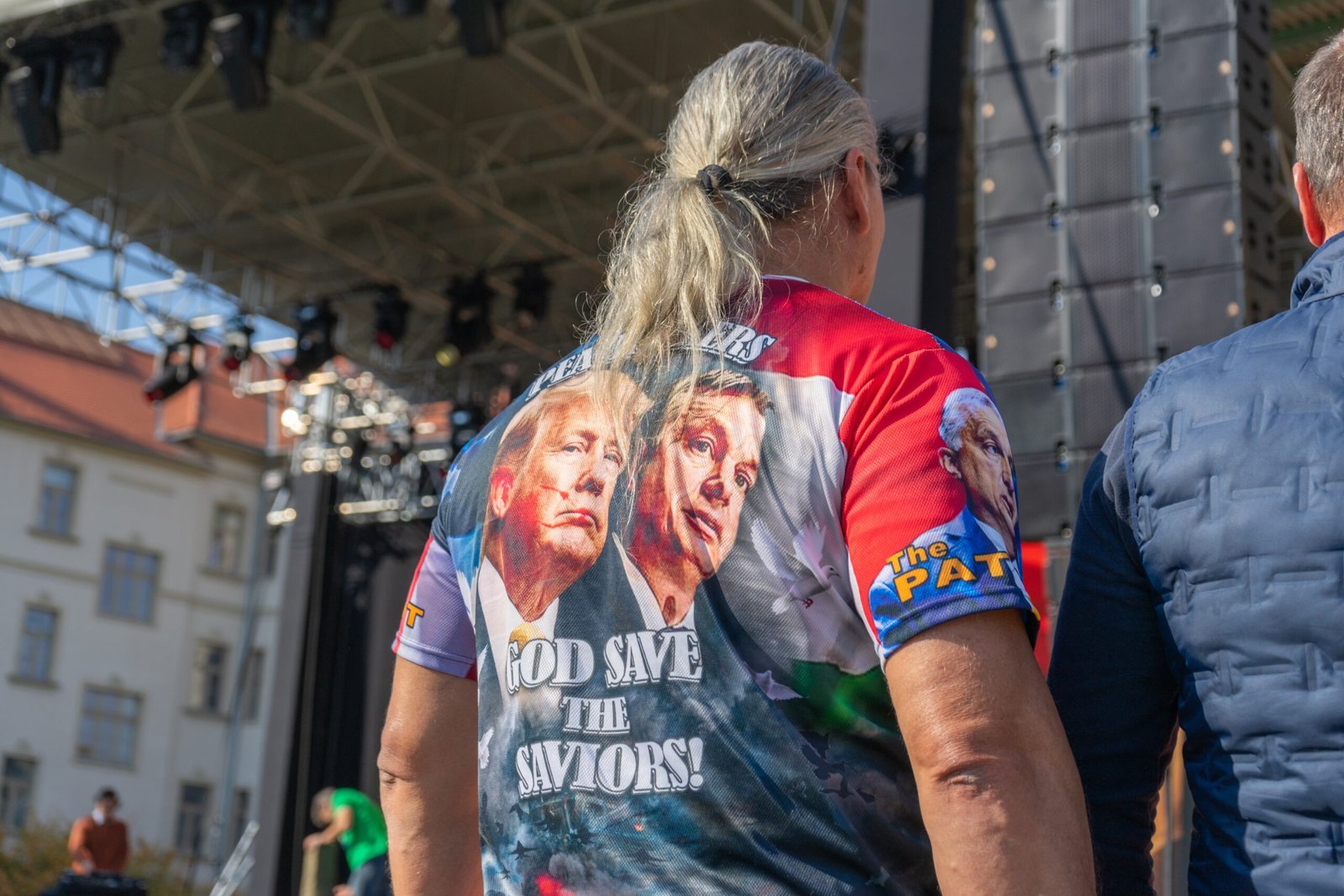
During his second term as president, Trump has been perceived as a true populist right-wing leader; a point of reference for populists in the Western world. His presidency has empowered several similar European political movements, some of which leaders received direct endorsement. European right-wing populists have never formed a united front, as they hold differing views on topics such as whether to remain in the EU or whether condemn Russia for its invasion of Ukraine.Trump became a factor that sets them apart beyond the current fragmentation. Especially since he is increasingly implementing measures that weaken Europe such as the trade war or threats against Greenland, and that are, in fact, unpopular among European (far-right) voters. This poses the question: Will Trump’s second term strengthen Europe’s populist right-wing, or will it expose its contradictions and ultimately weaken it?
TRUMP’S INTENTIONS FOR EUROPE
Since the first month of his second presidency, Trump has been undermining the transatlantic alliance by threatening Europe to remove its security umbrella, dealing unilaterally with Putin over Ukraine, and by threatening to occupy Greenland.
Michel Don Michaloliákos (The Hague Institute for Geopolitics) says “Trump’s aim of a weakened Europe is indeed crystal clear. He targets the rule setting power of the EU.”
Samuel Dempsey (The European Correspondent, POLITICO) states that Trump’s goals are dissolving the supranational EU, dissolving the single market, and preventing a European army. He attributes this to the administration’s lack of knowledge on Europe. “They base their power structure ideas of Europe on the experience from the European tech sector that is overregulated, which they find frustrating.”
Dempsey adds that in general, those intentions can be best seen from where the money and events go such as CPAC or the World Congress of Families. The other example that he mentions is the connection of the Hungarian MCC (educational talent program and, increasingly, a right-wing think tank) with the Heritage Foundation, which provides ideological leadership on the EU’s future.
THE FRAGMENTED POPULIST RIGHT
In the European Parliament, populist right-wing parties are divided into three different factions: European Conservatives and Reformists (ECR), the Patriots for Europe (PfE) and the Europe of Sovereign Nations (ESN) group. The divisions among them are significant and multidimensional; the most important of which are the degree of Euroscepticism and their closeness to Russia.
Since the Trump administration has an interest in a weakened, disintegrated Europe, his presidency may be structurally more favourable to hardline Eurosceptic parties represented by Viktor Orbán’s Fidesz and the German AFD.
Traditionally, they reject the supranational integration and authority of the European Union and often call for their countries to leave the EU, although, Zsolt Kerner (24.hu) argues that there is a clear trend in such parties no longer wanting to actually leave the European Union, but rather take it over.
The soft Eurosceptic approach is well presented by Giorgia Meloni, who tends to criticize specific EU policies, point out structural problems, and call for internal reforms but openly condemns Russia, in contrast to several parties in the Patriots, and the Sovereignists factions. So far, Trump has also paid attention to moderate Eurosceptic politicians as well, especially Meloni, who was the only European leader at his inauguration.
THE TRUMP EFFECT
Michaloliákos expects the Trump administration to Europeanise (to soften Eurosceptic voices into a more moderate position) populist right-wing parties to some extent. He argues that the ECR faction is already more moderate, some hardline Sovereignists might slightly soften, however, the majority of the Patriots will probably not. A counterexample, however, is Le Pen’s Rassemblement National (RN), which has already softened its position.
Kerner and Michaloliákos agree that Trump has strengthened the already existing divisions between European right-wing populists, and that those dividing lines lay both between countries and within countries. Kerner highlights the French (and British) far-right, who seem to maintain a more independent stance while supporting the Trump administration, while the German and the Romanian right-wing parties seem to be much more uncritical of Trump.
Michaloliákos argues that Trump has rather strengthened the international exposure of specific parties, primarily the AFD and Fidesz, but not necessarily their electoral chances. Kerner adds that “In Hungary, it is not yet clear whether the Orbán government’s friendship with Trump is actually popular.” Interestingly, Kerner also sees Trump as a factor that seems to bring the Greens back in Germany (and the UK).
When examining the depth of the rifts between these parties and the extent to which Trump is capable of deepening them, the Coalition of the Willing is another interesting example. It was formed to defend Ukraine at the beginning of Trump’s second term, when the possibility of US disengagement became a threat. Not all EU member states joined the Coalition of the Willing; while the prime ministers of Hungary, Slovakia and Italy can each be classified as right‑wing populists, only Italy chose to participate, highlighting the Russia factor and illustrating how the right-wing populists’ division on foreign policy issues weakens their overall influence.
IS DIVISION A WEAKNESS?
By eliciting different reactions from European right-wing populists following Trump’s geopolitical moves against Europe and the transatlantic alliance, he weakens them to some extent – as all the experts interviewed agree. However, they do not have to be united in order to have harmful effects on Europe.
Dempsey reminds the audience that populist far-right parties are pragmatic, therefore, if they felt threatened, they would try to work together, because “they are united in illiberalism and following self-interest”. The other experts share this caution. Kerner says that previously, the idea that these parties would cooperate in an organized manner “was unimaginable”.
Michaloliákos notes that division can be eventually useful for the populist right as a whole because they appeal to a broader electorate, therefore, channelling out more votes and gaining more power.
This aligns with Dempsey’s assessment on the main variables in whether they will further unite and succeed in dismantling the current structure of the EU, which are popularity/public support and Trump himself. He assumes that the far-right will probably get more and more powerful in Europe, and based on the Trump variable, he sees two scenarios:
Situation One (Trump’s own power is stable): NATO might stay alive with different norms, or since populists do not like current institutions, they will create more new institutional infrastructures (similar to the Board of Peace, an international organisation founded by Trump and intended to achieving lasting peace and reconstruction in Gaza).
Situation Two (Trump’s own power decreases): there is a big democratic turnout (firstly already during the midterm elections) and without the US, European populists alone cannot create or retain those new or hoped institutional infrastructures.
CONCLUSION
Overall, Trump might not necessarily make Europe’s various right-wing populist parties more popular individually, nor does he strengthen specific EP factions. However, as Kerner points out, he normalizes right-wing populist topics, at least on the policy level. Furthermore, by building new international organizational infrastructures, he creates platforms for his sympathisers where they can assert themselves.
On the other hand, not all European right-wing populists perceive Trump as an ally or patron. Pragmatism and self-interest lead some to hold him at arm’s length, despite their ideological ties, particularly given how strong the scepticism of European citizens is towards Trump. This further reinforces existing divisions, however, from Trump’s perspective, these parties are likely tools: the main objective is less to make them become stronger for themselves, but rather to become strong enough to be able to weaken and fragment Europe, for which they do not need complete unity.
As Kerner notes: “supporting the Trump administration from Europe seems very risky in the long term, especially since the conflict with Iran”. This risk has indeed become even more apparent, for example, the AfD has recently publicly condemned Trump for the U.S. attack on Iran.
Thus, Trump’s second term so far has not strengthened specific European populist right-wing parties or EP factions but it has structurally strengthened the environment in which those operate, increasing leverage for their future electoral successes.