

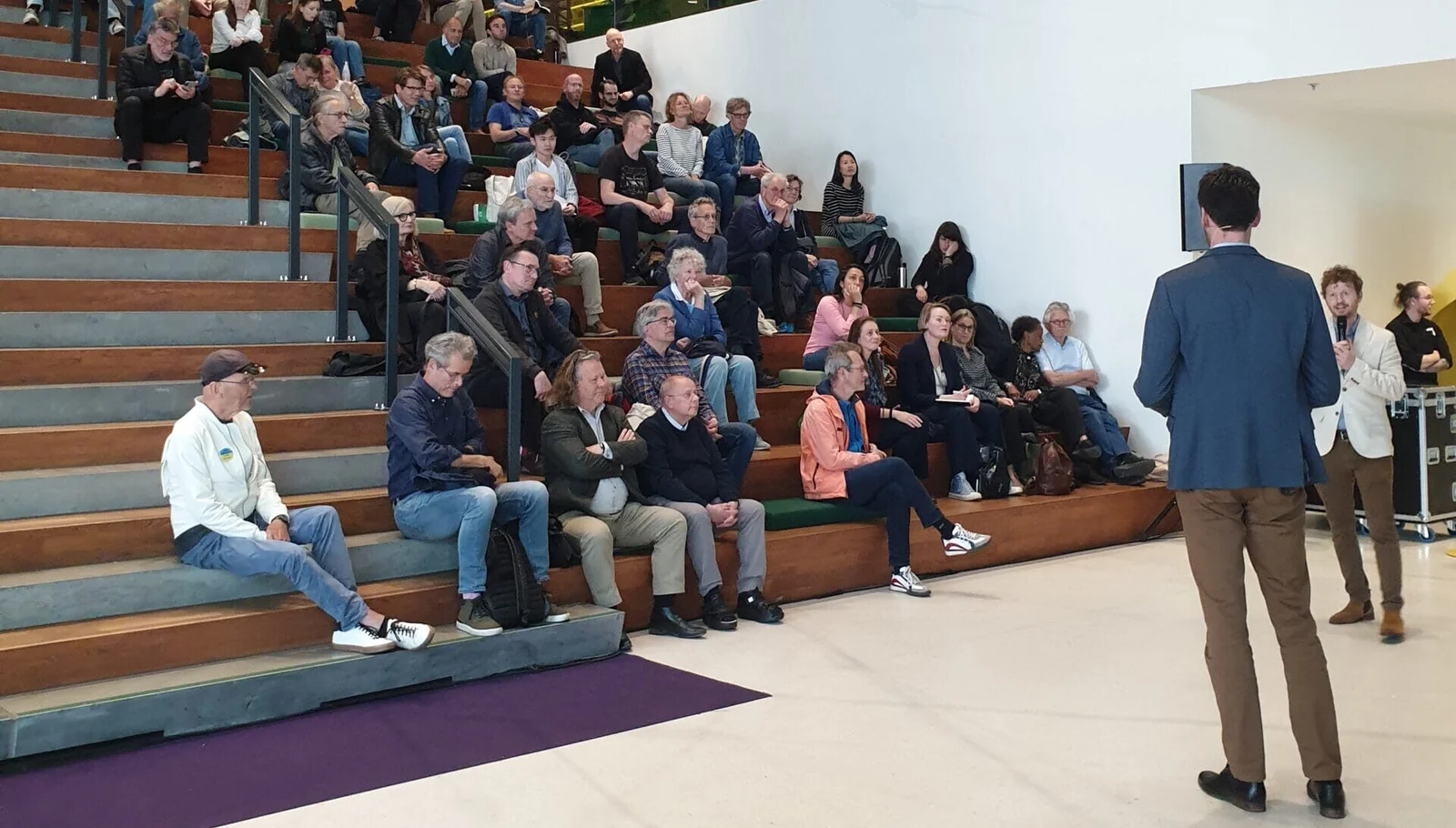
The Current Affairs Lecture Series in The Hague is a series of lectures organised by the Hague Institute GeopoliticsNow, in collaboration with Studium Generale and LeidenGlobal, and takes place in the Amare cultural centre in The Hague. Experts give concise lectures of approximately fifteen minutes on current geopolitical developments. Afterwards, there is ample time for interaction with the audience, led by Michaloliákos. The aim of the Current Affairs Lecture in Amare in The Hague is to appeal to as wide an audience as possible.
Since Russia’s invasion of Ukraine in 2022, Europe has been facing a growing number of cross-border operations originating in Russia. According to Bart Schuurman, professor of Terrorism and Political Violence at Leiden University, there is a structural campaign of sabotage, influence and physical threats aimed at weakening European stability and support for Ukraine. During the current affairs lecture “Russian actions against Europe after the invasion of Ukraine” on 26 May in The Hague, he elaborated on this under the chairmanship of Michaloliákos:
Although many incidents go relatively unnoticed in the media, Prof. Schuurman points to a clear increase in physical actions: from sabotage of infrastructure to firebombs at logistics companies. Attempts at political assassinations have also increased. His research focuses exclusively on physical incidents, not cyber operations, which are expected to be even more numerous. Incidents are only included if they have been publicly linked to Russia by authorities, or if they fit strongly into known Russian patterns. He emphasises that mistakes and misattribution are unavoidable: for example, sabotage of trains in Sweden was ultimately found to be due to climate change, although it was initially attributed to Russian interference.
Prof. Schuurman identifies a number of clear trends since 2022: a sharp increase in the number of incidents, an increase in their severity, and a geographical shift towards Western Europe. The numbers of incidents are alarming. The number of physical incidents in 2023 doubled compared to 2022, and in 2024 it doubled again. Sabotage in particular is on the rise, but so are vandalism, influence operations, terrorism and even political assassinations and attempts thereof. For example, monuments are defaced to sow division, and arson attacks on logistics companies such as DHL are hardly taken seriously in the media, even though they are in fact acts of terrorism..
While incidents were initially concentrated mainly in border countries such as Poland and the Baltic states, Germany, France and the Netherlands are now increasingly becoming targets. Germany was recently confronted with possible Russian involvement in foiled attacks on civil aviation and the fuelling of unrest around migration just before the German elections.
According to Prof. Schuurman, the probable motives are clear: Russia is trying to undermine public and political support for Ukraine and sow division within and between EU Member States. The stakes are high. In addition to military and human casualties, Russia is also using economic pressure. Europe finds itself in a geopolitical field of tension between a dictatorial Russia and an increasingly autocratic America.
With Donald Trump’s re-election and the accompanying uncertainty about American support, it is all the more urgent for Europe to take these Russian operations seriously and strengthen its own defences.
What can Europe do? According to Prof. Schuurman, there are three possible solutions: setting clear “red lines” for Moscow, investing in the European defence industry, and strengthening intelligence services. He believes that Europe has the economic and military capacity to effectively help Ukraine push back Russia, even if this requires short-term sacrifices.
Interested in a lecture or masterclass? Click here for more information.