

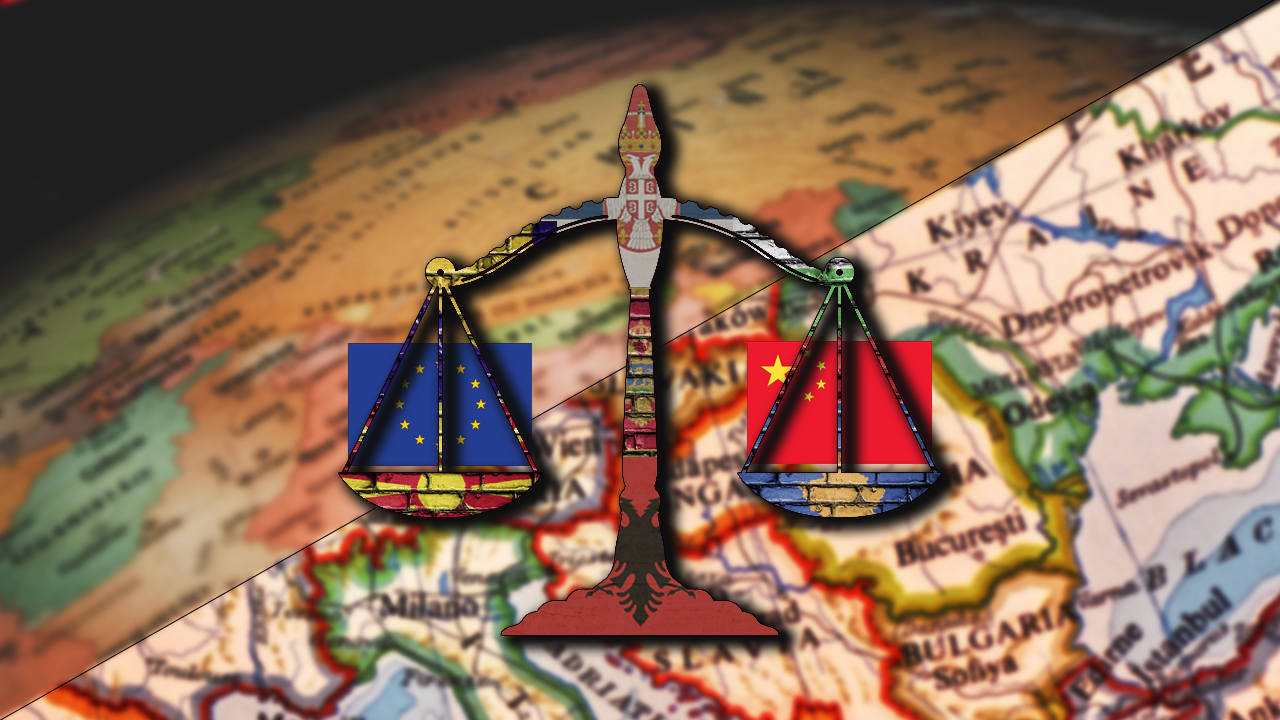
EU accession progress has stalled, and created a vacuum on Europe’s periphery, encouraging the Western Balkan countries to pursue relations with other powerful external actors. This vacuum favours China, which seeks to leverage influence through the Belt and Road Initiative engagements in the region. The BRI has propelled the importance of China’s role in the region, financing numerous large-scale projects which reform crucial sectors (e.g. energy and transportation sectors), and allow for enhanced connectivity coupled with improved bilateral relations. However, the BRI faces scrutiny: bloated costs, transparency concerns, anti-corruption protests and fiscal sustainability risks plague the region, calling for a shift in approach. China steps in where EU momentum falls short, this regional dynamic prompts the central question: “To what extent does Beijing’s influence through BRI reorient the geopolitical balance in the Western Balkans toward China?”
Regional Dynamics
Beijing’s approach to the region is strategically important; the complex, multilateral nature of the region requires China to adapt to the unique economic structure and follow political priorities per country. China is confronted by differentiating challenges on varying dimensions, such as corruption protests, fiscal risks, overlapping spheres of influence and regional fragmentation.
“In my view, The Western Balkans act as a micro-cosmos for the current fragmented world order”
– Michel Michaloliákos
However, China’s interest in the region does not solely relate to the specific countries, rather their geographic position on the periphery of the EU, a significant export market for China. Beijing’s strategic approach to the BRI in the Western Balkans yields benefits by creating a trade-route, connecting the COSCO-controlled Port of Piraeus to central Europe through the Western Balkans, while providing additional, necessary sectoral reforms, thus allowing both economies to benefit.
“Given as Europe remains one of China’s most important export markets, the BRI engagements in the Western Balkans enhance connectivity and provide Beijing with access to the market”
– Michel Michaloliákos
The Western Balkan region is of significant importance to the EU. Geographically surrounded by EU Member States, the region is a necessity for EU security and stability. Enlargement serves as a security approach, by extending the reach and governance of the EU, it is able to apply its control and monitoring mechanisms to the region. Additionally, EU control of the region would limit the influence of third parties. Pressure befalls the European Union, as EU credibility relies on the success of the integration of the Western Balkans.
However, the uneven pace of EU accession in the Western Balkans marked by stagnation in Serbia, North Macedonia, Bosnia and Herzegovina and Kosovo, shifts geopolitical orientation away from Brussels and possibly towards alternative external partners. Contrary to stagnation, Montenegro and Albania see accelerated accession through reforms, which strengthens EU ambitions and diverts influence away from external partners towards Western Influence.
“The stability outcome depends on whether diversification strengthens resilience, or instead entrenches fragmented standards, opaque deals, and external dependencies that amplify rivalries”
– Dr. Ivona Ladjevac
Western Balkans divided
The Case of Serbia
The EU has left a void in Serbia through the stalled accession process, where China, with ties to the countries through historical, political relations, stepped in. Meanwhile, significant Chinese engagement and investment projects such as the Kostolac Power Plant, the flagship Smederevo Steel Mill and Bor Copper Mining Complex serve as prospects for growth and infrastructural development in the Eastern European countries. The BRI-powered projects result in economic benefits through enhanced connectivity, job preservation and better manufacturing capabilities, though tainted by controversy. The lack of transparency, environmental concerns, accusations of democratic backsliding and corruption concerns are widely reported in the media, which scrutinizes the BRI. In addition, critics believe China provides the ruling government with necessary support through tangible results under current-potentially corrupt-leadership, creating context to highlight their ruling capabilities in Serbia.
“In the short term, it can support stability by delivering visible infrastructure, sustaining employment, and reinforcing state capacity narratives. In countries such as Serbia, this can strengthen political legitimacy and create a perception of economic momentum, particularly when EU enlargement appears uncertain”
– Dr. Ivona Ladjevac
Serbia is economically vulnerable towards China; Serbia’s bilateral relationship with China is coupled with a trade deficit estimating to USD 3.81 billion (EUR 3.24 billion) in 2022 and USD 2.23 billion (EUR 1.9 billion) in 2024. Serbian export to China consists of 5.9 per cent of the total exports in 2024, while Serbian imports from China consisted of 10.8 per cent. Furthermore, the total debt at sources estimating EUR 3.7 billion, 8.4 percent of its total external debt as of 2026, with repayments estimated until 2039.
“Large state-backed loans can increase fiscal exposure, especially where projects face delays, inflated costs, or lower-than-expected returns”
– Dr. Ivona Ladjevac
The Sino-Serbian relations increase at a steady pace, with planned expansion and the signing of the 2023 ‘Joint Declaration on the Establishment of the Comprehensive Strategic Partnership’, deepening relations, enriching dialogues on all levels, enhancing political exchanges and cooperation, and supporting each country’s political challenges (e.g. Taiwan and Kosovo dialogue).
The Case of Montenegro
Beijing’s interest in Montenegro was fuelled by the Montenegrin need for infrastructure. Montenegro’s difficult terrain makes constructing highways difficult. With the construction of the Bel-Boljare highway construction, China provided most of the funding. Feasibility studies highlighted the risks of such loans, stating it could be detrimental to the future Montenegrin economy. However, the then-president Milo Djukanovic, marked by his oppressive political atmosphere and corruptive ethics, endorsed the Bel-Baljare project, regardless of the financial risks.
Montenegro has been the flagship example when raising concerns regarding the BRI. It struggled with loan repayment, as Montenegro borrowed an estimated USD 1 billion, resulting in China’s share exceeding a quarter of the total debt. As estimated in the feasibility studies, the total Montenegrin debt reached over 100 per cent in 2020, confirming earlier concerns and creating significant financial instability. The economic dependency on China, coupled with Montenegro promising to deepen relations with China, expanding to other sectors, creates worry among critics regarding Beijing’s increasing influence.
However, Montenegro is currently the frontrunner for EU accession, with accelerated progress and increased support. Even so, the newfound financial support is tied to increased conditionality, which acts as a vulnerability through a lack of incentive and availability of alternative, no-strings-attached support. The ultimate reward for reforms is EU membership, but as EU credibility has faltered, the reward is perceived as uncertain and distant.
Balancing of influences
The region’s relations with Beijing are primarily focused on economic benefits, through investments and financial engagements. Beijing’s BRI effectively acts as a geo-economic actor, offering capital, providing tangible results benefiting economy (e.g. infrastructural projects). The region acts as multi-actor landscape, allowing the BRI to operate alongside the EU, and other actors.
“China mainly benefits from Improved bilateral relations and expansion of economic influence through commercial opportunities, and closer diplomatic ties”
– Frans-Paul van der Putten
However, as an economic superpower, China holds significant influence over the region, creates economic dependencies and undermines EU integration– and accession, through a lack of action against negative political factors (e.g. corruption and poor environmental standards), effectively challenging a section of the Copenhagen Criteria. In addition, Beijing’s engagements are entangled with challenges to EU integration, and EU law and cause concerns regarding labour standards. China holds leverage over the EU through providing an alternative support contrary to EU’s conditionality.
“While Chinese involvement can generate long-term economic and political linkages, EU accession remains the dominant normative and institutional framework shaping the region’s trajectory.”
– Dr. Ivona Ladjevac
The EU’s influence through financial and structural support in the region, coupled with the reward of EU membership translates to dominance. The European Union remains the largest donor and trade partner to the region, accelerating the accession progress for the sake of stability, integrity and security. Moreover, Kaja Kallas stated in the 2025 Enlargement package, “The enlargement process is moving faster today than in the last 15 years. But we cannot afford to lose momentum. The global order is shifting, and Europe’s security is increasingly at risk”.
Conclusion
The EU remains the only regulatory credible framework for long-term institutional anchoring and the largest economic partner. While the region may not face a ‘reorientation’ toward China, Chinese influence is deepening, mainly visible where Chinese finance, procurement or technology is effectively entangled with infrastructure (e.g. in energy, mining or digital systems).
“Overall, public opinion tends to support a “both/and” approach, with the EU as the desired end-state (especially outside Serbia), but China as a useful partner for quicker delivery and fewer political conditions”
– Dr. Ivona Ladjevac
Beijing’s influence on the stability of the region ultimately depends on domestic governance quality, diversification of partnerships and the continued anchoring role of the EU integration process. While it does not necessarily shift the geopolitical balance of the region, economic asymmetries, fragmentation and translate into political leverage, which could complicate regional stability and challenge EU-reforms (e.g. through lack of compliance with EU standards).