


At a time when the United States and European leaders are seeking a peace agreement for Ukraine, the country is struggling on the battlefield and with protecting its energy infrastructure over the winter. The army is now fighting for Pokrovsk – a key hub of the Donetsk region defence, and the civilians are suffering from Russian missile attacks on the critical energy infrastructure. Only in October 2025, Russia launched approximately 5,300 Shahed drones, 74 cruise missiles, and 148 ballistic missiles on Ukrainian territory.
Ukraine’s capabilities are finite, which is why strategists are looking to tailor them to cause maximum damage to Russia, and long-range precision strikes are exactly what Ukraine needs now. Obtaining different types of these weapons enables the attacks targeting internal energy and military infrastructure, which is both a tactical win and a psychological leverage. This approach is not new – since 2022, Ukraine has requested the ATACAMS missiles, which can reach up to 300km into Russian territory, and at that point, it seemed merely impossible to obtain them from Washington. By acquiring ATACAMS missiles and starting its own production of long-range missiles and drones, Ukraine tried to change the equation on the battlefield. Ukraine was trying to acquire even longer range missiles, such as the Tomahawks, at the beginning of October. This is an instrument that can help reach further targets, including military bases and oil and gas infrastructure, in Russia. This poses the question: how could long-range missile capabilities for Ukraine change the balance on the battlefield, in the war and even a post-war situation?
What is the Tomahawk missile?
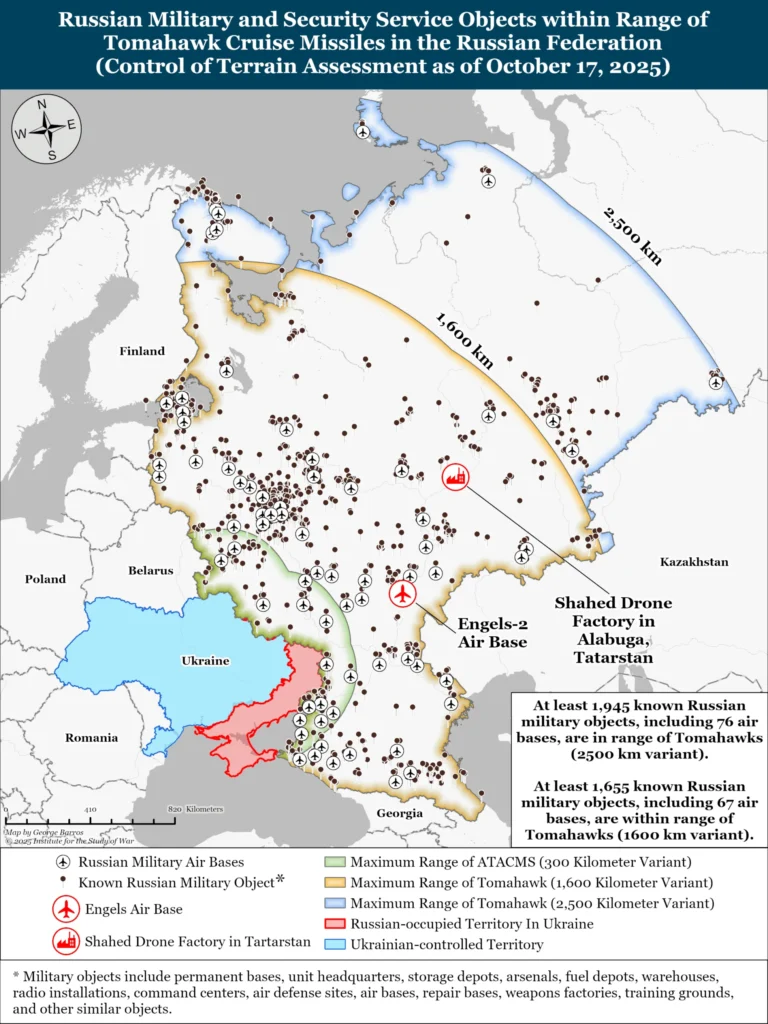
The center of the discussion is the BGM-109 Tomahawk – a cruise missile, arguably one of the most advanced precision weapons in the US arsenal. Even though it is usually launched from sea, it can also be used with an on-ground launcher called Typhon. The launcher is a very costly addition; however, Ukraine cannot avoid it since the country lacks surface navy capabilities. The subsonic missile operates at a low altitude, making it less visible to the air defence systems and more evasive. With its 1600 km range, the Ukrainian army can target the Tomahawks at the Engels-2 Airbase and the drone factory in Alabuga, Tatarstan, which are crucial for the mass attacks against Ukraine. The missile combines all the necessary elements – a large payload, accuracy, and the ability to strike at long range.
What can long-range missiles do for Ukraine?
For Ukraine, Tomahawks and other long-range missiles like German Taurus would be a powerful addition to its arsenal that could not only strike military bases and weapon factories, but also Russian oil and gas facilities. Davis Ellison, a strategic analyst at the HCSS, said:” At the tactical level, the most effective use would be to continue using such systems against high-value targets in the operational theatre. Hardened command and control, logistics sites, staging areas, and so on.”
In his latest book “What will they fight with in World War III? New Ukrainian weapons”, Roman Romaniuk mentioned that the oil facilities are one of the most “sacred” foundations for the Russians. These kinds of attacks combine targeting state revenues, decreasing the amount of petrol for their army, and serve as a psychological risk.
In its first public press event, a Ukrainian weapon manufacturer Fire Point presented its achievements and goals, including the list of the infrastructure targeted inside Russia, that reached up to 1000 km deep into the adversary’s territory. The company also announced the trial runs of the “Flamingo,” a long-range missile capable of targeting up to 3,000 kilometers and carrying a 1,150-kilogram payload. The hopes are high for this kind of weapon system, and the Ukrainian missile industry is working to compensate for the absence of Western systems.
Except for the military effects, Tomahawk deployment is considered a political indicator of support from Western countries and a demonstration of readiness to have their missiles targeted inside the Russian territory. During the meeting with journalists, Zelenskyy mentioned that the Tomahawks will “strengthen Ukraine and force the Russians to sober up a little and sit down at the negotiating table.”
At the same time, Davis Ellison emphasized that if the Tomahawks were deployed to Ukraine, Washington would send a signal that it is stepping back from negotiations with Russia and committing to supporting Ukraine’s forces. He emphasised the strategic and political benefits of the Tomahawks, as Ukraine has begun developing its own long-range missile industry.
Can the acquisition of the Tomahawks be a game-changer?
According to experts, the Tomahawks would indeed strengthen Ukrainian forces and capabilities inside Russia; however, this would come with numerous difficulties.
Firstly, the missile itself and the Typhon launcher are very costly, and with the current system of Europe paying for the weapons, it would be a hardship for the allied countries.
Secondly, the effects of using the missiles highly depend on the quantity available. Fabian Hoffman, a missile industry expert, argues that, for example, to neutralize the drone factory, the Ukrainian army would need at least 150 Tomahawk missiles, which seems unlikely at the moment.
With the current development of the potential peace deal between Ukraine and Russia initiated by the US, Trump’s administration is not looking at strengthening Ukraine; it is looking at cooperating with Russia. According to the CSIS, one of the reasons why the US is not willing to supply Tomahawks is also the fact that the country is counting on these missiles itself, with a focus on the Indo-Pacific region.
Even with the potential acquisition of Tomahawks, the Ukrainian cruise missile industry is still developing and is not comparable to the Russian one. According to the Main Intelligence Directorate of Ukraine (HUR), Russia currently has 2000 cruise missiles, and produces 200 ballistic and cruise missiles a month. At the same time, Ukraine’s focus remains on drone technology, which is a tool of compensation for the lack of missile capabilities, since it is more accessible and less costly.
Having taken everything into account, including the successes the Ukrainian army has achieved with its long-range capabilities, it remains unclear whether these strikes can have a tangible impact on the war.
“Long-range strikes on strategic targets will always support a front-line strategy, but by themselves, they cannot change the status quo on the battlefield. They can force Russia to reprioritize, adjust its strategy, and reposition its operations. Still, they won’t win a war,” an anonymous expert has stated, and it explains the fact that Tomahawks themselves cannot stand as a game-changing chance for Ukraine.
Broader NATO perspective
Since the INF Treaty in 1987, long-range precision strikes have not been as prominent in NATO defence operations, with greater emphasis on airpower. According to Davis Ellison, deep-strike capabilities will become a larger part of NATO strategies in the coming years, given Ukraine’s practical management of long-range capabilities. This is why following developments in Ukrainian warfare is crucial to transatlantic analysts; it is the only way they can see the practical use of weapons in an active war environment.
Ellison said: “Based on Ukraine’s experience, deep-strike is going to be very much a part of NATO strategy and doctrine for a long time to come.”
Conclusion
Concluding, the long-range missiles are an essential part of Ukraine’s strategy and can help the country achieve its strategic goals through targeting critical military infrastructure in Russia – both in a war and a post-war situation. However, the missiles cannot be a full game-changer for Ukraine in the current circumstances. With the present political developments, it is unlikely that Tomahawks would be deployed to Ukraine anytime soon, however, there is a higher chance of obtaining European long-range missiles such as Taurus missiles.In any case, Ukraine now has to focus on its domestic long-range capabilities. Inevitably, Ukraine’s experience will contribute to NATO’s doctrine and will be used to strengthen Europe’s security infrastructure in the future.