

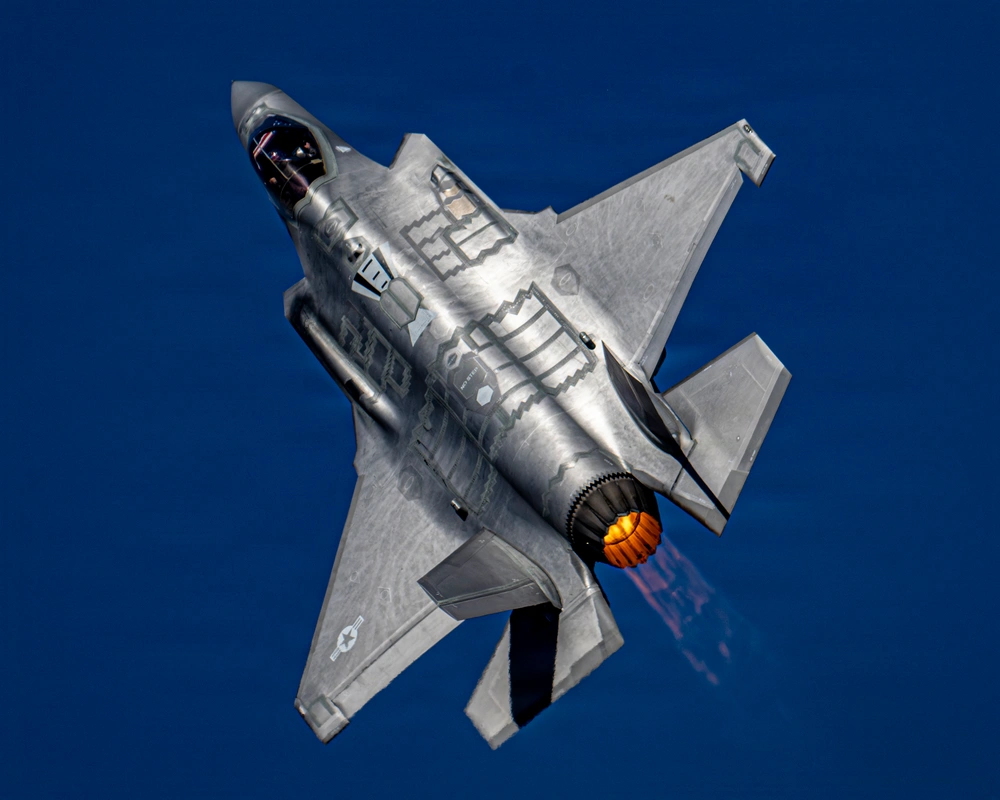
- The F-35 aircraft has recently received substantial attention in the media, featuring heavily in European debates on the future of defence procurement, and deployed in contemporary conflicts across the Middle East. The balance between dependency on the U.S. as a supplier with the requirement for advanced capabilities to deal with pressing security threats leaves many U.S. allies and partners with a conundrum of how to secure more sovereignty in an era of global rivalry.
- Understanding the F-35 programme is therefore crucial to comprehending what has become a Trump card in Washington’s dominance of the global military export market. Each of these aircraft has been envisioned to slot directly into a broader U.S. defence ecosystem, sharing targeting data, threat libraries, and maintenance standards.
- The nature of these exports, and the strategic leverage that comes with them, may therefore serve as a useful barometer of the direction and priorities of the Trump White House’s foreign policy.
The American F-35 jet is rapidly forming the backbone of western air power. This is the case not only for the U.S. itself, which by the mid-2040s plans to acquire some 2,500 F-35s across all three variants, but through their export to a wide range of U.S. partners across the globe. This article seeks to address three key questions: What makes this aircraft such a valuable addition to allied air forces? Which types of operations does it excel at? Finally, what are the implications of the asymmetric relationship the F-35 procurement pipeline creates between customer nations and the U.S.?
To help explore these questions, I spoke with Justin Bronk, Senior Research Fellow, Airpower & Technology at RUSI, who elucidated both the impressive technical capabilities and political nuances surrounding the aircraft he sees as “more capable in almost every respect in contested airspace than any other western fighter aircraft.”
One programme, three variants
Born out of the Joint Strike Fighter programme in the late 1990s, the F-35 aircraft is a single-engine, supersonic, stealth multirole jet fighter manufactured by Lockheed Martin. F-35 comes in three distinct variants: A, B and C models, which primarily differ in terms of take-off and landing mechanics. The A, designed to operate from conventional runways, is the most common variant operated by the U.S. Air Force and most allied customers. The B incorporates a lift fan allowing it to hover and land vertically like a helicopter. It can take off in very short distances, which makes it a suitable model to deploy from austere, short-field bases and small aircraft carriers, currently operated by the U.S. Marines and a smaller number of allied customers. The C was designed with larger wings and more robust landing gear, built explicitly for large aircraft carrier operations and currently operated exclusively by the U.S. Navy.
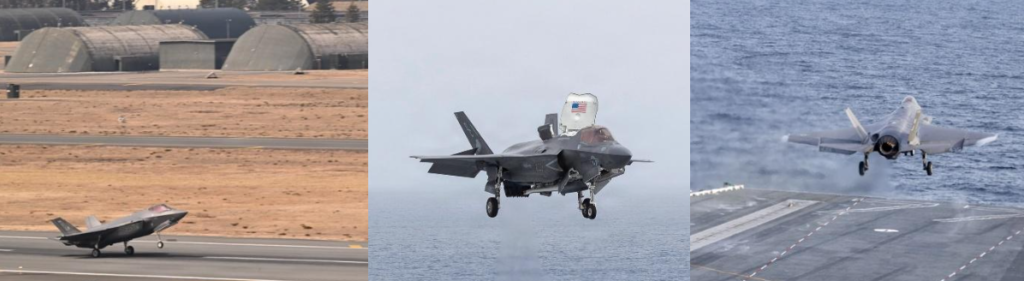
| F-35A Conventional take-off / landing (U.S. Air Force photo) | F-35B Short take-off / vertical landing (U.S. Marine Corps photo) | F-35C Catapulted take-off / arrested landing (U.S. Navy photo) |
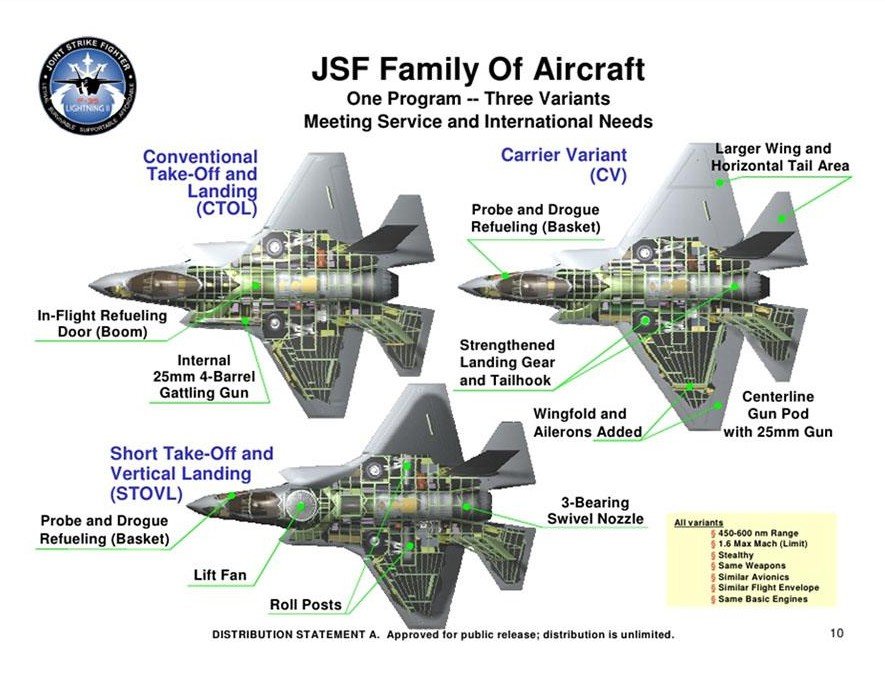
F-35 Joint Strike Fighter (JSF) Programme – EveryCRSReport.com
5th generation capability
One of only a handful of operational 5th generation aircraft, F-35 brings distinct technologies and characteristics compared to older generations of aircraft. Of note, these include a stealth design, with weapons stored internally, making it much more difficult to detect and track on radar. This is combined with a networked sensor suite and data fusion, meaning that aircraft can more efficiently gather data from multiple sensors and link with other F-35s to pool information, enhancing situation awareness on the battlefield. This is then all comprehensively translated into a unified, tactical picture for the pilot to view, with aid from the F-35’s advanced computers that scrub duplication and identify priority threats.
According to Justin Bronk, these make F-35 “superbly adapted for going into heavily contested airspace,” and for conducting missions such as Suppression of Enemy Air Defences (SEAD). This has become a particularly relevant mission in environments against adversaries such as Russia and China, who have attempted to employ Anti Access / Area Denial (A2/AD) strategies, utilising surface to air missile systems (SAMs).
Having F-35s even as one part of a larger, older fleet of aircraft can also act as a force-multiplier, utilising its networked sensor suite, providing significant benefits to having 5th generation aircraft alongside older aircraft. According to Bronk, “F-35 provides a huge survivability and lethality boost to 4th generation aircraft, if they can directly datalink to it, they can get significant amounts of situational awareness from F-35.” Fielded within such a mixed fleet, older platforms become “vastly more capable and survivable, fighting against them together is a nightmare.”
In terms of the classic manoeuvres of air-to-air combat within visual range, Bronk states that “F-35 is not a particularly good ‘dogfighter’.” Such classic manoeuvring dogfights which used to characterise most aerial combat have become less relevant with longer range weapons and sensors of modern fighters, although these situations can still occur, especially when stealthy aircraft fight one another. However, to achieve air superiority, F-35 can more easily leverage its advantage in situational awareness to position advantageously and strike from long range without being detected thanks to its stealth.
Premium price tag, delays in delivery
Whilst being optimised for ‘high-end’ scenarios – such as fighting advanced adversaries in contested airspace – Bronk adds that F-35 is noticeably “less efficient for doing defensive, peace-time air policing missions compared to older aircraft, as well as operations in less contested airspace.” The premium paid to acquire F-35 is even more stark for the B-model with its niche ability to take off and land in confined spaces. But this capability is offset, by significantly less internal fuel and weapons payload. “[Countries] pay a considerable price in terms of comparative cost, complexity and capability versus A and C models”, Bronk explains. However, as he puts it, “if there is a requirement for short take-off and landing operations, it remains the only available aircraft on the international market”.
As comes with the territory of such a high profile, decades-long and globally spanning procurement item, F-35 has had its fair share of criticism over the years, from defence analysts to Elon Musk. One such major criticism concerns its delayed upgrade packages. Indeed, upgrade delays have meant that even in the United States’ war with Iran in 2026, F-35s being used are older jets, with what is known as TR-2 rated software, due to setbacks in the delivery of a modernised software suite known as TR-3. Further modifications remain in the pipeline, notably engine upgrades with superior cooling and power. Previous issues in maintaining the jets stemmed from a lack of spares, with Bronk observing that there has been a recent “shift from growing production rate of airframes to more spare parts to deal with that bottleneck in supply.”
Alliance politics
Bronk assesses that the jets at their current stage of upgrades can already sufficiently fulfil requirements for operations in the European theatre. This raises dilemmas for many NATO allies as to whether to purchase F-35s as a proven design to deal with the near-term threat from Russia within the context of fraying and tense relations with the Trump administration. Some allies, notably Canada, have worried that the sale of the jets constitutes a potential double-edged sword, delivering much needed 5th generation capability on the one-hand but creating dependency on the U.S. on the other. In 2025, rumours even circulated about a supposed ‘kill switch’ inherent in F-35s that the U.S. might be able to trigger. Although this was later disproven, the episode underscored how acutely countries understood the potential leverage that controlling the keys to the vast F-35 programme could grant the Trump administration. This is because commitment to F-35 goes beyond simple procurement: it binds a nation into a coalition of states with convergent strategic priorities, common supply chain reliance, and access to unified software and modernisation pathways.
Current F-35 export orders and deliveries
| Country | On order | Delivered |
|---|---|---|
| Australia | 72 F-35A | 72 F-35A |
| Belgium | 45 F-35A | 12 F-35A |
| Canada | 88 F-35A | Awaiting delivery |
| Denmark | 43 F-35A | 17 F-35A |
| Finland | 64 F-35A | 1 F-35A |
| Germany | 35 F-35A | Awaiting delivery |
| Greece | 20 F-35A | Awaiting delivery |
| Israel | 100 F-35I (A-based) | 48 F-35I (A-based) |
| Italy | 115 total: 75 F-35A + 40 F-35B | 25 F-35A + 8 F-35B |
| Japan | 147 total: 105 F-35A + 42 F-35B | 42 F-35A + 3 F-35B |
| Netherlands | 58 F-35A | 49 F-35A |
| Norway | 52 F-35A | 52 F-35A |
| Poland | 32 F-35A | 11 F-35A |
| South Korea | 85 F-35A | 59 F-35A |
| Romania | 48 F-35A | Awaiting delivery |
| Saudi Arabia | 48 F-35A | Awaiting delivery |
| Singapore | 20 total: 8 F-35A + 12 F-35B | 4 F-35B |
| Switzerland | 30 F-35A | Awaiting delivery |
| United Kingdom | 75 total: 63 F-35B + 12 F-35A | 47 F-35B |
Country roster excludes the United States. Delivered figures are the latest publicly confirmed counts located in official Lockheed Martin, government, or major defence sources (confirmed as of May 2026). Variant note: F-35I is the Israeli A-based derivative.
U.S. dependencies and leverage
Each F-35 operator must strive to keep their F-35s maintained, updated, and able to respond to threats as they continuously evolve. A key part of ensuring this involves ‘mission-data programming,’ essentially software updates that respond in real-time to the latest developments in threat data from systems such as enemy SAMs. Bronk explains, “[sovereign] mission-data programming is an option to pay for, but quite difficult to independently achieve, and requires lots of resource and security clearance from the U.S.” If opted for, these customers could then change their own mission data files without waiting for updates to filter through from the U.S. directly. However, such an option is only available to those with sufficient national capacity to collect and process signals and electronic intelligence on the latest threat systems of the adversary.
This is a key example of how the U.S., even after an initial sale of the aircraft, still holds valuable cards in determining how the jets are serviced for decades. Being reliant on the U.S.-granted security clearances or U.S.-owned sustainment architecture therefore means Washington retains the ability to restrict access to spare parts and software updates at will. The reward mechanisms contained within such procurement are clear: remain on the good side of the U.S. and place large, lucrative orders of F-35s to gain more sovereign capability in the programme. Bronk explains, “customers with larger orders can agree to a larger amount of other associated infrastructure, such as local assembly lines or maintenance centres.” The Netherlands is one such example, housing an indigenous maintenance centre for its F-35 fleet and co-running a joint programming lab to upgrade mission data files with Norway and Italy.
The Saudi case, a barometer of Trump’s foreign policy
For potential F-35 customers, the expectations from the U.S. side are clear: access to F-35 comes with expectations of broader strategic alignment. Planned F-35 sales to its newest export customer, Saudi Arabia, when considered with this logic in mind, can offer an instructive barometer of the regional foreign policy goals of the Trump White House. The Kingdom’s F-35s constitute a key element of the broader strategy that Washington is devising, which aims for progress towards Saudi–Israeli normalisation and greater defence cooperation. The sale is significant due to a 2008 amendment to the U.S. Arms Export Control Act, requiring that any arms sale to a Middle Eastern country other than Israel “will not adversely affect Israel’s qualitative military edge over military threats to Israel.” This has previously resulted in Israeli protests over any potential F-35s being acquired by other states in West Asia. However, in light of the Trump White House’s deepening cooperation with both Israel and Saudi Arabia throughout the Iran war, including airspace overflights and sharing of intelligence, a tacit bargain appears to have been reached. Israel has not publicly opposed the export deal, and now will soon be operating a common, advanced 5th generation platform with the Kingdom it hopes will eventually join the Abraham Accords. The U.S., deployed its Trump card through an F-35 sale, which appears to have smoothed the pathway towards greater alignment between its two most important regional partners and cementing its own defence ties to Saudi Arabia during an ongoing regional conflict.
Conclusion
F-35 is an aircraft built for 21st-century warfare in highly contested environments. As a 5th generation platform, it combines advanced software, networked data systems, and stealth technology to operate in high-risk conditions where older aircraft would struggle to survive. Through its three variants, this single aircraft has the versatility to meet operational requirements of a wide range of customers, making it an increasingly central pillar of both the U.S. and allied airpower.
Buying F-35 also means entering a deeper defence relationship with the United States, one that will create long-term dependence on the American defence ecosystem that sustains mission data file updates and other critical capabilities. Washington can therefore use the leverage embedded in the F-35 programme to advance broader foreign policy objectives, making it a useful barometer for assessing where the Trump administration is placing its strategic emphasis. Despite recent transatlantic tensions, competition for new customers appears to be intensifying, most recently with Saudi Arabia’s inclusion. This highlights the aircraft’s strong position in a crowded international market, where F-35 remains a Trump card for Washington to play in an era of global rivalry.