

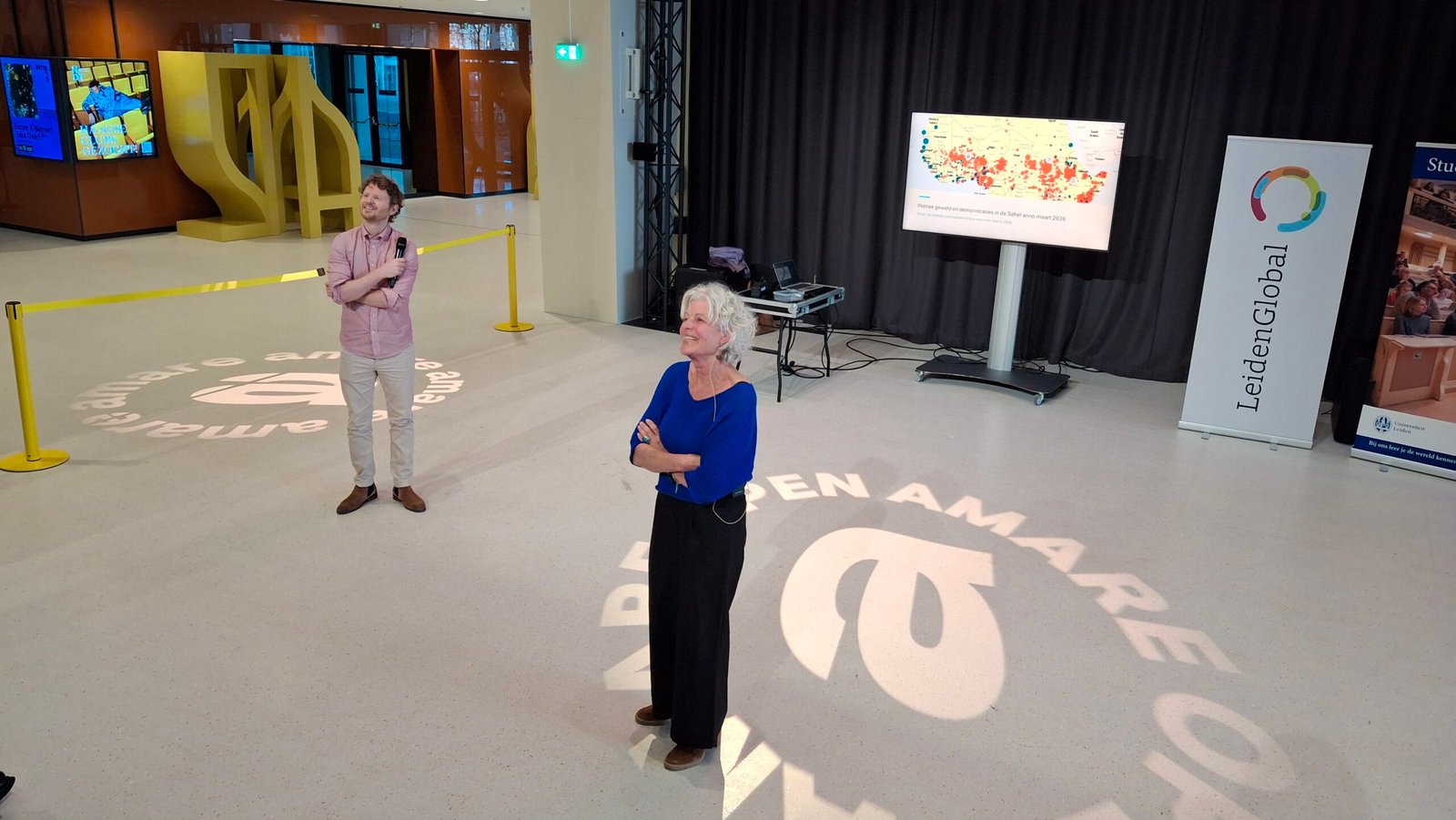
On Tuesday 7 April 2026, the Hague Institute for Geopolitics (HIG), in collaboration with LeidenGlobal, Leiden University’s Studium Generale and Amare, organised a current affairs lecture on the violent conflicts in the Sahel (West and Central Africa), which are increasingly being fuelled and fought out online.
HIG analyst Michel Michaloliákos acted as chair and moderator, alongside anthropologist and professor of African Studies Mirjam de Bruijn (Leiden University and Leiden Centre for African Studies).
The central question was: “What influence does social media have on the conflicts in the Sahel?”
According to De Bruijn, who has been conducting research in the Sahel region for 30 years, a parallel rise can be observed from the year 2000 onwards between the growth in mobile telephony and the increase in political violence. After Facebook became free to use in 2009, the use of social media in the region increased significantly.
As a result of this increased online presence, interconnectedness also grew. War and conflict were increasingly documented online and widely shared. Viewing these extreme images is compelling and gradually became an online revenue model as part of the so-called ‘attention economy’: the more clicks a post receives, the more the creator earns from it.
In the context of the Sahel, where various armed groups, local militias and jihadist groups are fighting for regional power, divisions between different population groups are amplified through social media. The result is the telling of stories about mutual alliances and the sharpening of existing fault lines. In this way, the battlefield is fuelled and fought out both on the ground and online.
According to De Bruijn, these exaggerated online narratives of conflict are becoming increasingly popular and are more frequently dominating the narrative on social media. Online algorithms ensure that these images are displayed more and more frequently. These clickbait stories find their way onto legitimate media platforms and are thus becoming increasingly central to the media landscape.
Because 65 per cent of the population in the Sahel is under 25 years old, and there are few job opportunities, there is a large pool from which armed groups seeking to gain control of an area can recruit. These various groups compete for support, and it is precisely this struggle that is often fuelled and fought out online. The government also uses social media to gain influence in rural areas. In Burkina Faso, Niger and Mali, the free press is increasingly being controlled and restricted.
De Bruijn conducts extensive research into the Fulani community, a nomadic Muslim people spread across the Sahel region. Because some label them as jihadists, many ethnic tensions arise. These stories are shared online with the diaspora, where words such as ‘attack’, ‘killing’ and ‘innocence’ form a narrative within which these Fulani can retreat into a bubble of opposition. Furthermore, this circulation of references to violence contributes to the promotion of a pan-Fulani identity amongst the community in the Sahel and the diaspora.
Finally, De Bruijn emphasises that we are all complicit in digital warfare through our clicking behaviour and encourages us to be more mindful of this.
The Current Affairs Lecture in The Hague is a series of activities organized by LeidenGlobal, in collaboration with Studium Generale and The Hague Institute for Geopolitics, and takes place in the Amare cultural center in The Hague. During these ‘lectures’, experts share concise background information on current topics related to specific regions and cultures. We then provide ample opportunity for questions from the audience and knowledge exchange.
Interested in a lecture or masterclass? Click here for more information.