

As Friedrich Merz stated at the Munich Security Conference, the old world order “no longer exists.” An important part of that order was nuclear non-proliferation and the nuclear umbrella for Europe. On the 5th of February, the New START treaty between the US and the Russian Federation expired.
New START was a bilateral nuclear arms control agreement that limited strategic nuclear weapons and included mutual on-site inspections. The significance of the treaty lies in providing transparency for the world’s two largest nuclear powers and supporting the global non-proliferation regime. It was extended twice; the latest extension followed in 2021 by Biden and Putin, a year before Russia had waged a full-scale invasion in Ukraine. At that time, the US administration had already expressed interest in engaging China in nuclear arms control and risk reduction, however, the country never joined the treaty. The non-extension of New START marked the first time in 50 years that the Cold War rivals lacked a nuclear arms control agreement.
This raises the question – Is the expiration of New START a turning point in the erosion of nuclear norms, and what does it mean for Europe, East Asia, and the broader multipolar nuclear landscape?
This article draws on conversations with three experts who offer US-Russia, European, and Indo-Pacific perspectives on the end of New START: Juraj Majcin, a Policy Analyst on European and transatlantic security at the European Policy Centre (EPC) in Brussels; Paul van Hooft, Research Leader for Defence and Security at RAND Europe; and Casper Wits, an East Asian studies professor at Leiden University and analyst at the Hague Institute for Geopolitics.
Juraj Majcin notes that the most important part of New START was not only the numerical caps but “the transparency mechanisms that are very important in nuclear deterrence”. Paul van Hooft similarly argues that the expiry will not likely trigger an immediate nuclear arms race: both sides could load non-deployed warheads if they wanted, but “drastic steps wouldn’t benefit Russia, which cannot outspend the United States”. Casper Wits points out that Beijing would see little benefit in joining a treaty that constrains its arsenal while it is still catching up with the US and Russia, and prefers to frame its expanding forces as being mostly about deterrence.
On one hand, the expiration of New START does not mean an immediate nuclear arms race – on the other, this is slowly leading to the erosion of the nuclear order that makes some states consider proliferation.
New START Explained
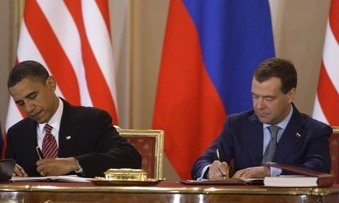
Commonly known as New START, the treaty’s full title is a Treaty onMeasures for the Further Reduction and Limitation of Strategic Offensive Arms. Together with arms control, it is aimed at promoting transparency in terms of strategic nuclear weapons. It kept the Russian and U.S. sides at 800 strategic delivery vehicles (launchers) and 1.550 nuclear warheads. The treaty was first signed on April 8, 2010, between Medvedev and President Obama as part of the latter’s “Reset” of relations with Russia.
https://2009-2017.state.gov/r/pa/ei/pix/eur/c36296.htm
In September 2025, Vladimir Putin proposed extending the treaty for one year, with both parties voluntarily maintaining the New START caps, and Trump gave a positive response to that. The challenge is that it goes against the treaty’s legal architecture – the 2021 extension was thelast one the treaty allowed under its own terms and the five-year extension mechanism was fully used. A potential future arrangement would not be an extension, but an entirely new treaty. In this case, the United States and Russia, which together possessroughly 90% of the world’s nuclear arsenal would need to go through a full negotiation and ratification process that is difficult to imagine in the current political climate.
Majcin underlines that even before formal suspension, Russia “limited sites that the inspections could see” and did not notify of new strategic systems, thereby undermining the transparency New START was supposed to guarantee. Given Russia’s lack of transparency throughout this treaty in 2021, there will be no significant effects on arms control.
“Russia would go far to maintain its leading nuclear status, which is its last resort to be a great world power,”
Paul van Hooft
Consequences: Proliferation Risks and the China Question
When discussing the non-extension of New START, the question arises – was it a failure of diplomacy, a consequence of great-power rivalry, or an intentional strategic choice by Moscow and Washington?
The answer is all of the above, as well as the Trump administration’s willingness to include Beijing in the trilateral nuclear arms control treaty.
“New START is just another series in the nuclear domino after INF, Open Skies and other similar agreements”
Juraj Majcin
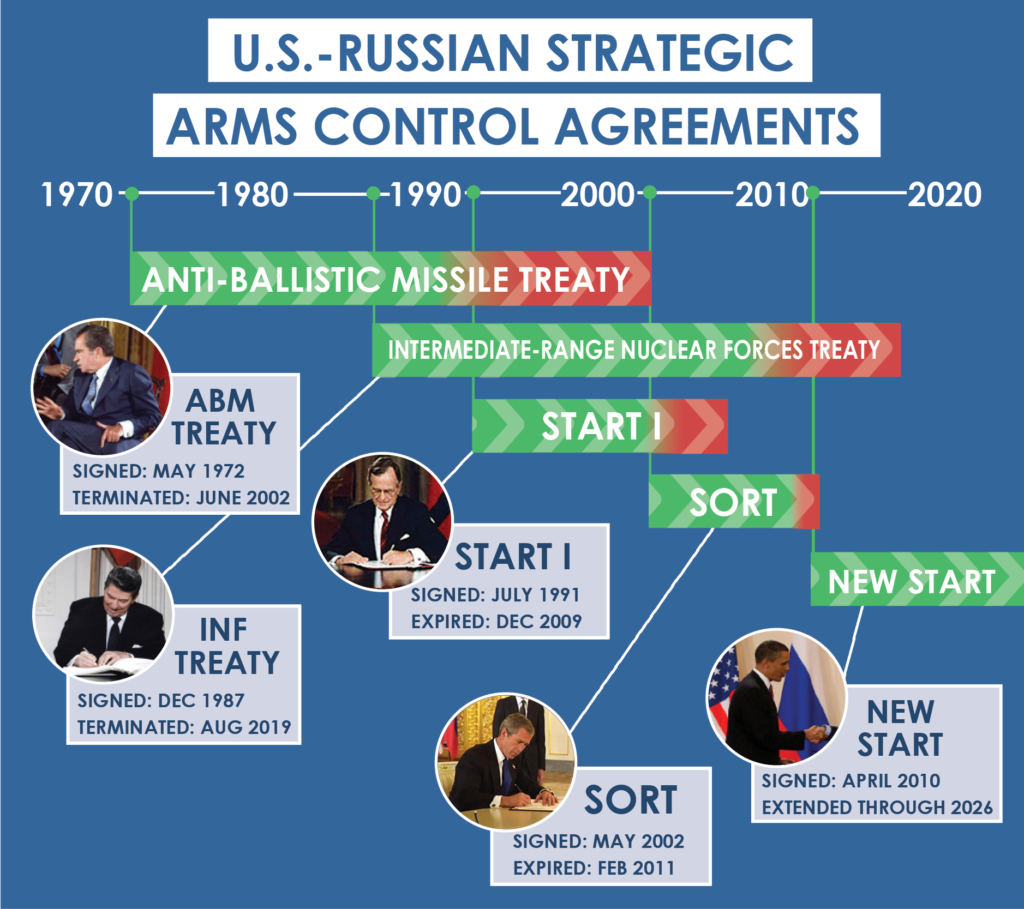
Once again, the treaty was not actively upheld since 2021, when the Russian side stopped monitoring its nuclear arms and formally left the treaty in 2023. One of the main challenges was the lack of transparency, which jeopardised the implementation.
The demise of START will likely not pose immediate risks to global nuclear security; however, it will gradually bring nuclear thinking closer to some middle powers.
There are ongoing debates in Poland, for example, where the President Nawrocki expressed the willingness to begin working on nuclear arms. Turkish officials have also made claims that the country will consider nuclear armament if Iran acquires a nuclear weapon. Amongst these countries is South Korea, where nuclear armament is on the table of public debate, with polls showing a record 76.2% supporting indigenous nuclear capabilities. At the same time, the potential nuclear proliferation in East Asia clearly depends on the US security involvement. On this matter, Casper Wits argued that the current regime shows no signs of withdrawal at the moment.
South Korea is not the only one reviewing its position. The old US-Russia bilateral framework was built for a two-player world that does not exist anymore. In a new multipolar configuration, Beijing comes up as a new actor on the nuclear field.
However, when exploring a scenario of a similar arms control treaty with China, Casper Wits is very hesitant on the matter – Beijing would not find any advantages in it. The country is now expanding its nuclear arsenal, however, with a very different narrative from Moscow – their alleged aim is only deterrence. The other aspect is an image of a world power having a nuclear arsenal.
What Does This Mean for Europe?
The expiration of START can become a catalyst for the development of European nuclear capacities and for diversifying domestic weaponry. The change should start both in terms of weapons types and with production capacity, reducing dependence on US-supplied systems.
On this matter, Paul van Hooft argues Europe should probably prioritise deep-precision strike capabilities and integrated air and missile defence, because these are more credible alliance-wide tools than jumping first to new tactical nuclear weapons. At the same time, Majcin suggests that Russian tactical nuclear missiles like Oreshnik/Novato make the short- and intermediate-range nuclear weapons a bigger problem for Europe than the big strategic warheads.
Given the pace and intensity of weapon system development in Russia, Europe should keep track of it and review its thinking – from going strictly conventional to recognizing opportunities in drones and deep strikes. Deterring the nuclear threat from Russia can be done without going into another nuclear arms race, but by using the available high technologies in the domestic security infrastructure. This diversification means both looking at different types of weapons and boosting the production, looking at the potential threat from Russia in the East.
Conclusion
The non-extension of New START is a continuation of Russian policy of turning away from the Western mechanisms and pursuing its “strategic autonomy” in their own way. At the same time, the country does not mind entering a similar strategic nuclear arms control treaty – Russia’s focus lies in the tactical nuclear weapons like the newly developed Oreshnik, which was fired without a nuclear load on Ukraine this January. Because of the need to negotiate a brand new bilateral treaty to replace START, it is less likely that the US and Russia would do it, instead of informally holding the caps, as now.
The expiration of the treaty will not bring a rapid change to the nuclear world order, however, will be some kind of encouragement for the countries who were already considering it for a long time, like the Republic of Korea. For Europe, this is an indication of the fact that Russia’s main interest lies in the tactical nuclear weapons, having approximately 2000 warheads. It is also a call for change and diversification in European domestic weaponry – rethinking a “conventional-only” architecture. The United States’ plan to involve China into a similar kind of treaty would not likely work out, looking at Chinese internal interest in expanding its arsenal, not constraining it.
Uncertainty is tying these perspectives – Europe is facing a huge threat from Russia, East Asian countries are uncertain about their main security ally, and the rest of the world is looking out for the consequences of the unregulated strategic nuclear arms from their main holders.