


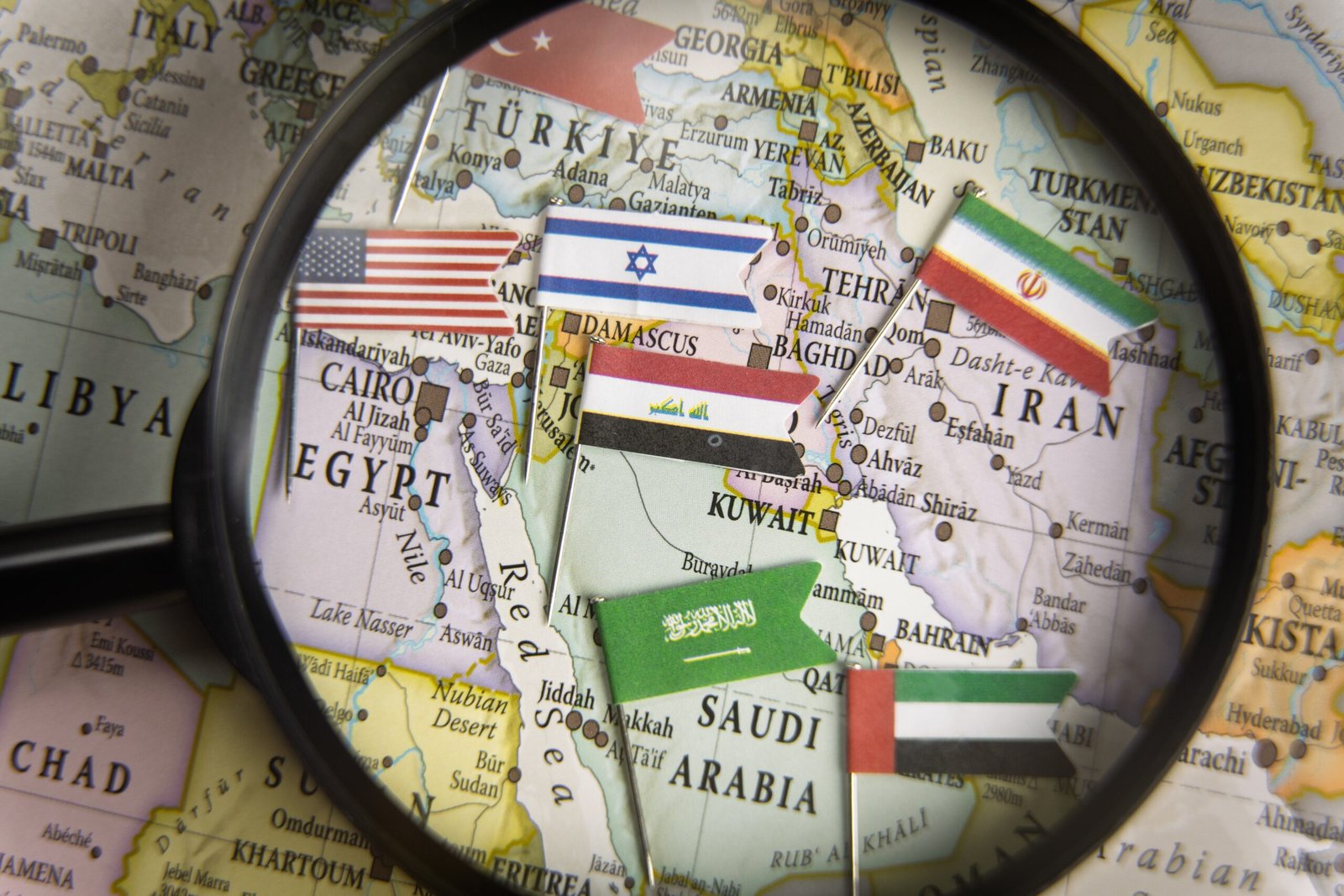
Over the past three years, the Middle East/West-Asia has undergone fundamental shifts in its security landscape. Until October 7, 2023, regional security was defined by the perception of Iran, Turkey, and Islamist movements such as the Muslim Brotherhood as primary rivals to stability, fostering strategic realignment between, most notably Israel, Saudi Arabia, and the United Arab Emirates.
However, October 7, 2023, denotes a landmark. Iranian capabilities have degraded dramatically, while Israeli hawkishness has intensified as illustrated by escalations such as the ongoing joint military attack on Iran with the United States, but also the airstrike on Qatari capital Doha and the bombing of Iranian nuclear sites provoking the Twelve-Day War in June 2025. These developments have not gone unnoticed by regional powers and security elites, as they signal a departure from the pre-October 7, 2023 security order.
In essence, it marks a shift from strategic realignment to strategic hedging as states seek to avoid the emergence of a regional hegemon. This begs the question of how this shift shapes the security landscape in the Middle East/West-Asia and how the EU should respond given the ongoing region-wide escalation.
The pre-October 7, 2023 Security Order
For nearly half a century, the perception of Iran as the principal driver of regional instability has deeply shaped security trends in the Middle East/West-Asia. Owing to its controversial status, Iran has cultivated ‘strategic loneliness’, relying on a forward defense doctrine through a chain of non-state and hybrid actors stretching across the region. These actors have functioned as deterrence buffers, and even coercive instruments against adversaries of the Islamic Republic.
Prior to October 7, 2023, the regional security balance was relatively straightforward: Iran was regarded as the black sheep and the leading security threat, while Turkey exponentially sparked distrust among countries in the region due to its growing regional ambitions and, notably, its active support for the Muslim Brotherhood. Against this backdrop, Israel and a number of Arab states engaged in normalization efforts and pursued closer security ties underpinned by the Abraham Accords.
October 7, 2023 as Watershed
October 7, 2023 and its aftermath represent an inflection point in the existing security currents. Subsequently, Iran’s forward defense structure has been systematically dismantled by Israel, inter alia, during the Twelve-Day War in June 2025, and as highlighted by the successful erosion of Hezbollah’s military wing – once viewed as Israel’s biggest security hurdle.
Recently, the US and Israeli joint forces have launched operations ‘Epic Fury’ and ‘Roaring Lion’, firing ‘pre-emptive’ strikes in the midst of negotiations over a nuclear agreement with Tehran. The ongoing war not only killed Iranian Supreme Leader Ali Khamenei but has created widespread chaos as Iran responded with horizontal escalation, aiming to increase the costs of war by involving US regional partners due to its military inferiority.
From Strategic Realignment to Strategic Hedging
For a long time, security doctrines in the Middle East/West-Asia have been characterised by zero-sum logics. However, important security trends leading up to October 7, 2023, challenge this assertion. These may even signal an important turning point: from zero-sum logics to strategic realignment. Strategic realignment refers to countries adjusting their strategies, alliances, and goals to better align with external challenges and threats, as happened between Israel, the Gulf states and other partners.
Post-October 7, 2023, strategic realignment evolved into strategic hedging as the main driver of security trends. Strategic hedging is a strategy where actors pursue multiple alliances and policies simultaneously. It involves the pursuit of contradictory policies at the same time: collaborating and engaging economically, culturally and diplomatically, while preparing security insurance via alliances or military build-up.
As strategic hedging has prevented the emergence of a single hegemon and a main villain, the lack of a collective threat has carved out space for other pathways to function as vehicles to reach the top of the security ladder. In this new equilibrium, economic dominance supersedes ideology which is directly reflected in the nature of the blocs.
The KSA and the UAE: A Reclaimed Rivalry
In the wake of the shifting security landscape, regional middle powers have capitalized on the developments. Saudi Arabia (KSA), Turkey, Israel, the United Arab Emirates (UAE), and to a secondary extent, Pakistan and India have formed flexible hedging blocs, prioritizing economic cooperation over Iran containment to achieve geostrategic dominance and domestic regime legitimacy.
Strikingly, Gulf states the KSA and the UAE, increasingly oppose one another as evidenced by their diverging roles in Yemen’s civil war, with tensions further escalating due to Emirati involvement in conflicts across the broader Red Sea-East Africa corridor as well as its expanding entanglement in Syria.
Their developing rivalry stems from contrasting visions of how to achieve regional stability, security, and regime survival. In this, the UAE views its strategy of fragmentation of states by supporting non-state actors, as crucial for maintaining and widening its regional leverage. It favours a regional security infrastructure that it can shape to its advantage through a network of aligned separatist actors rather than through direct support of central regimes. By contrast, the KSA opts for a nation-state-based security order to safeguard its Vision 2030 and regards the Red Sea region as an area of direct security interest.
Yet, the cause for their ever-amplifying rift is hardly contemporary. The two states have endured centuries of tribal mistrust and territorial disputes with the most renowned instance, the Buraimi Oasis where the KSA sought to annex the Trucial States’ domain in the 1960s. Furthermore, dynastic politics have long reflected a ‘big brother-younger brother’ complex, evidenced over oil policy and tensions concerning spare production capacity, inter alia, during the 2021 OPEC+ dissent, as the KSA initiated an extension of production cuts among all members following the pandemic-induced oil price crash. Although formal resolutions were reached, reminiscences of wariness and territorial contestation remain and are reflected in the newfound hedging blocs.
The Hedging Blocs
The KSA has formed an alliance with Pakistan, signing a Strategic Mutual Defense Agreement (SMDA) in September 2025. The agreement stipulates that an act of aggression against one party will be regarded as an act of aggression against both. The liaison comes as a response to Israel’s strike on Doha, signalling that the Gulf is no exception to Israel’s growing unrestricted aggression and the US increasingly withdrawing as the global protector, proving a breakaway from the former security balance. Moreover, advanced talks with Turkey have prompted speculations aboutAnkara joining the alliance, yet the actual plausibility of a formal signatory remains low in light of Turkey’s emphasis on flexibility in its security strategy.
In parallel, the UAE, Israel, and India have increasingly cooperated, heightening the KSA’s threat perception. Riyadh has expressed concerns over the UAE-Israel alignment, as objectives of the two blocs are fundamentally juxtaposed. It fears that the toppling of weak states by secessionist movements backed by external actors such as the UAE and Israel could set a dangerous precedent for the region at large, normalizing fragmentation and external meddling over government protection, and potentially encouraging internal turmoil within the KSA itself. Patterns of fragmentation politics are, among others, seen in Somaliland’s growing international visibility underlined by Israel’s recent diplomatic recognition of the breakaway region, while regional proxies such as the Houthis and Al-Qaida profit from the growing rift between the Gulf states as they increasingly see free play in attaining territory.
However, what notably distinguishes strategic hedging from strategic realignment is the lack of a long-term ambition in the hedging process. Observing the aforementioned cooperations between the different blocs, they may disguise as durable partnerships, but in practice, a zero-sum model is still at the base of the current regional status quo: the alliances are characterized by competitive cooperation and pragmatism and therefore, will be revised and even abandoned as soon as jumping ship would imply a ‘better hedge’.
The intensifying conflicts across a myriad of battlegrounds indicate continued fragmentation of the security order. In fact, as strategic hedging prevails, the race for security supremacy may not reach a decisive outcome in the foreseeable future.
Anchoring the EU in the post-Iran Order
The opportunist essence of the alliances makes anticipation challenging – yet not impossible. For the EU to respond effectively to the evolving regional order, it must recognize the dominant concepts driving security currents.
First, the shift from strategic realignment to strategic hedging, and from deterrence to preemption, increases the risk of escalation significantly. Whether this is military or economic in nature, the likelihood of friction is rising as defense gives way to preventive measures, as has been indisputably evidenced by the Iran war. Second, the KSA’s regime-centric politics versus the UAE’s fragmenting methods heighten tensions, especially in the Red Sea and East Africa corridor. Iran’s succeeding Supreme Leader might seek to exploit this rift in post-war Iran following an offensive deterrence doctrine.
As binary blocs lie in the past, the EU needs to act accordingly. While the EU’s strategic competencies are still in their infancy, Europe must accept the new world order as it is: hawkish, pre-emptive, and opportunistic – one in which executive decisions are taken in ambiguous terrain, with little regard for international law. Therefore, the space for prolonged deliberation is shrinking as the Iran war continues. While the conflict has not yet had a direct spillover into European territory, ad hoc strikes on British and French bases in Cyprus and Iraq show that Europe is not exempt from Iran’s horizontal escalation.
Simultaneously, it should be emphasized that this is by no means Europe’s war. The ultimate objectives of the conflict remain vague. The EU must be careful not to be drawn in prematurely, as the endgame is unclear, and the rulebook contradicts the EU’s commitment to international law.
Yet, two realities can exist simultaneously. While this war is not Europe’s responsibility, the time for a comprehensive strategy toward the MENA region was yesterday. While the EU is not a military power, it must signal that diplomacy is not the only instrument in its toolkit. The EU’s fractured nature can, in fact, be an asset by drawing on members such as France, Greece, Cyprus, and Italy, which are vanguards in security thinking on the MENA.
By allowing these states to take the lead in charting EU primary interests, mapping an accurate picture of the regional security architecture, and ultimately developing an all-encompassing strategy, which emphasizes de-escalation, but is eclectic at the same time, Europe can move beyond the sidelines, not only in the current war but for all its future endeavours with the region.